Basic Probability
Sample-space probability: dice, coins, cards, random selection
What you need to know
- Equally likely outcomes. Write for the probability of an event . Then , but only when every outcome is truly equally likely. For two dice, count the ordered pairs, not the possible sums. Example: a sum of comes from of the pairs, so its probability is , not .
- The opposite event (complementary counting). . This is the key to "at least one" questions. Example: at least one in rolls: .
- Independent events multiply. For events that do not affect each other (separate coins or dice, or draws with replacement), . Without replacement, multiply step by step, updating the bag after each draw. Example: reds in a row from red and blue marbles, without replacement: .
- Common sample spaces (the list of all outcomes): two dice give , coins give , and choosing of objects gives .
- Symmetry. In draws without replacement, each later draw (second, third, …) has the same chances as the first, as long as you don't know what the earlier draws were. Example: the third card dealt from a shuffled deck is an ace with probability , the same as the first card.
How AMC 10 tests it
- Problems 4–12: dice, coins, spinners, marbles from a bag, with outcomes few enough to count directly.
- Problems 10–18: the probability that a random arrangement or subset has a property, so the real work is the counting underneath.
- Problems 12–20: "at least one" or "two the same" questions designed for complementary counting.
- Problems 18–25: random whole numbers from to with a number theory condition (the product is even, or the numbers are relatively prime, meaning they share no factor bigger than ), which need casework on remainders.
- The choices are fractions in lowest terms, built to catch counts that are off by one.
Standard approaches
- Write down the sample space and check that its outcomes are equally likely. Then count the outcomes you want.
- If the event says "at least" or "not all the same," find the probability of the opposite and subtract from .
- Multiply along a sequence of draws, shrinking the counts as objects leave the bag. Or use if order does not matter.
- Use symmetry: "the first ball is red" and "the last ball is red" have the same probability.
- Do casework on the first object or the largest value when the condition depends on it.
Worked example
A bag contains red, blue, and green marbles. Three marbles are drawn at random without replacement. What is the probability that the three marbles are not all of different colors?
(A) (B) (C) (D) (E)
Solution. "Not all of different colors" is the opposite of "one of each color," so find the probability of the opposite and subtract it from .
Step 1: all draws. Order does not matter, so there are equally likely draws.
Step 2: one of each color. There are three colors, so we need one red, one blue, and one green: draws.
Step 3: subtract from . All different colors has probability . So "not all different" has probability .
The answer is .
Pitfalls
- Treating outcomes that are not equally likely as if they were, such as the dice sums through .
- Forgetting to shrink the bag after each draw without replacement: two reds from red and blue is , not .
- Counting the outcomes you want in order but the total without order, or the other way around. Pick one way and keep it. For two reds, is wrong; is right.
- Answering the opposite of what was asked. Reread the last sentence before you choose.
Traps that recur
- Forgetting that rerolling all three dice (15/216) beats keeping a 4 or 5, or failing to count ordered outcomes when listing the favorable rolls. (2020 AMC 10A #25)
- Forgetting to multiply the 3 completions by the 3 · 2 choices for the first two moves (giving 3/2187 = 1/729, choice (B)), or using 3^8 as the total. (2006 AMC 10A #25)
- Adding up only the straight-up path 0 to 1 to 2 to 3 to 4, giving (1/2)(1/4)^3 = 1/128 and a guess at the smallest choice (A); the backtracking paths are exactly what turn 128 into 97. (2025 AMC 10B #24)
- Only forbidding immediate backtracking (probability 125/216) without requiring the path to stay in a unit cube, i.e. that a repeated axis be traversed back the other way. (2024 AMC 10A #24)
- 1.2023 AMC 10A #7
Janet rolls a standard -sided die times and keeps a running total of the numbers she rolls. What is the probability that at some point, her running total will equal
- A)
- B)
- C)
- D)
- E)
- 2.2022 AMC 10B #12
A pair of fair -sided dice is rolled times. What is the least value of such that the probability that the sum of the numbers face up on a roll equals at least once is greater than ?
- A)
- B)
- C)
- D)
- E)
- 3.2021 AMC Fall 10A #9
When a certain unfair die is rolled, an even number is times as likely to appear as an odd number. The die is rolled twice. What is the probability that the sum of the numbers rolled is even?
- A)
- B)
- C)
- D)
- E)
- 4.2018 AMC 10B #9
The faces of each of standard dice are labeled with the integers from to . Let be the probability that when all dice are rolled, the sum of the numbers on the top faces is . What other sum occurs with the same probability ?
- A)
- B)
- C)
- D)
- E)
- 5.2018 AMC 10B #6
A box contains chips, numbered and . Chips are drawn randomly one at a time without replacement until the sum of the values drawn exceeds . What is the probability that draws are required?
- A)
- B)
- C)
- D)
- E)
- 6.2017 AMC 10B #9
A radio program has a quiz consisting of multiple-choice questions, each with choices. A contestant wins if he or she gets or more of the questions right. The contestant answers randomly to each question. What is the probability of winning?
- A)
- B)
- C)
- D)
- E)
- 7.2016 AMC 10B #12
Two different numbers are selected at random from and multiplied together. What is the probability that the product is even?
- A)
- B)
- C)
- D)
- E)
- 8.2016 AMC 10A #12
Three distinct integers are selected at random between and , inclusive. Which of the following is a correct statement about the probability that the product of the three integers is odd?
- A)
- B)
- C)
- D)
- E)
- 9.2013 AMC 10B #12
Let be the set of sides and diagonals of a regular pentagon. A pair of elements of are selected at random without replacement. What is the probability that the two chosen segments have the same length?
- A)
- B)
- C)
- D)
- E)
- 10.2012 AMC 10A #9
A pair of six-sided dice are labeled so that one die has only even numbers (two each of , , and ), and the other die has only odd numbers (two each of , , and ). The pair of dice is rolled. What is the probability that the sum of the numbers on the tops of the two dice is ?
- A)
- B)
- C)
- D)
- E)
- 11.2011 AMC 10A #14
A pair of standard 6-sided fair dice is rolled once. The sum of the numbers rolled determines the diameter of a circle. What is the probability that the numerical value of the area of the circle is less than the numerical value of the circle's circumference?
- A)
- B)
- C)
- D)
- E)
- 12.2005 AMC 10A #9
Three tiles are marked and two other tiles are marked . The five tiles are randomly arranged in a row. What is the probability that the arrangement reads ?
- A)
- B)
- C)
- D)
- E)
- 13.2005 AMC 10B #12
Twelve fair dice are rolled. What is the probability that the product of the numbers on the top faces is prime?
- A)
- B)
- C)
- D)
- E)
- 14.2005 AMC 10B #15
An envelope contains eight bills: ones, fives, tens, and twenties. Two bills are drawn at random without replacement. What is the probability that their sum is or more?
- A)
- B)
- C)
- D)
- E)
- 15.2005 AMC 10B #9
One fair die has faces and another has faces The dice are rolled and the numbers on the top faces are added. What is the probability that the sum will be odd?
- A)
- B)
- C)
- D)
- E)
- 16.2004 AMC 10A #5
A set of three points is randomly chosen from the grid shown. Each three point set has the same probability of being chosen. What is the probability that the points lie on the same straight line?

- A)
- B)
- C)
- D)
- E)
- 17.2004 AMC 10A #10
Coin is flipped three times and coin is flipped four times. What is the probability that the number of heads obtained from flipping the two fair coins is the same?
- A)
- B)
- C)
- D)
- E)
- 18.2025 AMC 10B #11
On Monday, students went to the tutoring center at the same time, and each one was randomly assigned to one of the tutors on duty. On Tuesday, the same students showed up, the same tutors were on duty, and the students were again randomly assigned to the tutors. What is the probability that exactly students met with the same tutor both Monday and Tuesday?
- A)
- B)
- C)
- D)
- E)
- 19.2025 AMC 10B #14
Nine athletes, no two of whom are the same height, try out for the basketball team. One at a time, they draw a wristband at random, without replacement, from a bag containing blue bands, red bands, and green bands. They are divided into a blue group, a red group, and a green group. The tallest member of each group is named the group captain. What is the probability that the group captains are the three tallest athletes?
- A)
- B)
- C)
- D)
- E)
- 20.2025 AMC 10A #14
Six chairs are arranged around a round table. Two students and two teachers randomly select four of the chairs to sit in. What is the probability that the two students will sit in two adjacent chairs and the two teachers will also sit in two adjacent chairs?
- A)
- B)
- C)
- D)
- E)
- 21.2024 AMC 10A #17
Two teams are in a best-two-out-of-three playoff: the teams will play at most games, and the winner of the playoff is the first team to win games. The first game is played on Team A's home field, and the remaining games are played on Team B's home field. Team A has a chance of winning at home, and its probability of winning when playing away from home is . Outcomes of the games are independent. The probability that Team A wins the playoff is . Then can be written in the form , where and are positive integers. What is ?
- A)
- B)
- C)
- D)
- E)
- 22.2021 AMC 10B #18
A fair -sided die is repeatedly rolled until an odd number appears. What is the probability that every even number appears at least once before the first occurrence of an odd number?
- A)
- B)
- C)
- D)
- E)
- 23.2021 AMC Fall 10A #13
Each of balls is randomly and independently painted either black or white with equal probability. What is the probability that every ball is different in color from more than half of the other balls?
- A)
- B)
- C)
- D)
- E)
- 24.2021 AMC Fall 10B #14
Una rolls standard -sided dice simultaneously and calculates the product of the numbers obtained. What is the probability that the product is divisible by
- A)
- B)
- C)
- D)
- E)
- 25.2020 AMC 10B #11
Ms. Carr asks her students to read any of the books on a reading list. Harold randomly selects books from this list, and Betty does the same. What is the probability that there are exactly books that they both select?
- A)
- B)
- C)
- D)
- E)
- 26.2019 AMC 10B #17
A red ball and a green ball are randomly and independently tossed into bins numbered with positive integers so that for each ball, the probability that it is tossed into bin is for What is the probability that the red ball is tossed into a higher-numbered bin than the green ball?
- A)
- B)
- C)
- D)
- E)
- 27.2015 AMC 10B #16
Al, Bill, and Cal will each randomly be assigned a whole number from to , inclusive, with no two of them getting the same number. What is the probability that Al's number will be a whole number multiple of Bill's and Bill's number will be a whole number multiple of Cal's?
- A)
- B)
- C)
- D)
- E)
- 28.2014 AMC 10B #16
Four fair six-sided dice are rolled. What is the probability that at least three of the four dice show the same value?
- A)
- B)
- C)
- D)
- E)
- 29.2014 AMC 10A #17
Three fair six-sided dice are rolled. What is the probability that the values shown on two of the dice sum to the value shown on the remaining die?
- A)
- B)
- C)
- D)
- E)
- 30.2008 AMC 10B #16
Two fair coins are to be tossed once. For each head that results, one fair die is to be rolled. What is the probability that the sum of the die rolls is odd? (Note that if no die is rolled, the sum is .)
- A)
- B)
- C)
- D)
- E)
- 31.2008 AMC 10B #20
The faces of a cubical die are marked with the numbers , , , , , and . The faces of another die are marked with the numbers , , , , , and . Both dice are thrown. What is the probability that the sum of the top two numbers will be , , or ?
- A)
- B)
- C)
- D)
- E)
- 32.2008 AMC 10B #17
A poll shows that of all voters approve of the mayor's work. On three separate occasions a pollster selects a voter at random. What is the probability that on exactly one of these three occasions the voter approves of the mayor's work?
- A)
- B)
- C)
- D)
- E)
- 33.2007 AMC 10B #19
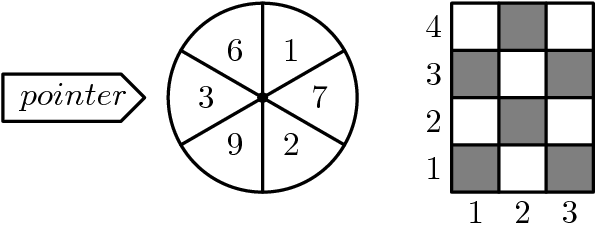
The wheel shown is spun twice, and the randomly determined numbers opposite the pointer are recorded. The first number is divided by and the second number is divided by The first remainder designates a column, and the second remainder designates a row on the checkerboard shown. What is the probability that the pair of numbers designates a shaded square?
- A)
- B)
- C)
- D)
- E)
- 34.2007 AMC 10A #16
Integers and , not necessarily distinct, are chosen independently and at random from 0 to 2007, inclusive. What is the probability that is even?
- A)
- B)
- C)
- D)
- E)
- 35.2006 AMC 10B #17
Bob and Alice each have a bag that contains one ball of each of the colors blue, green, orange, red, and violet. Alice randomly selects one ball from her bag and puts it into Bob's bag. Bob then randomly selects one ball from his bag and puts it into Alice's bag. What is the probability that after this process the contents of the two bags are the same?
- A)
- B)
- C)
- D)
- E)
- 36.2006 AMC 10B #21
For a particular peculiar pair of dice, the probabilities of rolling , , , , , and , on each die are in the ratio . What is the probability of rolling a total of on the two dice?
- A)
- B)
- C)
- D)
- E)
- 37.2004 AMC 10B #11
Two eight-sided dice each have faces numbered through . When the dice are rolled, each face has an equal probability of appearing on the top. What is the probability that the product of the two top numbers is greater than their sum?
- A)
- B)
- C)
- D)
- E)
- 38.2025 AMC 10B #24
A frog hops along the number line according to the following rules.
It starts at .
If it is at , then it moves to with probability and it disappears with probability .
For or if it is at then it moves to with probability it moves to with probability and it disappears with probability .
What is the probability that the frog reaches
- A)
- B)
- C)
- D)
- E)
- 39.2024 AMC 10A #24
A bee is moving in three-dimensional space. A fair six-sided die with faces labeled and is rolled. Suppose the bee occupies the point If the die shows , then the bee moves to the point and if the die shows then the bee moves to the point Analogous moves are made with the other four outcomes. Suppose the bee starts at the point and the die is rolled four times. What is the probability that the bee traverses four distinct edges of some unit cube?
- A)
- B)
- C)
- D)
- E)
- 40.2023 AMC 10A #25
If and are vertices of a polyhedron, define the distance to be the minimum number of edges of the polyhedron one must traverse in order to connect and . For example, is an edge of the polyhedron, then , but if and are edges and is not an edge, then . Let , , and be randomly chosen distinct vertices of a regular icosahedron (regular polyhedron made up of equilateral triangles). What is the probability that ?
- A)
- B)
- C)
- D)
- E)
- 41.2021 AMC Fall 10B #23
Each of the sides and the diagonals of a regular pentagon are randomly and independently colored red or blue with equal probability. What is the probability that there will be a triangle whose vertices are among the vertices of the pentagon such that all of its sides have the same color?
- A)
- B)
- C)
- D)
- E)
- 42.2019 AMC 10A #20
The numbers are randomly placed into the squares of a grid. Each square gets one number, and each of the numbers is used once. What is the probability that the sum of the numbers in each row and each column is odd?
- A)
- B)
- C)
- D)
- E)
- 43.2016 AMC 10A #17
Let be a positive multiple of . One red ball and green balls are arranged in a line in random order. Let be the probability that at least of the green balls are on the same side of the red ball. Observe that and that approaches as grows large. What is the sum of the digits of the least value of such that ?
- A)
- B)
- C)
- D)
- E)
- 44.2012 AMC 10A #20
A square is partitioned into unit squares. Each unit square is painted either white or black with each color being equally likely, chosen independently and at random. The square is then rotated clockwise about its center, and every white square in a position formerly occupied by a black square is painted black. The colors of all other squares are left unchanged. What is the probability the grid is now entirely black?
- A)
- B)
- C)
- D)
- E)
- 45.2010 AMC 10A #18
Bernardo randomly picks 3 distinct numbers from the set and arranges them in descending order to form a 3-digit number. Silvia randomly picks 3 distinct numbers from the set and also arranges them in descending order to form a 3-digit number. What is the probability that Bernardo's number is larger than Silvia's number?
- A)
- B)
- C)
- D)
- E)
- 46.2009 AMC 10A #24
Three distinct vertices of a cube are chosen at random. What is the probability that the plane determined by these three vertices contains points inside the cube?
- A)
- B)
- C)
- D)
- E)
- 47.2009 AMC 10A #22
Two cubical dice each have removable numbers through . The twelve numbers on the two dice are removed, put into a bag, then drawn one at a time and randomly reattached to the faces of the cubes, one number to each face. The dice are then rolled and the numbers on the two top faces are added. What is the probability that the sum is ?
- A)
- B)
- C)
- D)
- E)
- 48.2009 AMC 10B #25
Each face of a cube is given a single narrow stripe painted from the center of one edge to the center of the opposite edge. The choice of the edge pairing is made at random and independently for each face. What is the probability that there is a continuous stripe encircling the cube?
- A)
- B)
- C)
- D)
- E)
- 49.2008 AMC 10A #22
Jacob uses the following procedure to write down a sequence of numbers. First he chooses the first term to be 6. To generate each succeeding term, he flips a fair coin. If it comes up heads, he doubles the previous term and subtracts 1. If it comes up tails, he takes half of the previous term and subtracts 1. What is the probability that the fourth term in Jacob's sequence is an integer?
- A)
- B)
- C)
- D)
- E)
- 50.2008 AMC 10B #22
Three red beads, two white beads, and one blue bead are placed in line in random order. What is the probability that no two neighboring beads are the same color?
- A)
- B)
- C)
- D)
- E)
- 51.2005 AMC 10B #21
Forty slips are placed into a hat, each bearing a number , , , , , , , , , or , with each number entered on four slips. Four slips are drawn from the hat at random and without replacement. Let be the probability that all four slips bear the same number. Let be the probability that two of the slips bear a number and the other two bear a number . What is the value of ?
- A)
- B)
- C)
- D)
- E)
- 52.2004 AMC 10B #23
Each face of a cube is painted either red or blue, each with probability 1/2. The color of each face is determined independently. What is the probability that the painted cube can be placed on a horizontal surface so that the four vertical faces are all the same color?
- A)
- B)
- C)
- D)
- E)
- 53.2002 AMC 10A #24
Tina randomly selects two distinct numbers from the set , and Sergio randomly selects a number from the set . What is the probability that Sergio's number is larger than the sum of the two numbers chosen by Tina?
- A)
- B)
- C)
- D)
- E)
- 54.2001 AMC 10 #23
A box contains exactly five chips, three red and two white. Chips are randomly removed one at a time without replacement until all the red chips are drawn or all the white chips are drawn. What is the probability that the last chip drawn is white?
- A)
- B)
- C)
- D)
- E)
- 55.2020 AMC 10A #25
Jason rolls three fair standard six-sided dice. Then he looks at the rolls and chooses a subset of the dice (possibly empty, possibly all three dice) to reroll. After rerolling, he wins if and only if the sum of the numbers face up on the three dice is exactly Jason always plays to optimize his chances of winning. What is the probability that he chooses to reroll exactly two of the dice?
- A)
- B)
- C)
- D)
- E)
- 56.2006 AMC 10A #25
A bug starts at one vertex of a cube and moves along the edges of the cube according to the following rule. At each vertex the bug will choose to travel along one of the three edges emanating from that vertex. Each edge has equal probability of being chosen, and all choices are independent. What is the probability that after seven moves the bug will have visited every vertex exactly once?
- A)
- B)
- C)
- D)
- E)
Answers
| # | Answer | The idea it turns on |
|---|---|---|
| 1 | B | Each roll adds at least 1, so the total can reach 3 only in the first three rolls. List the orders adding to 3: 3; 1,2; 2,1; 1,1,1. |
| 2 | C | Work out the chance of never rolling a 7. That is 5/6 multiplied by itself once per roll; find the first number of rolls where it drops below 1/2. |
| 3 | E | Each roll is even with probability 3/4 and odd with probability 1/4. The sum is even when both rolls match, so the chance is 9/16 + 1/16 = 5/8. |
| 4 | D | Turn every die upside down: a face k becomes 7 minus k. A roll with sum 10 becomes a roll with sum 49 minus 10, which is 39. |
| 5 | D | Three draws are needed exactly when the first two chips add to 4 or less, which only happens for the pairs 1 and 2 or 1 and 3. |
| 6 | D | There are 27 equally likely ways to answer. Exactly two right happens in 3 times 2 = 6 ways, all three right in 1 way: 7 out of 27. |
| 7 | D | A product is odd only when both numbers are odd. Only 3 of the 10 pairs are both odd, so the other 7 pairs give an even product. |
| 8 | A | All three numbers must be odd. The first pick is odd half the time, each later pick slightly less, so p is below 1/8. |
| 9 | B | A regular pentagon has 5 sides of one length and 5 diagonals of another length. Whatever segment you pick first, 4 of the other 9 match it. |
| 10 | D | Each die really has three equally likely values. Whatever the even die shows, exactly one of the three odd values makes the total 7. |
| 11 | B | With diameter d, the area is less than the circumference exactly when d is less than 4. So the dice must sum to 2 or 3: 3 of 36 rolls. |
| 12 | B | Only the spots of the two O tiles matter. There are 10 ways to pick 2 spots out of 5, and XOXOX is exactly one of them. |
| 13 | E | A prime product needs eleven dice showing 1 and one die showing 2, 3 or 5: 12 times 3 = 36 good outcomes out of 6 to the 12th. |
| 14 | D | Only two kinds of pairs reach 20 dollars: any pair with a twenty, or the two tens. That is 14 of the 28 possible pairs. |
| 15 | D | The sum is odd only when one die is odd and the other even. The first die is odd 2/3 of the time, the second only 1/3. |
| 16 | C | There are 84 ways to pick 3 of the 9 points, and only 8 of them lie on a line: the 3 rows, the 3 columns and the 2 diagonals. |
| 17 | D | Go through each possible number of heads, 0 to 3. Multiply the ways coin A and coin B can each get that many, then add: 35 out of 128. |
| 18 | B | Only Tuesday matters: compare it with Monday. Choose the 2 students who repeat, then the other 4 must all get a new tutor, which happens in 9 ways. |
| 19 | C | The three tallest are the captains exactly when they land in three different groups. Only their three wristbands matter: 6/8 × 3/7. |
| 20 | B | The students sit side by side with chance 6/15. The four chairs left then form a row, not a circle, so the teachers have 3 good pairs out of 6. |
| 21 | E | List the three ways Team A can win: win-win, win-lose-win, lose-win-win. Add their chances, set the total to one half, and solve the quadratic for p. |
| 22 | C | Rolls that repeat a number already seen change nothing, so skip them. Then the first three different numbers to appear must be 2, 4, 6: (1/2)(2/5)(1/4) = 1/20. |
| 23 | D | Each ball needs at least 3 of the other color among the other 5. That forces exactly 3 black and 3 white: 20 of 64 colorings. |
| 24 | C | Count failures: the product lacks a factor of 4 only if all dice are odd, or one die shows 2 or 6 and the rest are odd. |
| 25 | D | Whatever five books Harold picks, Betty must take 2 of his 5 books and 3 of the other 5. Count her ways and divide by all her possible choices. |
| 26 | C | Red higher and green higher are equally likely. The only other result is a tie, which has probability 1/4 + 1/16 + 1/64 + ... = 1/3. |
| 27 | C | Each number must be a bigger multiple of the next, so Cal gets 1 or 2. There are 9 good outcomes out of 720. |
| 28 | B | Count two separate cases: all four dice match (6 ways), and exactly three match (6 values, 4 spots for the odd die, 5 values for it). |
| 29 | D | Choose which die shows the total (3 ways). The other two dice must add up to at most 6, and there are 15 ordered ways to do that. |
| 30 | A | Once at least one die is rolled, the sum is odd half the time. Only two tails is different: no dice, and 0 is even. |
| 31 | B | Each die has six faces, so there are 36 equally likely outcomes. Count the face pairs for sums 5, 7 and 9, counting a repeated number once for each face. |
| 32 | B | One fixed order, like yes-no-no, has chance 0.7 times 0.3 times 0.3. The single yes can come on any of 3 occasions, so multiply by 3. |
| 33 | C | In every column the shaded squares are rows 1 and 3, or rows 2 and 4, and each of those row pairs comes up exactly half the time. |
| 34 | E | Only odd and even matter. A product of two random numbers is odd just 1/4 of the time, and ad - bc is even when both products match. |
| 35 | D | Whatever color Alice gives, Bob then has six balls with two of that color. The bags match only if Bob sends back one of those two. |
| 36 | C | The weights 1 through 6 add to 21, so face k comes up with chance k/21. Then add up the chances of the six ordered ways to make 7. |
| 37 | C | Count the rolls that fail: any roll with a 1, plus 2 and 2 (a tie). That is 16 of the 64 rolls. |
| 38 | E | Let p1, p2, p3 be the chances of reaching 4 from 1, 2, 3. Each is a quarter of the chances one step down and one step up. |
| 39 | B | Each roll must use a new direction, and a direction used before must be reversed. Counting roll by roll gives 6 · 4 · 7 = 168. |
| 40 | A | Stand at R and sort the other 11 vertices by distance: 5 at distance 1, 5 at distance 2, 1 at distance 3. Then count pairs. |
| 41 | D | With no one-color triangle, every corner has 2 red and 2 blue lines, forcing the red lines into a five-sided loop: only 12 of 1024. |
| 42 | B | Only odd or even matters. The five odd numbers must fill one whole row and one whole column, a cross shape. There are 9 crosses out of 126 odd-even patterns. |
| 43 | A | Only the red ball's spot matters; all N + 1 spots are equally likely. For N = 5m, exactly m - 1 middle spots fail. |
| 44 | A | A spot stays white only if it and the square rotating into it were both white. Corners and edges each cycle in fours; no two neighbours may be white. |
| 45 | B | If Bernardo picks a 9 (chance 1/3), he surely wins. If not, both choose from the same digits, so apart from a tie each is equally likely to win. |
| 46 | C | Count the bad choices: the plane misses the inside only when all three corners lie on one face. That is 6 faces times 4 choices, 24 out of 56. |
| 47 | D | Random stickers make the first top number any of the 12, and the second any of the other 11. Exactly 2 of those 11 make 7. |
| 48 | B | A loop must run through four faces forming a belt. There are 3 belts; each needs its 4 faces right, the other 2 faces are free, and belts never overlap. |
| 49 | D | Only three coin flips matter, so list all eight paths and follow the actual numbers. Five of the eight fourth terms are whole numbers. |
| 50 | C | Place the three red beads first. They cannot touch, so they fit only four ways in six spots. Then check where the white and blue beads can go. |
| 51 | A | Both probabilities have the same bottom, so q/p is just the count of two-pair draws (1620) divided by the count of four-of-a-kind draws (10). |
| 52 | B | It works when the less common color is on no faces, one face, or two opposite faces (top and bottom). That is 20 of 64. |
| 53 | A | Tina has only 10 possible pairs. List each pair's sum; Sergio wins with every number above that sum, which is 10 minus the sum. |
| 54 | D | Imagine drawing all five chips. The whites run out first exactly when the last chip in the box is red, and each chip is equally likely to be last. |
| 55 | A | Keeping one die and rerolling two is best only when every pair of dice adds to 7 or more and the smallest die is 1, 2 or 3. |
| 56 | C | By symmetry fix the first two moves (3 × 2 ways). Only 3 ways to finish visit every corner: 18 good paths out of 3^7 = 2187. |
Problems © Mathematical Association of America (MAA), American Mathematics Competitions. Reproduced for non-commercial educational use. The topic note, tags and key insights are original to this site.