Geometric Probability
Probability as a ratio of lengths, areas, or volumes
What you need to know
- Probability as a ratio of sizes. When a point is picked at random from a region (every part equally likely), the chance it lands in a part is . "Size" means length on a line, area in the plane, or volume in space. Example: a random number between and is less than with probability .
- Two random numbers make one random point. Picking and at random between and , independently (neither affects the other), is the same as picking one random point in an square. A condition such as becomes a region cut out by straight lines.
- Two regions to know. The band inside the square has area (for ): the square minus two corner triangles, each with legs . Example: two friends arrive at random times and (in minutes) within one hour, and each waits minutes. They meet when , which has probability . Also, with is a right triangle with legs , so its area is . The worked example uses both regions.
- Dropped coins. A coin of radius misses every tile edge exactly when its center is at least from every edge, that is, inside the tile shrunk by on every side. Example: with tiles and a coin of radius , the center must land in the middle square: probability .
How AMC 10 tests it
- Problems 10–18: two people arrive at random times within an hour and each waits minutes; find the probability they meet (the square with a band along the diagonal).
- Problems 12–20: a random point in a square, circle, or triangle; the probability it is closer to one side, or inside a related shape.
- Problems 15–22: two random points split a segment into three pieces; the probability that the pieces can form a triangle.
- Problems 20–24: a coin dropped on a tiled floor; the probability it does not touch a line.
Standard approaches
- Name the random numbers and the values each can take. That fixes the whole region.
- Turn the event into inequalities and sketch the region where it happens.
- Find that area by cutting it into simple pieces, or by subtracting what you do not want.
- For dropped objects, shrink the allowed region by the radius and divide the areas.
- Test extreme cases: pushing the numbers to their limits should push the answer to or . Example: friends who each wait all minutes surely meet, and the formula gives .
Worked example
Real numbers and are chosen independently and uniformly at random from . What is the probability that and ?
(A) (B) (C) (D) (E)
Solution. Here means all real numbers from to , and "uniformly" means every part of it is equally likely.
Step 1: the whole region. The point is random in the square, which has area .
Step 2: the band. is the strip between the lines and . Outside it are two corner triangles with legs , each of area . So the band has area .
Step 3: remove . The region is the triangle with corners , , , of area . Its tip near , below the line , is outside the band: the triangle with corners , , , with base , height , and area . The tip near is its mirror image, also area . So the band loses .
Step 4: divide. The region we want has area , so the probability is .
The answer is .
Pitfalls
- Using lengths when the event depends on two independent random numbers. It must be an area in the square.
- Forgetting to square when scaling. Shrinking every side by a factor shrinks the area by : halving the sides of a square leaves of the area, not .
- Drawing the band with corner triangles whose legs are . The legs are (in the worked example, , not ).
- Shrinking the tile by the coin's diameter instead of its radius. Above, the safe square is , not .
Traps that recur
- Handling only the case BP < AP < AB and missing the sliver near D where AB < AP < BP, which leaves pi/6 - sqrt3/8 and cannot even be written in the required form. (2025 AMC 10A #25)
- Treating the three pairwise conditions as independent, or extrapolating the two-variable answer ((n-1)/n)^2, which gives a formula with n-1 instead of n-2. (2012 AMC 10A #25)
- Thinking the third step is skipped or truncated when time runs out (it is completed), or coupling the step lengths to the times. (2022 AMC 10B #23)
- Treating the corner triangles like the diamond, adding quarter-circles or strips along their legs, which lie outside the region the center can occupy. (2021 AMC 10B #23)
- 1.2017 AMC 10A #15
Chloé chooses a real number uniformly at random from the interval . Independently, Laurent chooses a real number uniformly at random from the interval . What is the probability that Laurent's number is greater than Chloé's number?
- A)
- B)
- C)
- D)
- E)
- 2.2011 AMC 10B #13
Two real numbers are selected independently at random from the interval . What is the probability that the product of those numbers is greater than zero?
- A)
- B)
- C)
- D)
- E)
- 3.2003 AMC 10A #12
A point is randomly picked from inside the rectangle with vertices , , , and . What is the probability that ?
- A)
- B)
- C)
- D)
- E)
- 4.2024 AMC 10B #14
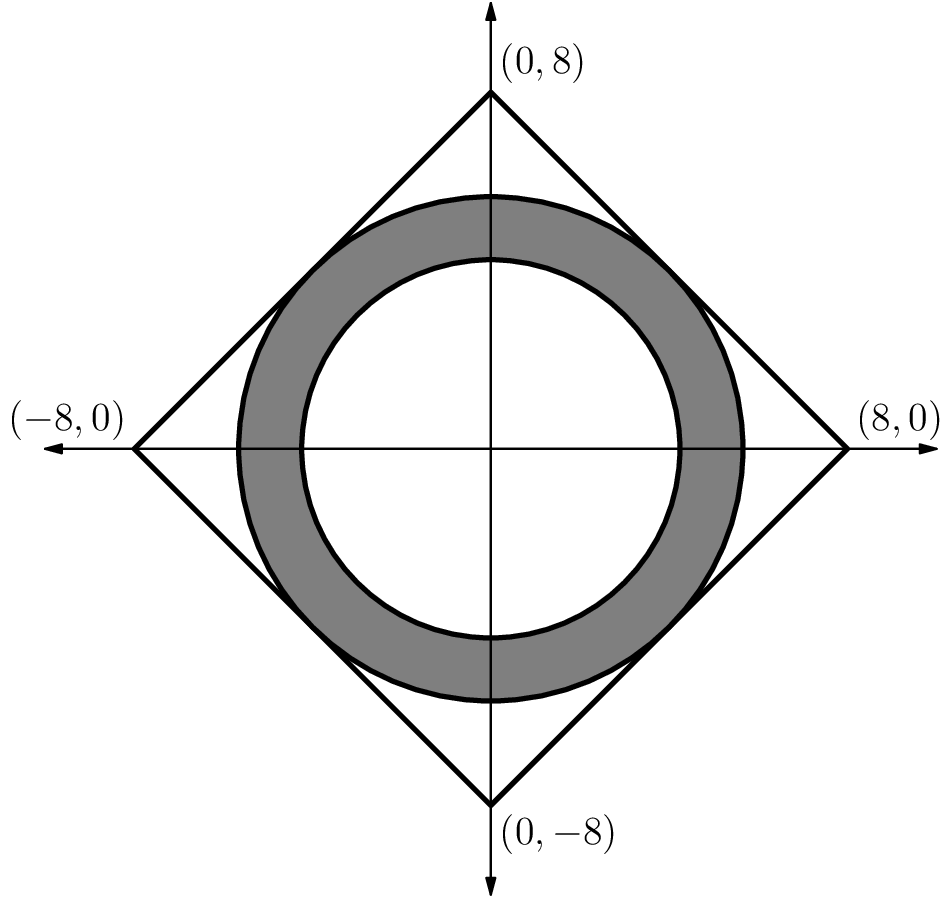
A dartboard is the region in the coordinate plane consisting of points such that . A target is the region where . A dart is thrown and lands at a random point in B. The probability that the dart lands in can be expressed as , where and are relatively prime positive integers. What is ?
- A)
- B)
- C)
- D)
- E)
- 5.2023 AMC 10B #19
Sonya the frog chooses a point uniformly at random lying within the square in the coordinate plane and hops to that point. She then randomly chooses a distance uniformly at random from and a direction uniformly at random from {north, south, east, west}. All her choices are independent. She now hops the distance in the chosen direction. What is the probability that she lands outside the square?
- A)
- B)
- C)
- D)
- E)
- 6.2020 AMC 10A #16
A point is chosen at random within the square in the coordinate plane whose vertices are and . The probability that the point is within units of a lattice point is . (A point is a lattice point if and are both integers.) What is to the nearest tenth?
- A)
- B)
- C)
- D)
- E)
- 7.2014 AMC 10B #19
Two concentric circles have radii and . Two points on the outer circle are chosen independently and uniformly at random. What is the probability that the chord joining the two points intersects the inner circle?
- A)
- B)
- C)
- D)
- E)
- 8.2011 AMC 10B #16
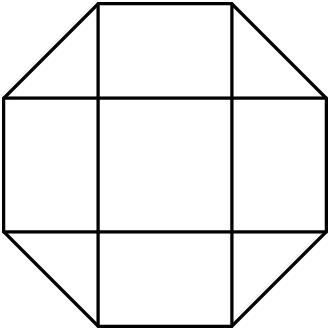
A dart board is a regular octagon divided into regions as shown. Suppose that a dart thrown at the board is equally likely to land anywhere on the board. What is the probability that the dart lands within the center square?
- A)
- B)
- C)
- D)
- E)
- 9.2022 AMC 10B #23
Ant Amelia starts on the number line at and crawls in the following manner. For Amelia chooses a time duration and an increment independently and uniformly at random from the interval During the th step of the process, Amelia moves units in the positive direction, using up minutes. If the total elapsed time has exceeded minute during the th step, she stops at the end of that step; otherwise, she continues with the next step, taking at most steps in all. What is the probability that Amelia’s position when she stops will be greater than ?
- A)
- B)
- C)
- D)
- E)
- 10.2021 AMC 10B #23
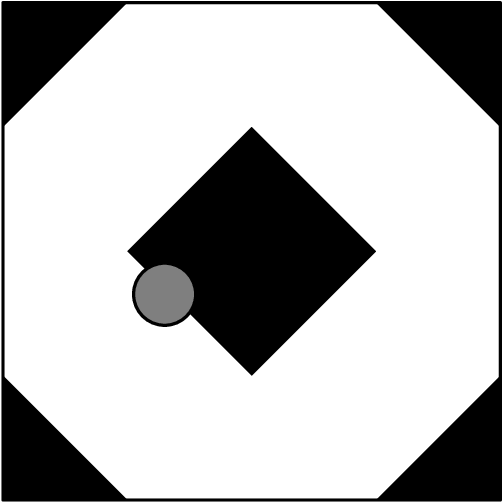
A square with side length is colored white except for black isosceles right triangular regions with legs of length in each corner of the square and a black diamond with side length in the center of the square, as shown in the diagram. A circular coin with diameter is dropped onto the square and lands in a random location where the coin is completely contained within the square. The probability that the coin will cover part of the black region of the square can be written as , where and are positive integers. What is ?
- A)
- B)
- C)
- D)
- E)
- 11.2018 AMC 10B #22
Real numbers and are chosen independently and uniformly at random from the interval . Which of the following numbers is closest to the probability that and are the side lengths of an obtuse triangle?
- A)
- B)
- C)
- D)
- E)
- 12.2015 AMC 10A #25
Let be a square of side length . Two points are chosen at random on the sides of . The probability that the straight-line distance between the points is at least is , where , , and are positive integers with . What is ?
- A)
- B)
- C)
- D)
- E)
- 13.2011 AMC 10A #20
Two points on the circumference of a circle of radius are selected independently and at random. From each point a chord of length is drawn in a clockwise direction. What is the probability that the two chords intersect?
- A)
- B)
- C)
- D)
- E)
- 14.2009 AMC 10B #23
Rachel and Robert run on a circular track. Rachel runs counterclockwise and completes a lap every 90 seconds, and Robert runs clockwise and completes a lap every 80 seconds. Both start from the same line at the same time. At some random time between 10 minutes and 11 minutes after they begin to run, a photographer standing inside the track takes a picture that shows one-fourth of the track, centered on the starting line. What is the probability that both Rachel and Robert are in the picture?
- A)
- B)
- C)
- D)
- E)
- 15.2025 AMC 10A #25
A point is chosen at random inside square . The probability that is neither the shortest nor the longest side of can be written as , where and are positive integers, , and is not divisible by the square of a prime. What is ?
- A)
- B)
- C)
- D)
- E)
- 16.2012 AMC 10A #25
Real numbers , , and are chosen independently and at random from the interval for some positive integer . The probability that no two of , , and are within 1 unit of each other is greater than . What is the smallest possible value of ?
- A)
- B)
- C)
- D)
- E)
Problems © Mathematical Association of America (MAA), American Mathematics Competitions. Reproduced for non-commercial educational use. The topic note, tags and key insights are original to this site.