2026 AMC 10A Problem 3
Square has side length . Let be the midpoint of , and let be the intersection of and .
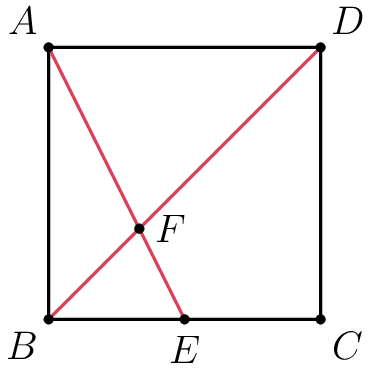
What is the area of ?
Show solution without answering
Key insight
Base BE is 12 and lies on the bottom side, so only the height of F matters. The two lines cross 8 units above the bottom.
Solution
Triangle has side lying along the bottom of the square, so use as the base. Its length is easy: is the midpoint of a side of length , so . The only unknown is the height, which is how far sits above the bottom side. Coordinates find that directly.
1. Place the square on a grid. Put at the origin, as in the picture:
The midpoint of is .
2. Line . It goes from to , rising for every across. Its equation is
3. Line . It starts at and ends at . It drops while moving across, so its slope is . Its equation is
(Check: at this gives , which is point .)
4. Where they cross. At both equations hold, so
and then . So .
5. The area. The base lies on the line and has length . The height is the distance from up to that line, which is the -coordinate of , namely . So
The answer is .
Why this works
When a triangle has one side lying on a side of a square (or on any line you know well), the area comes down to one number: how far the third corner is from that line. Two lines crossing inside a square are easy to write as equations once the square sits on a grid with a corner at the origin, and the crossing point gives that height immediately.
Alternative approach
Use similar triangles instead of coordinates.
- Sides and of the square are parallel. Look at triangle (at the bottom) and triangle (at the top).
- The angles at are equal because they are vertical angles. The angles at and at are equal because crosses the two parallel sides, making alternate angles. So the two triangles are similar.
- Their matching sides and are in the ratio . So the whole bottom triangle is half the size of the top triangle, and in particular its height (from down to ) is half the top triangle's height (from up to ).
- These two heights add up to the side of the square, . Splitting in the ratio gives and . So is above .
- The area of triangle is .
Concise solution
A shorter write-up, the way contest solutions are usually written. It may take a different route from the solution above.
Set , , , , so . Line is and line is . They meet where , giving . With base on the -axis and height ,
the area of is .
The answer is .
Review in the AoPS books
- Introduction to Geometry, Chapter 4: Perimeter and Area (§4.2)
- Introduction to Geometry, Chapter 3: Congruent Triangles
- Introduction to Geometry, Chapter 17: Analytic Geometry (§17.4, §17.6)
- Introduction to Geometry, Chapter 6: Right Triangles (§6.1, §6.2, §6.3)
Similar problems
Problem © Mathematical Association of America (MAA), American Mathematics Competitions. Reproduced for non-commercial educational use. Solution and commentary are original to this site.