A dartboard is the region in the coordinate plane consisting of points such that . A target is the region where . A dart is thrown and lands at a random point in B. The probability that the dart lands in can be expressed as , where and are relatively prime positive integers. What is ?
- A)
- B)
- C)
- D)
- E)
Answer
B
Key insight
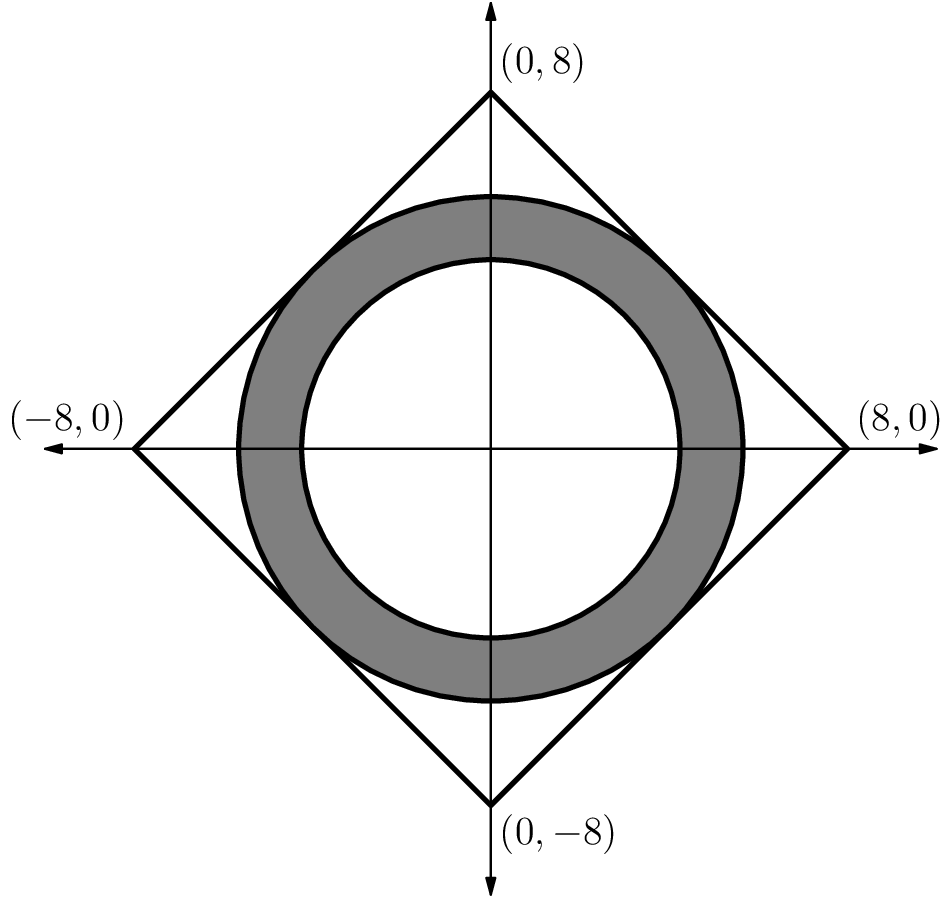
The target is the annulus 18 <= x^2 + y^2 <= 32, area 14 pi, fully inside the diamond of area 128 (inradius sqrt32).
Solution
The board is a square (a diamond) with vertices and . Its diagonals both have length , so its area is .
The target condition means , i.e.
This is the ring between circles of radii and centered at the origin, with area .
Does the ring lie inside the board? The nearest points of the board's boundary to the origin are on the lines , at distance . So the outer circle is exactly inscribed in the diamond and the whole ring is inside.
The probability is , so .
The answer is .
Why this works
Geometric probability is a ratio of areas, so the task is to recognize each region: an absolute-value inequality gives a diamond, and a squared inequality unpacks to a band , which for is an annulus. The one thing that can go wrong is containment, so always compare the target's extent with the board's inradius.
The trap
Forgetting to check that the outer circle of radius sqrt32 lies inside the board; here it is exactly inscribed, so no part of the ring is cut off.
Common mistakes
- Forgetting to check that the outer circle of radius sqrt32 lies inside the board; here it is exactly inscribed, so no part of the ring is cut off.
- Using for the area of the board (as if it were an axis-aligned square of side ), which gives and .
Techniques
Bound the quantity above/below or estimate to pin it down · Set up the equation/formula and compute; no special trick needed