Four congruent semicircles are drawn on the surface of a sphere with radius , as shown, creating a close curve that divides the surface into two congruent regions. The length of the curve is . What is ?
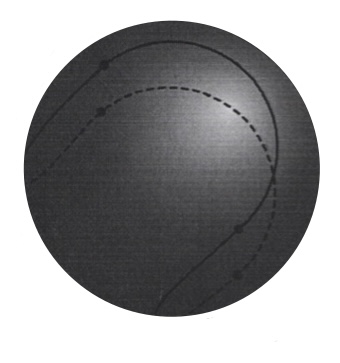
- A)
- B)
- C)
- D)
- E)
Answer
A
Key insight
The four junction points are equally spaced on a great circle, so each semicircle's diameter is a chord of length 2*sqrt(2); four semicircles of radius sqrt(2) total 4*pi*sqrt(2).
Solution
Let the four points where consecutive semicircles meet be . Since the semicircles are congruent and the curve splits the sphere into two congruent pieces (like the seam of a tennis ball), the picture has fourfold symmetry about an axis through the center: the four junction points lie on a great circle, spaced apart, and the semicircles bulge alternately to one side and the other.
Each semicircle joins two adjacent junction points and, being a semicircle, has that segment as its diameter. The chord between adjacent points on a great circle of radius subtending has length : it is the hypotenuse of the right isosceles triangle formed with the center, whose legs are radii of length . So each semicircle has radius and length .
Check that such a semicircle really lies on the sphere: the plane circle with that diameter has center at distance from the sphere's center, and the sphere's section by any plane at distance is a circle of radius , matching.
Total length: , so .
The answer is .
Why this works
Curves drawn on a sphere are still plane circles when they are circular arcs, so the problem reduces to locating the endpoints and using chord geometry. Congruence of the two regions forces the symmetric arrangement with junctions apart, and "semicircle" pins the radius to half that chord. Turn a description of symmetry into explicit positions before computing lengths.
The trap
Assuming each semicircle is half a great circle of radius 2, which gives 8*pi = pi*sqrt(64), not among the choices.
Common mistakes
- Assuming each semicircle is half a great circle of radius 2, which gives 8pi = pisqrt(64), not among the choices.
- Using the great-circle arc between adjacent junctions (a quarter circle of length ) instead of the semicircle that bulges off that great circle.
Techniques
Add construction lines/points (drop altitudes, extend segments, connect centers) · Exploit symmetry to reduce work or pair up objects