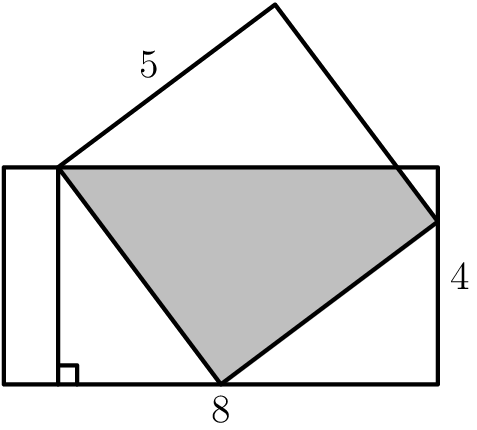
The diagram below shows a rectangle with side lengths and and a square with side length . Three vertices of the square lie on three different sides of the rectangle, as shown. What is the area of the region inside both the square and the rectangle?
- A)
- B)
- C)
- D)
- E)
Answer
D
Key insight
The square is tilted along a 3-4-5 triangle, so the overlap is the square minus a right triangle with legs 5 and 15/4.
Solution
Place the rectangle with corners and . Call the square's vertices (on the bottom side), (on the right side), (on the top side) and (outside), with and the two sides meeting at .
Going from to moves with ; since is rotated , going from to moves . is on the top side, units above , so and then . Thus is right and up from ; since is on the right side, , , and .
The only part of the square outside the rectangle is the piece above the top side : triangle , where is where side crosses . This triangle has a right angle at (a corner of the square) and . Side has slope , so has tangent and
Its area is .
The overlap is therefore .
The answer is .
Why this works
A square with one vertex on the bottom and one on the top of a height- rectangle, with side , must be tilted along a -- triangle; the perpendicular sides are rotations of each other, so one right-triangle relation determines the whole figure. Once the geometry is pinned down, "area of the overlap" is just "square minus the protruding triangle," and that triangle is similar to the -- triangle as well.
Alternative approach
Shoelace on the overlap quadrilateral , , , : the cross terms are , and half of that is .
The trap
Assuming the square's vertices on the rectangle sit at 'nice' positions (like the midpoint) or that only a small corner of the square pokes out, then guessing from the choices.
Common mistakes
- Assuming the square's vertices on the rectangle sit at 'nice' positions (like the midpoint) or that only a small corner of the square pokes out, then guessing from the choices.
- Computing the protruding triangle with legs and (area ) rather than and , giving , which is not even a choice.
Techniques
Place the figure on coordinates and compute · Cut the figure into known shapes (triangles, rectangles, sectors)