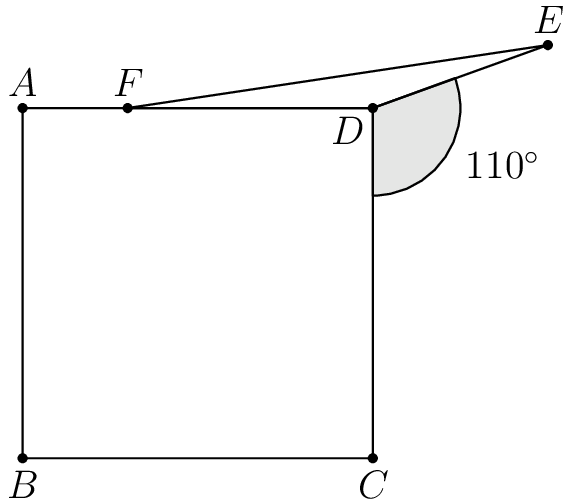
As shown in the figure below, point lies on the opposite half-plane determined by line from point so that . Point lies on so that , and is a square. What is the degree measure of ?
- A)
- B)
- C)
- D)
- E)
Answer
D
Key insight
At D the square's 90 degrees and the given 110 degrees leave angle FDE = 160, so the isosceles triangle DEF has base angles 10 and angle AFE = 170.
Solution
Look at the three angles around vertex . Since is a square, . We are given , and because is on the far side of line from , the rays , , go around in order, so
Point lies on segment , so . In triangle , makes the triangle isosceles with apex , so the two base angles are equal:
Finally is between and , so and are supplementary:
The answer is .
Why this works
Angle chasing is a chain: go around a vertex (sum ), inside a triangle (sum , equal base angles when two sides are equal), and along a line (sum ). The only judgment call is orientation; the phrase "opposite half-plane" tells you the angle opens away from the square, so it and the right angle add rather than overlap.
The trap
Computing angle FDE as 110 - 90 = 20 or as 180 - 110 = 70 instead of 360 - 90 - 110 = 160, since E sits across line CD from A.
Common mistakes
- Computing angle FDE as 110 - 90 = 20 or as 180 - 110 = 70 instead of 360 - 90 - 110 = 160, since E sits across line CD from A.
- Reporting or its complement instead of the supplementary angle .
Techniques
Set up the equation/formula and compute; no special trick needed