2021 AMC Fall 10A Problem 7
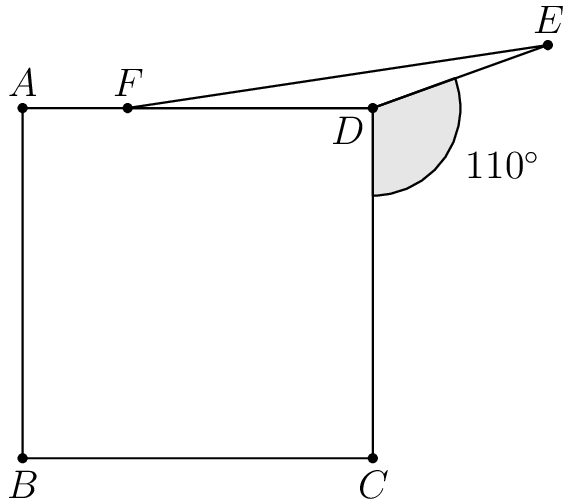
As shown in the figure below, point lies on the opposite half-plane determined by line from point so that . Point lies on so that , and is a square. What is the degree measure of ?
Show solution without answering
Key insight
Around D, 360 - 90 - 110 leaves 160 degrees inside triangle DEF. Its two equal sides make the other angles 10 each, so angle AFE is 170.
Solution
The plan is to find the angles of triangle , then use the straight line to get .
1. Angles around . All the angles around a point add up to . At there are three of them:
- , because is a square.
- , given.
- , the one we want.
Because is on the other side of line from (see the figure), these three do not overlap. So
2. Angle at in the triangle. is on segment , so is the same angle: .
3. The other two angles of triangle . Since , the triangle has two equal sides, so the angles across from them are equal: . The three angles add to , so each of these is
4. Use the straight line. , , lie on one line with in the middle. The angles and sit side by side on that line, so they add to :
The answer is .
Why this works
This is a chain of three basic angle facts: angles around a point add to , angles in a triangle add to (with equal angles across from equal sides), and angles along a straight line add to . The only place to be careful is the picture: the phrase "opposite half-plane" tells you the angle opens away from the square, so it adds to the instead of overlapping it.
Concise solution
A shorter write-up, the way contest solutions are usually written. It may take a different route from the solution above.
Look at the three angles around vertex . Since is a square, . We are given , and because is on the far side of line from , the rays , , go around in order, so
Point lies on segment , so . In triangle , makes the triangle isosceles with apex , so the two base angles are equal:
Finally is between and , so and are supplementary:
The answer is .
Review in the AoPS books
- Introduction to Geometry, Chapter 2: Angles
- Introduction to Geometry, Chapter 4: Perimeter and Area (§4.2)
- Introduction to Geometry, Chapter 9: Polygons (§9.1, §9.2)
- Introduction to Geometry, Chapter 6: Right Triangles (§6.1, §6.2, §6.3)
Similar problems
Problem © Mathematical Association of America (MAA), American Mathematics Competitions. Reproduced for non-commercial educational use. Solution and commentary are original to this site.