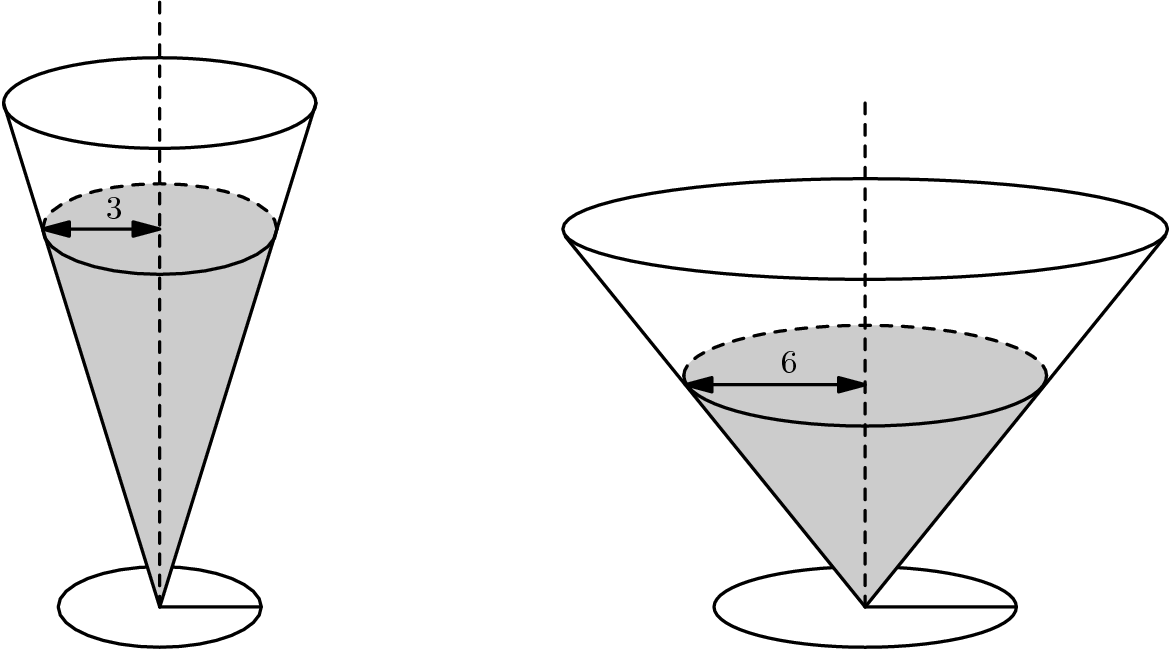
Two right circular cones with vertices facing down as shown in the figure below contain the same amount of liquid. The radii of the tops of the liquid surfaces are and . Into each cone is dropped a spherical marble of radius , which sinks to the bottom and is completely submerged without spilling any liquid. What is the ratio of the rise of the liquid level in the narrow cone to the rise of the liquid level in the wide cone?
- A)
- B)
- C)
- D)
- E)
Answer
E
Key insight
Equal volumes with radii 3 and 6 force heights in ratio 4:1; adding equal volumes scales both heights by the same factor, so the rises are also 4:1.
Solution
Let the liquid heights be (narrow cone, radius ) and (wide cone, radius ). Equal volumes give
Each body of liquid is itself a cone similar to its container, so its volume is proportional to the cube of its height. After the marble is added, both liquids have the same new volume , so both volumes grow by the same factor , and both heights grow by the same factor .
The rises are and , whose ratio is
The answer is .
Why this works
Liquid in an inverted cone always forms a cone similar to the container, so height is a function of volume alone, scaling as the cube root. Two similar situations with the same volume before and the same volume after keep the same height ratio throughout, so the rises inherit the original height ratio. The marble's exact volume never matters.
Alternative approach
Assign numbers: let the narrow cone hold liquid of height and the wide cone height (radii and give volumes and ). Adding volume multiplies each volume by , so each height becomes times larger; the rises are and , ratio .
The trap
Trying to compute the rise for each cone separately with the marble's volume, or assuming the rises are inversely proportional to the surface areas (4:1 by luck, but the reasoning fails in general).
Common mistakes
- Trying to compute the rise for each cone separately with the marble's volume, or assuming the rises are inversely proportional to the surface areas (4:1 by luck, but the reasoning fails in general).
- Treating the cones as cylinders; that also happens to give here but for the wrong reason and would fail on a variant with unequal starting volumes.
Techniques
Set up the equation/formula and compute; no special trick needed · Exploit symmetry to reduce work or pair up objects