In the figure below, of the disks are to be painted blue, are to be painted red, and is to be painted green. Two paintings that can be obtained from one another by a rotation or a reflection of the entire figure are considered the same. How many different paintings are possible?
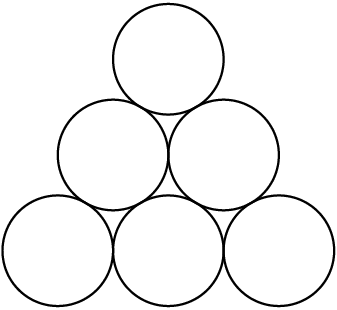
- A)
- B)
- C)
- D)
- E)
Answer
D
Key insight
Fix the unique green disk on a corner or a midpoint; the 10 red placements then fall into 6 classes under the one remaining reflection.
Solution
The six disks form a triangle: three corner disks and three edge-midpoint disks. The symmetries are the three rotations and three reflections of the triangle; every symmetry sends corners to corners and midpoints to midpoints.
Use the unique green disk to break the symmetry. Up to rotation, green is either on a corner or on a midpoint.
Case 1: green on a corner. The remaining symmetry is the reflection through that corner and the opposite midpoint. Choose of the other disks to be red: ways. Under the reflection, a placement is unchanged only if the two reds are a mirror pair: the two other corners, or the two other midpoints ( placements). The remaining placements pair off into classes. Distinct paintings: .
Case 2: green on a midpoint. The remaining symmetry is the reflection through that midpoint and the opposite corner. Again red placements; the mirror pairs are the two other midpoints or the two other corners ( placements), and the other pair off into . Distinct paintings: .
Total: .
The answer is .
Why this works
A unique object (the green disk) lets you fix its position and kill most of the symmetry group; what survives is a single reflection, and counting orbits of one reflection is easy: fixed placements count once, the rest count in pairs. This is Burnside's lemma done by hand.
Alternative approach
Burnside directly: the identity fixes colorings; each nontrivial rotation fixes (it would need a monochromatic -cycle of corners and of midpoints, impossible with reds and green); each of the reflections fixes (green on one of the fixed disks, reds on one of the swapped pairs). Orbits: .
The trap
Dividing the 60 raw colorings by 6 symmetries to get 10, which is wrong because some colorings are fixed by a reflection.
Common mistakes
- Dividing the 60 raw colorings by 6 symmetries to get 10, which is wrong because some colorings are fixed by a reflection.
- Treating "corner" and "midpoint" disks as interchangeable, or forgetting that the reflection fixes two disks (one corner and one midpoint), which changes which red pairs are self-symmetric.
Techniques
Split into exhaustive cases and handle each · Exploit symmetry to reduce work or pair up objects