2017 AMC 10B Problem 18
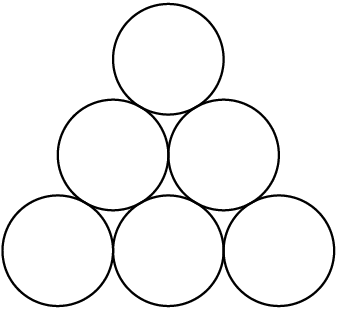
In the figure below, of the disks are to be painted blue, are to be painted red, and is to be painted green. Two paintings that can be obtained from one another by a rotation or a reflection of the entire figure are considered the same. How many different paintings are possible?
Show solution without answering
Key insight
Put the single green disk at the top corner or the bottom middle. Only a left-right flip is left, and the 10 red placements give 6 paintings each.
Solution
The six disks sit in a triangle: corner disks and middle disks (one in the middle of each side). Turning or flipping the triangle always moves corners to corners and middles to middles.
There is only one green disk, so use it to fix the picture. Turn the figure so that green is either at the top corner or at the middle of the bottom side. These two cases never match each other, because a corner can never move to a middle spot.
Case 1: green at the top corner.
- The only move that keeps green at the top (other than doing nothing) is the left-right flip.
- Name the other five disks: bottom-left corner , bottom-right corner , left middle , right middle , bottom middle . The flip swaps with and with , and keeps in place.
- Choose of these disks to be red ( ways); the rest are blue. Group each choice with its mirror image:
| Red pair | Its mirror image | Paintings |
|---|---|---|
| itself | ||
| itself | ||
- That covers all choices and gives different paintings.
Case 2: green at the bottom middle.
- Again only the left-right flip keeps green in place. It swaps the two bottom corners and the two side middles, and keeps the top corner in place.
- This is the same pattern as Case 1: one disk stays put and two pairs swap. So again there are different paintings.
Total: .
The answer is .
Why this works
A color used only once is a handle: fix where it goes, and almost all the turning and flipping is used up. What is left is a single flip, and with one flip the counting is easy: a choice that is its own mirror image counts once, and the other choices pair up with their mirror images.
Alternative approach
Count all colorings, then group them.
- Without worrying about turns and flips: places for green, then ways for the reds, so colorings.
- Each painting normally shows up as colorings (three turns, each flipped or not). But a painting that looks the same after some flip shows up only times.
- Count colorings that match their own flip. For each of the flip lines, green must sit on the line (there are disks on it) and the reds must be one of the swapped pairs: . Over the lines that is colorings, which form paintings.
- The other colorings form paintings.
- Total: .
Concise solution
A shorter write-up, the way contest solutions are usually written. It may take a different route from the solution above.
The six disks form a triangle: three corner disks and three edge-midpoint disks. The symmetries are the three rotations and three reflections of the triangle; every symmetry sends corners to corners and midpoints to midpoints.
Use the unique green disk to break the symmetry. Up to rotation, green is either on a corner or on a midpoint.
Case 1: green on a corner. The remaining symmetry is the reflection through that corner and the opposite midpoint. Choose of the other disks to be red: ways. Under the reflection, a placement is unchanged only if the two reds are a mirror pair: the two other corners, or the two other midpoints ( placements). The remaining placements pair off into classes. Distinct paintings: .
Case 2: green on a midpoint. The remaining symmetry is the reflection through that midpoint and the opposite corner. Again red placements; the mirror pairs are the two other midpoints or the two other corners ( placements), and the other pair off into . Distinct paintings: .
Total: .
The answer is .
Review in the AoPS books
- Introduction to Counting & Probability, Chapter 2: Basic Counting Techniques (§2.5)
- Introduction to Geometry, Chapter 16: The More Things Change. . . (§16.1, §16.2, §16.3, §16.4)
- Introduction to Algebra, Chapter 22: Special Manipulations (§22.3)
- Introduction to Counting & Probability, Chapter 3: Correcting for Overcounting (§3.2, §3.4)
Similar problems
Problem © Mathematical Association of America (MAA), American Mathematics Competitions. Reproduced for non-commercial educational use. Solution and commentary are original to this site.