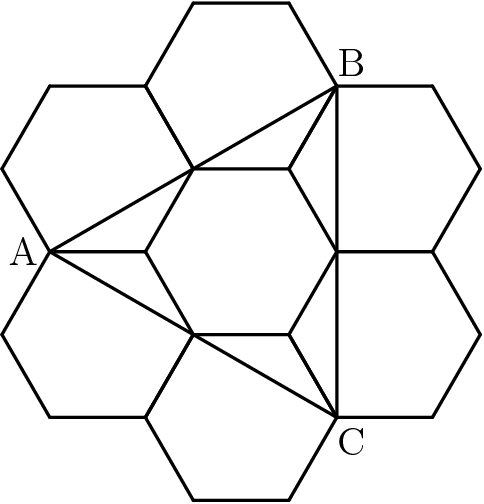
Six regular hexagons surround a regular hexagon of side length as shown. What is the area of ?
- A)
- B)
- C)
- D)
- E)
Answer
B
Key insight
Each vertex of triangle ABC is 2 units from the central hexagon's center, so ABC is equilateral with circumradius 2 and side 2*sqrt(3).
Solution
Let be the center of the middle hexagon. Draw , , .
Look at vertex . The ray from through a vertex of the central hexagon reaches after distance (a regular hexagon's circumradius equals its side). Beyond , two outer hexagons meet along a common edge that lies on the same ray by symmetry, and is the far end of that edge. So . Likewise .
The three rays are spaced apart, so is equilateral with circumradius . Dropping the perpendicular from to gives a -- triangle with hypotenuse , so half of is and .
The area is
The answer is .
Why this works
In a hexagonal tiling all the natural lengths are multiples of the side or of times it, and the center of the middle hexagon is the organizing point. Measuring each vertex from converts a picture question into a circumradius question, and an equilateral triangle with circumradius has side .
Alternative approach
Place at the origin with the central hexagon's vertices at , . Then , , ; is vertical and is units from that line, so the area is .
The trap
Estimating the side from the picture as 3 or 4 unit lengths instead of computing it from the 120-degree angles at the center.
Common mistakes
- Estimating the side from the picture as 3 or 4 unit lengths instead of computing it from the 120-degree angles at the center.
- Using as the side length of the triangle rather than its circumradius, giving .
Techniques
Add construction lines/points (drop altitudes, extend segments, connect centers) · Exploit symmetry to reduce work or pair up objects