Five unit squares are arranged in the coordinate plane as shown, with the lower left corner at the origin. The slanted line, extending from to , divides the entire region into two regions of equal area. What is ? 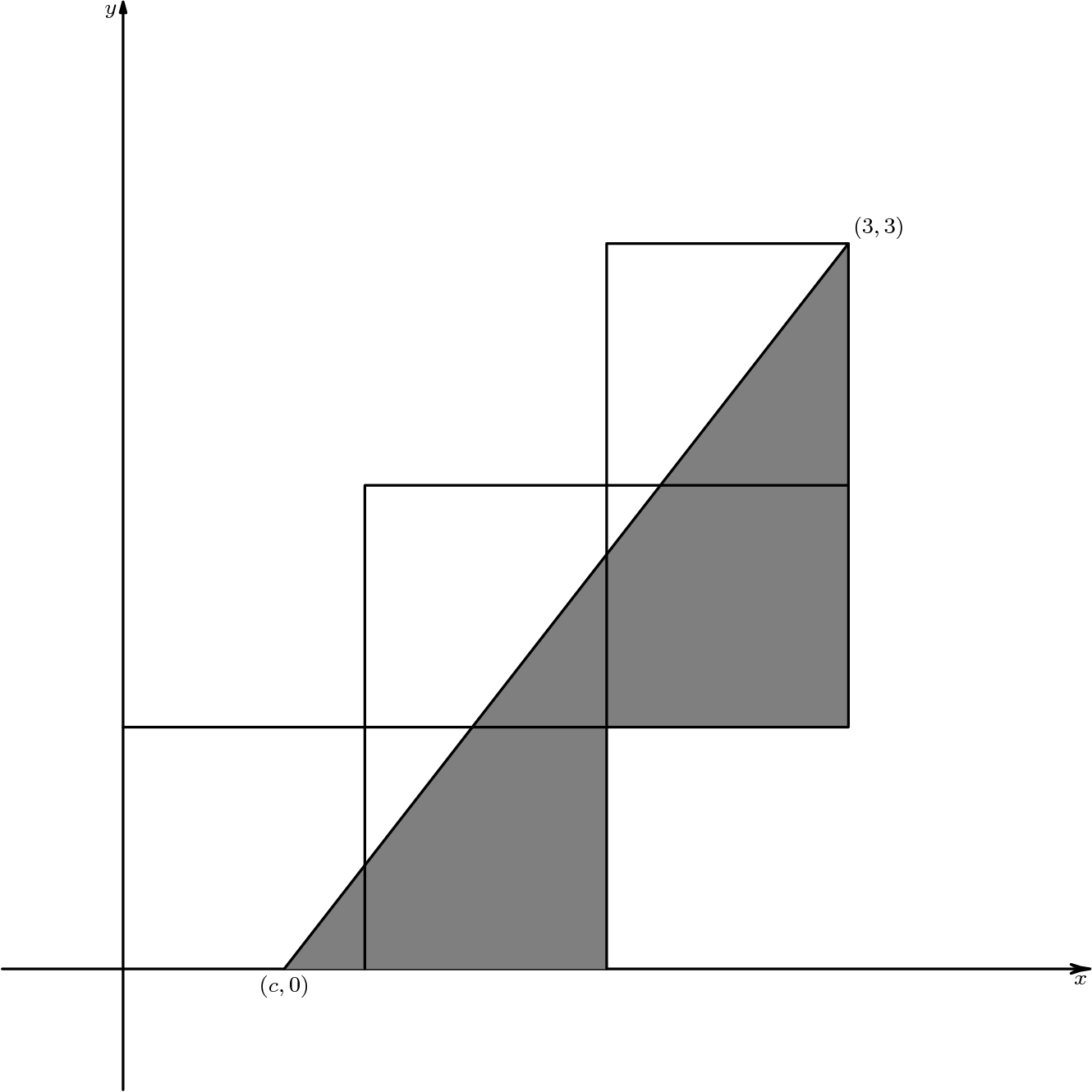
- A)
- B)
- C)
- D)
- E)
Answer
C
Key insight
The shaded piece is the big right triangle with vertices (c,0), (3,0), (3,3) minus the missing unit square in its corner, so 3(3 - c)/2 - 1 = 5/2.
Solution
The figure is a staircase of five unit squares with total area , so each side of the line must have area . Look at the shaded region below the slanted line.
Extend the picture: the triangle with vertices , , has legs and , so its area is . This triangle contains the whole shaded region plus one extra piece: the unit square with corners and , which is not part of the figure. (The line passes above that square, since at its height is already more than .) Therefore
The answer is .
Why this works
Awkward regions bounded by a line and a staircase become easy when you complete them to a triangle and subtract the pieces that do not belong. Verify that the subtracted piece lies entirely on one side of the line; otherwise the subtraction is wrong.
Alternative approach
Shoelace on the shaded polygon gives area ; setting this equal to yields .
The trap
Forgetting that the unit square with corners (2,0) and (3,1) is not part of the figure, and solving 3(3 - c)/2 = 5/2 to get c = 4/3 (not a choice, but a sign of the slip).
Common mistakes
- Forgetting that the unit square with corners (2,0) and (3,1) is not part of the figure, and solving 3(3 - c)/2 = 5/2 to get c = 4/3 (not a choice, but a sign of the slip).
- Miscounting the total area (for example using ) so that each half should be .
Techniques
Cut the figure into known shapes (triangles, rectangles, sectors)