2009 AMC 10B Problem 17
Five unit squares are arranged in the coordinate plane as shown, with the lower left corner at the origin. The slanted line, extending from to , divides the entire region into two regions of equal area. What is ? 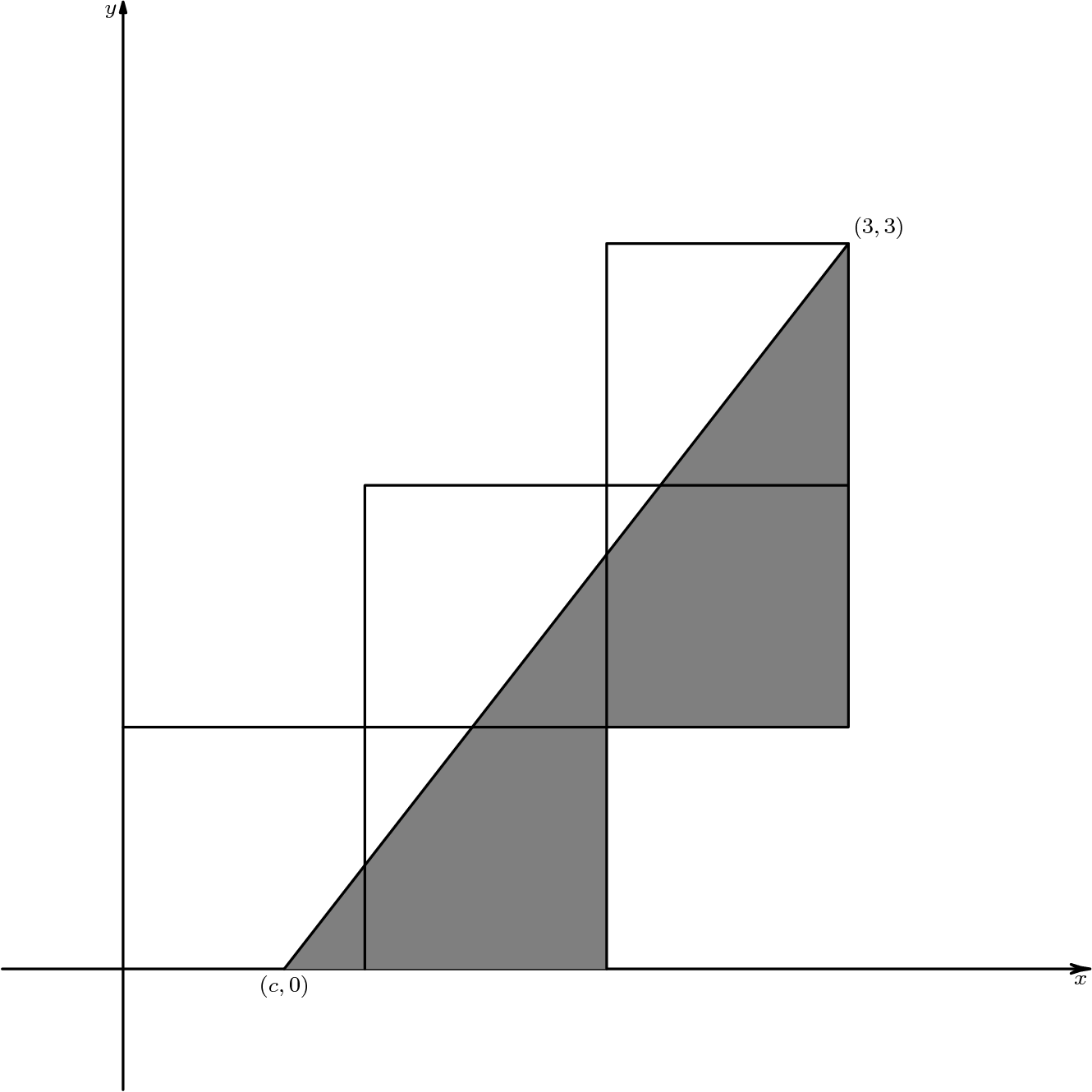
Show solution without answering
Key insight
The shaded part is the big right triangle with corners (c,0), (3,0), (3,3), minus the one empty unit square in its corner. Set it equal to 5/2.
Solution
The five squares have total area , so the shaded part below the line must have area . The shaded part is an awkward shape, so build it from a simpler one.
1. Look at the big right triangle with corners , and . Its bottom side runs from to , so it is long. Its right side runs from up to , so it is tall.
2. Its area is .
3. Compare this triangle with the shaded region. The triangle covers the whole shaded region, plus one extra piece: the unit square with corners and , which is empty in the figure.
4. That whole square really is inside the triangle: the line starts at (less than ) and rises to height at , so by it is already above height .
5. So
6. Set this equal to :
7. So and .
The answer is .
Why this works
A region cut off by a slanted line and a staircase is hard to measure directly. Fill it out to a simple triangle, then take away the pieces that do not belong. Just make sure each piece you take away lies completely inside the triangle.
Alternative approach
Test a choice. With , the line goes from to . The big triangle has area . Taking away the empty square leaves , exactly half of .
Concise solution
A shorter write-up, the way contest solutions are usually written. It may take a different route from the solution above.
The figure is a staircase of five unit squares with total area , so each side of the line must have area . Look at the shaded region below the slanted line.
Extend the picture: the triangle with vertices , , has legs and , so its area is . This triangle contains the whole shaded region plus one extra piece: the unit square with corners and , which is not part of the figure. (The line passes above that square, since at its height is already more than .) Therefore
The answer is .
Review in the AoPS books
- Introduction to Geometry, Chapter 17: Analytic Geometry
- Introduction to Geometry, Chapter 8: Quadrilaterals
- Introduction to Geometry, Chapter 4: Perimeter and Area (§4.2, §4.3)
- Introduction to Algebra, Chapter 8: Graphing Lines
Similar problems
Problem © Mathematical Association of America (MAA), American Mathematics Competitions. Reproduced for non-commercial educational use. Solution and commentary are original to this site.