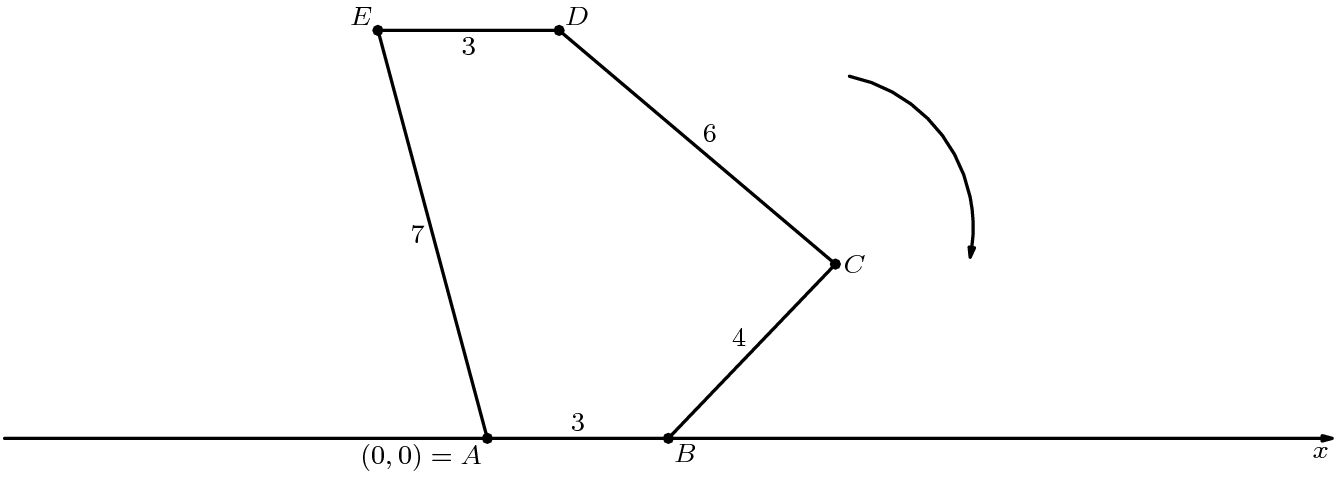
As shown below, convex pentagon has sides , , , , and . The pentagon is originally positioned in the plane with vertex at the origin and vertex on the positive -axis. The pentagon is then rolled clockwise to the right along the -axis. Which side will touch the point on the -axis?
- A)
- B)
- C)
- D)
- E)
Answer
C
Key insight
Rolling lays the sides along the axis in order AB, BC, CD, DE, EA with period 23; 2009 = 23*87 + 8 falls in CD's span 7 to 13.
Solution
As the pentagon rolls clockwise to the right, it pivots about and the next side to lie flat is , then , then , then , then again. Each side covers a stretch of the axis equal to its length, so the sides tile the positive -axis in this order:
- :
- :
- :
- :
- :
After one full turn ( units, the perimeter) the pattern repeats. Since , the point corresponds to in the first cycle, which lies strictly inside .
The answer is .
Why this works
A rolling polygon unrolls its perimeter onto the line: the sides appear consecutively, each spanning its own length, and the whole pattern has period equal to the perimeter. That turns a geometry question into a remainder computation. The shape of the pentagon (and its angles) never matters, only the side order and lengths.
The trap
Rolling the sides in the wrong order (AB, EA, DE, ...) or miscounting the cumulative endpoints 3, 7, 13, 16, 23.
Common mistakes
- Rolling the sides in the wrong order (AB, EA, DE, ...) or miscounting the cumulative endpoints 3, 7, 13, 16, 23.
- Computing incorrectly; , so the remainder is , not or .
Techniques
Set up the equation/formula and compute; no special trick needed