2009 AMC 10B Problem 13
As shown below, convex pentagon has sides , , , , and . The pentagon is originally positioned in the plane with vertex at the origin and vertex on the positive -axis. The pentagon is then rolled clockwise to the right along the -axis. Which side will touch the point on the -axis?
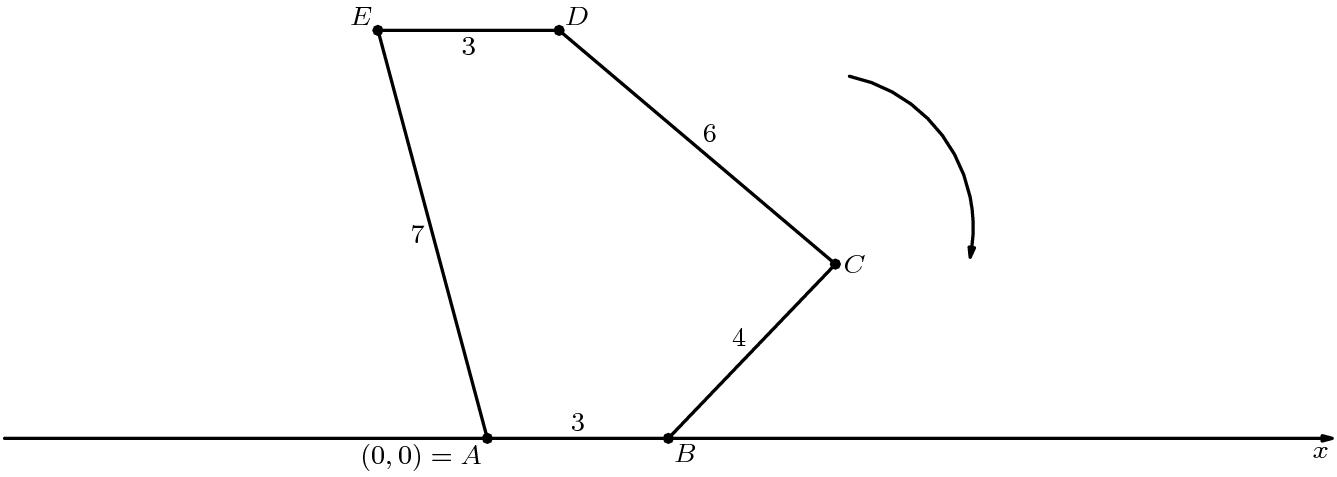
Show solution without answering
Key insight
Rolling lays the sides down in order AB, BC, CD, DE, EA, repeating every 23 units. 2009 leaves remainder 8 when divided by 23, landing on CD.
Solution
As the pentagon rolls, each side in turn lies flat on the -axis, and it covers a stretch of the axis as long as the side. So first work out which stretch each side covers.
- At the start, is on the axis from to .
- Rolling clockwise to the right, the pentagon tips over the corner . The next side to land is , then , then , then , and then again.
- Add up the lengths to see where each side lands:
| Side | Length | Covers |
|---|---|---|
| to | ||
| to | ||
| to | ||
| to | ||
| to |
- After units (the perimeter) the pentagon is back to the start position, just shifted, and the pattern repeats.
- Divide: . So is in the same spot of the pattern as .
- is between and , so side touches it.
The answer is .
Why this works
A rolling shape "unrolls" its edge onto the line: the sides land one after another, each covering its own length, and the whole pattern repeats every perimeter. That turns a geometry question into a division with remainder. The angles of the pentagon never matter, only the order and lengths of the sides.
Concise solution
A shorter write-up, the way contest solutions are usually written. It may take a different route from the solution above.
As the pentagon rolls clockwise to the right, it pivots about and the next side to lie flat is , then , then , then , then again. Each side covers a stretch of the axis equal to its length, so the sides tile the positive -axis in this order:
- :
- :
- :
- :
- :
After one full turn ( units, the perimeter) the pattern repeats. Since , the point corresponds to in the first cycle, which lies strictly inside .
The answer is .
Review in the AoPS books
- Introduction to Number Theory, Chapter 12: Introduction to Modular Arithmetic
- Introduction to Geometry, Chapter 2: Angles
- Introduction to Number Theory, Chapter 10: Units Digits
- Introduction to Geometry, Chapter 9: Polygons (§9.1, §9.2)
Similar problems
Problem © Mathematical Association of America (MAA), American Mathematics Competitions. Reproduced for non-commercial educational use. Solution and commentary are original to this site.