2008 AMC 10A Problem 14
Older television screens have an aspect ratio of . That is, the ratio of the width to the height is . The aspect ratio of many movies is not , so they are sometimes shown on a television screen by "letterboxing" - darkening strips of equal height at the top and bottom of the screen, as shown. Suppose a movie has an aspect ratio of and is shown on an older television screen with a -inch diagonal. What is the height, in inches, of each darkened strip? 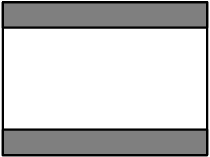
Show solution without answering
Key insight
A 4 to 3 screen with a 27-inch diagonal is a 3-4-5 triangle scaled up: 21.6 wide and 16.2 tall. The movie is 10.8 tall, leaving 5.4 for two strips.
Solution
1. First find the size of the screen. A width-to-height ratio of means the width, height and diagonal form a right triangle shaped like the -- triangle.
2. So the width, height and diagonal are , and times some number . The diagonal is , so .
3. The screen is inches wide and inches tall.
4. The movie uses the full width of the screen, inches. Its width is twice its height, so its height is
5. The rest of the screen's height is dark: inches.
6. That dark height is split into two equal strips, one on top and one on the bottom:
The answer is .
Why this works
A ratio of sides plus a diagonal is a Pythagorean-theorem problem, and is the familiar -- triangle, so the diagonal gives the real sizes quickly. After that, notice which length the movie and the screen share (the width) and split the leftover height in two.
Alternative approach
Stay with as long as possible. The screen is wide and tall. The movie is wide, so it is tall. The two strips together are tall, so each strip is . Since , and each strip is .
Concise solution
A shorter write-up, the way contest solutions are usually written. It may take a different route from the solution above.
A screen with width-to-height ratio has width , height and diagonal (a -- triangle). The diagonal is , so : the screen is inches wide and inches tall.
The movie fills the full width and has aspect ratio , so its height is inches.
The leftover height is inches, shared equally by the top and bottom strips:
The answer is .
Review in the AoPS books
- Introduction to Geometry, Chapter 4: Perimeter and Area (§4.2)
- Introduction to Algebra, Chapter 6: Ratios and Percents
- Introduction to Geometry, Chapter 6: Right Triangles (§6.1, §6.2, §6.3)
- Introduction to Algebra, Chapter 7: Proportion (§7.1, §7.2, §7.3)
Similar problems
Problem © Mathematical Association of America (MAA), American Mathematics Competitions. Reproduced for non-commercial educational use. Solution and commentary are original to this site.