A number of linked rings, each cm thick, are hanging on a peg. The top ring has an outside diameter of cm. The outside diameter of each of the outer rings is cm less than that of the ring above it. The bottom ring has an outside diameter of cm. What is the distance, in cm, from the top of the top ring to the bottom of the bottom ring?
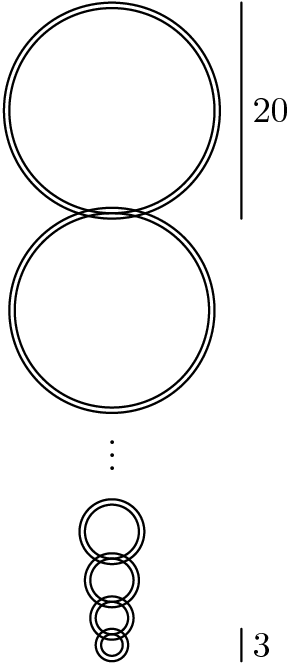
- A)
- B)
- C)
- D)
- E)
Answer
B
Key insight
Each ring hangs from the bottom of the one above, so the holes stack end to end: total = 1 + (18 + 17 + ... + 1) + 1.
Solution
The outside diameters are , so there are rings. A ring cm thick has inside diameter less than its outside diameter, so the holes have diameters .
Now see how the rings stack. Walk downward from the top of the top ring: first cm of metal, then the top ring's hole of cm. The second ring hangs from the inside bottom of the first, so the top of the second ring's metal sits in the last centimeter of the first ring's hole, and the second ring's hole begins exactly where the first ring's hole ends. The same happens at every link: the holes follow one another with no gaps and no overlaps.
So the total height is
the final being the metal at the bottom of the bottom ring.
The answer is .
Why this works
Stacked-object problems reduce to "what does each object contribute to the total once overlaps are removed?" Here each ring's net contribution is its inside diameter, and only the outermost metal at the two ends is extra. Testing the rule on two rings (outer and : height , which you can confirm by drawing) is a quick way to trust the pattern before summing.
Alternative approach
Sum the outside diameters, , then subtract the overlap at each of the links. At each link the lower ring's top centimeter lies inside the upper ring's bottom centimeter, an overlap of cm: .
The trap
Adding the outside diameters 3 + 4 + ... + 20 = 207 without removing overlaps, or forgetting the 1 cm of metal at the very top and bottom (171, choice (A)).
Common mistakes
- Adding the outside diameters without removing overlaps, or forgetting the cm of metal at the very top and bottom (, choice (A)).
- Miscounting the number of rings as (the number of gaps) instead of .
Techniques
Set up the equation/formula and compute; no special trick needed