2006 AMC 10A Problem 14
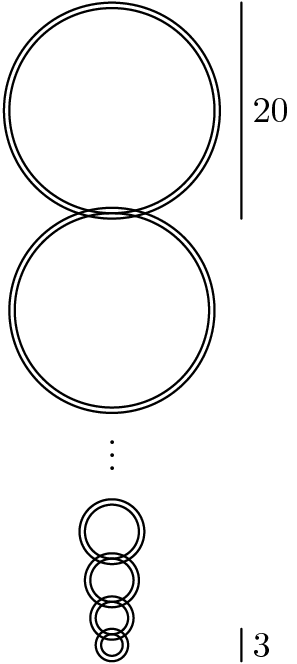
A number of linked rings, each cm thick, are hanging on a peg. The top ring has an outside diameter of cm. The outside diameter of each of the outer rings is cm less than that of the ring above it. The bottom ring has an outside diameter of cm. What is the distance, in cm, from the top of the top ring to the bottom of the bottom ring?
Show solution without answering
Key insight
Each ring hangs on the one above, so the holes line up end to end. Add the holes, 18 down to 1, plus 1 cm at each end.
Solution
Try two rings first to see how they stack, then add them all up.
1. The rings. The outside diameters are . That is rings.
2. The holes. Each ring is cm thick, so its hole is cm less than its outside diameter ( cm of metal on each side). The holes are cm.
3. Two rings. Go down from the top of the top ring: cm of metal, then its cm hole. The second ring hangs on the bottom of that hole, so the top of the second ring's metal sits in the last centimeter of the first hole. That means the second ring's hole starts exactly where the first hole ends. Then comes the cm hole of the second ring, then its cm of bottom metal. Two rings measure cm.
4. All the rings. The same thing happens at every link: the holes follow one after another with no gap and no overlap. Only the top metal of the first ring and the bottom metal of the last ring are extra:
5. Add. . The total is cm.
The answer is .
Why this works
For things stacked or linked together, ask what each piece adds to the total once the overlaps are taken out. Here each ring adds exactly its hole, and only the two outer bits of metal are extra. Checking the rule on two rings before summing all eighteen is a quick way to trust it.
Alternative approach
Add all the outside diameters: . This counts the places where two rings overlap twice, so take those away. At each link, the top of the lower ring sits cm above the inside bottom of the upper ring, which is cm above the upper ring's outside bottom. So neighboring rings overlap by cm. There are links, so the height is .
Concise solution
A shorter write-up, the way contest solutions are usually written. It may take a different route from the solution above.
The outside diameters are , so there are rings. A ring cm thick has inside diameter less than its outside diameter, so the holes have diameters .
Now see how the rings stack. Walk downward from the top of the top ring: first cm of metal, then the top ring's hole of cm. The second ring hangs from the inside bottom of the first, so the top of the second ring's metal sits in the last centimeter of the first ring's hole, and the second ring's hole begins exactly where the first ring's hole ends. The same happens at every link: the holes follow one another with no gaps and no overlaps.
So the total height is
the final being the metal at the bottom of the bottom ring.
The answer is .
Review in the AoPS books
- Introduction to Algebra, Chapter 21: Sequences & Series (§21.1, §21.2, §21.3, §21.4)
- Intermediate Algebra, Chapter 17: More Sequences and Series (§17.1, §17.2)
Similar problems
Problem © Mathematical Association of America (MAA), American Mathematics Competitions. Reproduced for non-commercial educational use. Solution and commentary are original to this site. Also appeared as 2006 12A #12.