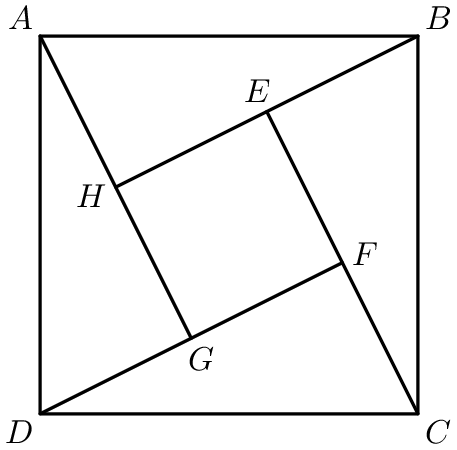
In the figure, the length of side of square is , is between and , and . What is the area of the inner square ?
- A)
- B)
- C)
- D)
- E)
Answer
C
Key insight
Each corner right triangle has legs 1 and s+1 (s the inner side) and hypotenuse root 50, so (s+1)^2 = 49.
Solution
The four segments from the corners cut the big square into the inner square plus four congruent right triangles, one at each corner. Let be the side of the inner square.
Look at the triangle with hypotenuse . Its short leg is . Its long leg runs from through to , and is a side of the inner square, so the long leg is .
Pythagoras on this triangle:
The inner square has area .
The answer is .
Why this works
A square with a tilted square inside is the classic "four congruent right triangles" picture; the outer side is a hypotenuse and the inner side is the difference of the two legs. The figure tells you the short leg, so a single Pythagorean equation finds everything. The number is chosen so that is a perfect square.
Alternative approach
Area bookkeeping: the big square's area equals plus four triangles of area , so , giving and .
The trap
Taking the longer leg to be s rather than s + 1, which gives s = 7 and area 49, or reporting s = 6 instead of the area 36.
Common mistakes
- Taking the longer leg to be s rather than s + 1, which gives s = 7 and area 49, or reporting s = 6 instead of the area 36.
- Assuming the triangles are --; they are not, since one leg is and the other is .
Techniques
Set up the equation/formula and compute; no special trick needed · Cut the figure into known shapes (triangles, rectangles, sectors)