2005 AMC 10A Problem 8
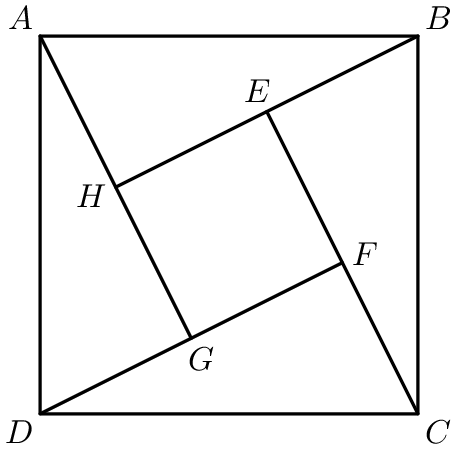
In the figure, the length of side of square is , is between and , and . What is the area of the inner square ?
Show solution without answering
Key insight
The corner triangle on side AB has legs 1 and (1 + inner side). The Pythagorean theorem with 50 gives the inner side 6.
Solution
The big square is made of the inner square plus four matching right triangles, one against each side of the big square. One of those triangles holds all the information, so work with it.
1. Pick the triangle on side . It is triangle , with the right angle at and hypotenuse .
2. Find its short leg. The four corner triangles are identical, and in the next triangle over, the short leg is . So the short leg here is too.
3. Find its long leg. The long leg goes from through all the way to . The piece is a side of the inner square. Call that side . So the long leg is .
4. Use the Pythagorean theorem.
So , which means and .
5. Area of the inner square. .
Check: legs and give , matching .
The answer is .
Why this works
A tilted square inside a square always makes four identical right triangles. The side of the outer square is the hypotenuse, and the side of the inner square is the long leg minus the short leg. Once you spot that, one Pythagorean equation solves the problem. The number was chosen so that is a perfect square.
Alternative approach
Use areas. The big square has area . It equals the inner square, , plus four triangles, each with area . So , or . This factors as , so and the area is .
Concise solution
A shorter write-up, the way contest solutions are usually written. It may take a different route from the solution above.
The four segments from the corners cut the big square into the inner square plus four congruent right triangles, one at each corner. Let be the side of the inner square.
Look at the triangle with hypotenuse . Its short leg equals , since the four corner triangles are congruent. Its long leg runs from through to , and is a side of the inner square, so the long leg is .
Pythagoras on this triangle:
The inner square has area .
The answer is .
Review in the AoPS books
- Introduction to Geometry, Chapter 4: Perimeter and Area (§4.2)
- Introduction to Geometry, Chapter 8: Quadrilaterals
- Introduction to Geometry, Chapter 6: Right Triangles (§6.1, §6.2, §6.3)
- Introduction to Geometry, Chapter 9: Polygons (§9.3)
Similar problems
Problem © Mathematical Association of America (MAA), American Mathematics Competitions. Reproduced for non-commercial educational use. Solution and commentary are original to this site.