2004 AMC 10A Problem 9
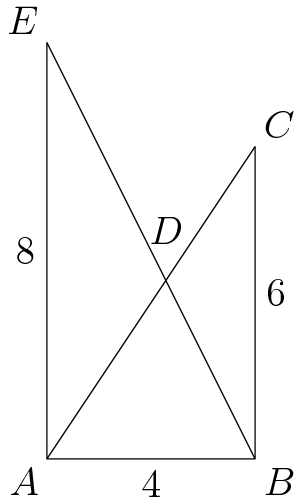
In the overlapping triangles and sharing common side , and are right angles, , , , and and intersect at . What is the difference between the areas of and ?
Show solution without answering
Key insight
Both big right triangles contain the same piece, triangle ABD. Take it away from each and the difference stays the same: 16 - 12 = 4.
Solution
The question asks for a difference of two areas, which hints that some unknown piece might cancel.
1. Find the two big areas. Both are right triangles with the leg :
2. Look at how each big triangle is cut up by point .
- Triangle is made of triangle and triangle .
- Triangle is made of triangle and the same triangle .
3. Call the area of the shared triangle by the letter . Then
4. Subtract. The unknown disappears:
The answer is .
Why this works
If two shapes share a common piece, removing that piece from both does not change the difference of their areas. Whenever a problem asks for a difference, check whether a shared region cancels. Here it means you never need to find where is.
Alternative approach
Find each area directly. Sides and are both perpendicular to , so they are parallel. That makes triangles and the same shape, with sides in the ratio .
- Their heights from (measured along the direction of ) are in the same ratio and add up to . So they are and .
- Area of , and area of .
- The difference is .
Concise solution
A shorter write-up, the way contest solutions are usually written. It may take a different route from the solution above.
Both large triangles are right triangles with leg :
Segment splits into and , and segment splits into and the same . Writing ,
Subtracting, the unknown cancels:
The answer is .
Review in the AoPS books
- Introduction to Geometry, Chapter 4: Perimeter and Area (§4.2)
- Introduction to Geometry, Chapter 6: Right Triangles (§6.1, §6.2, §6.3)
- Introduction to Geometry, Chapter 11: Circles (§11.3)
- Introduction to Geometry, Chapter 10: Geometric Inequalities (§10.3)
Similar problems
Problem © Mathematical Association of America (MAA), American Mathematics Competitions. Reproduced for non-commercial educational use. Solution and commentary are original to this site. Also appeared as 2004 12A #8.