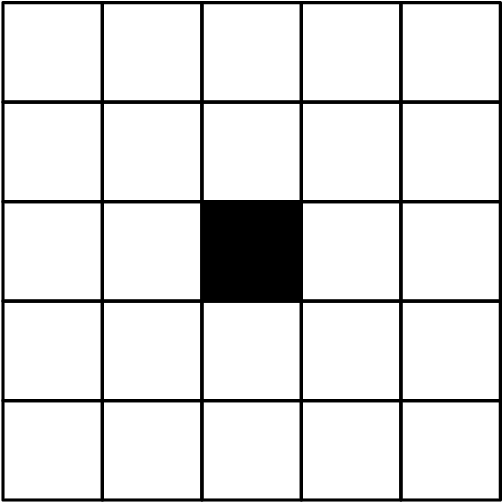
The grid shown contains a collection of squares with sizes from to . How many of these squares contain the black center square?
- A)
- B)
- C)
- D)
- E)
Answer
D
Key insight
Count by size: k by k squares containing the center number 1, 4, 9, 4, 1 for k = 1 to 5, totaling 19.
Solution
Number the rows and columns through ; the black cell is at row , column . A square is determined by its top row and left column , each ranging over . It contains the center exactly when and the same for ; by symmetry the row and column counts are equal, so the answer for size is (number of valid ).
- : only. .
- : . .
- : . .
- : (top row at most ). .
- : only. .
Total: .
The answer is .
Why this works
A sub-square is located by one corner, so counting squares is counting corner positions. The containment condition is independent in the two coordinates, which turns each case into a perfect square. The symmetric list is a good self-check: small squares are constrained by having to reach the center, large ones by having to fit in the grid.
Alternative approach
Complementary count: the grid has squares in all. Only and squares can avoid the center: of the unit squares and of the squares. So .
The trap
Counting all 55 squares in the grid, or forgetting the 4 by 4 squares and getting 15.
Common mistakes
- Counting all 55 squares in the grid, or forgetting the 4 by 4 squares and getting 15.
- Miscounting the case as or instead of ; every square in a grid contains the center.
Techniques
Split into exhaustive cases and handle each · Exploit symmetry to reduce work or pair up objects