2004 AMC 10A Problem 16
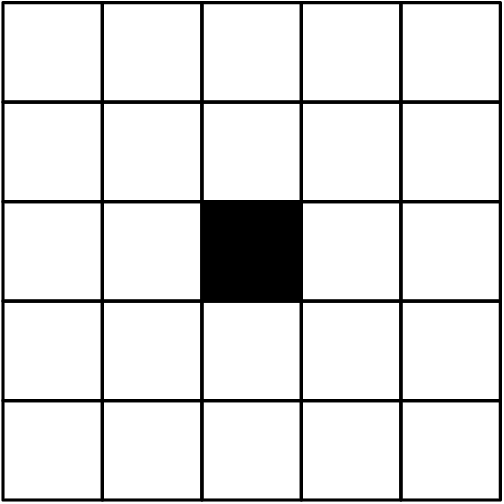
The grid shown contains a collection of squares with sizes from to . How many of these squares contain the black center square?
Show solution without answering
Key insight
Count by size. The numbers of squares that cover the center are 1, 4, 9, 4, 1 for sizes 1 through 5, which adds to 19.
Solution
Count the squares one size at a time. A square is fixed once you know which rows and which columns it covers, and the black square sits in row , column .
1. Rows first. For each size, list the groups of neighboring rows that include row .
- Size : just row . That is choice.
- Size : rows – or –. That is choices.
- Size : rows –, – or –. That is choices.
- Size : rows – or –. That is choices.
- Size : rows –. That is choice.
2. Columns. The columns work exactly the same way, so each size has the same number of column choices.
3. Squares. Any row choice can go with any column choice, so for each size multiply the row count by itself:
| size | row choices | squares with the center |
|---|---|---|
| 1 | ||
| 2 | ||
| 3 | ||
| 2 | ||
| 1 |
- Total: .
The answer is .
Why this works
A square in a grid is decided by its rows and its columns, and those two choices are separate, so each count is a number times itself. Notice the pattern : small squares are limited because they must reach the center, and big ones because they must fit in the grid. That balance is a good self-check.
Alternative approach
Count the squares that miss the center and subtract.
- The grid has squares of all sizes.
- Every square of size or more covers the center, so only small squares can miss it.
- Of the unit squares, miss it. Of the squares of size , the found above cover it, so miss it.
- That leaves .
Concise solution
A shorter write-up, the way contest solutions are usually written. It may take a different route from the solution above.
Number the rows and columns through ; the black cell is at row , column . A square is determined by its top row and left column , each ranging over . It contains the center exactly when and the same for ; by symmetry the row and column counts are equal, so the answer for size is (number of valid ).
- : only. .
- : . .
- : . .
- : (top row at most ). .
- : only. .
Total: .
The answer is .
Review in the AoPS books
- Introduction to Counting & Probability, Chapter 1: Counting Is Arithmetic
- Introduction to Counting & Probability, Chapter 5: More With Combinations (§5.2)
- Introduction to Counting & Probability, Chapter 2: Basic Counting Techniques (§2.2)
- Introduction to Algebra, Chapter 22: Special Manipulations (§22.3)
Similar problems
Problem © Mathematical Association of America (MAA), American Mathematics Competitions. Reproduced for non-commercial educational use. Solution and commentary are original to this site.