How many of the twelve pentominoes pictured below have at least one line of reflectional symmetry?
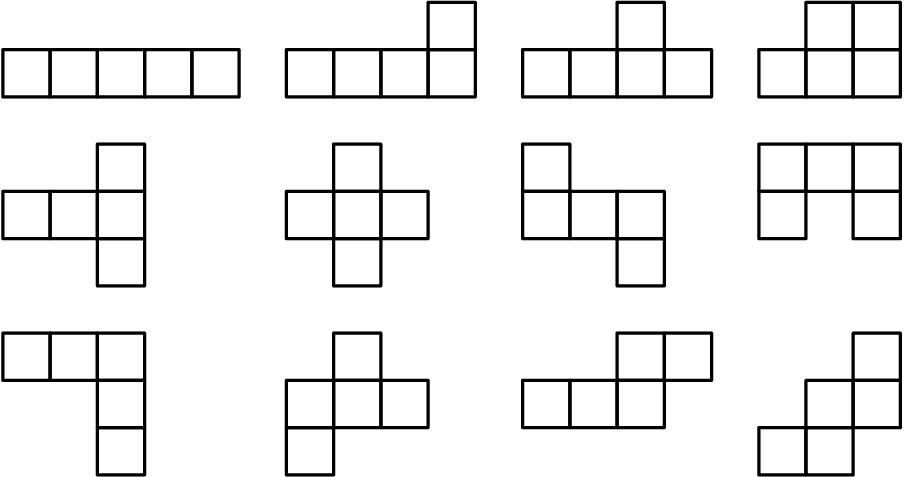
- A)
- B)
- C)
- D)
- E)
Answer
D
Key insight
Check each pentomino for a mirror axis, including diagonal ones: I, T, U, V, W and X have one; F, L, N, P, Y and Z do not.
Solution
Check each shape for a mirror line, allowing horizontal, vertical, and diagonal axes.
Shapes with a line of symmetry:
- the straight bar (I): mirror along its length and across its middle;
- the T shape: mirror down its stem;
- the U shape: mirror between its two prongs;
- the L-shaped corner with equal arms of length (V): mirror along the diagonal through the corner;
- the staircase (W): mirror along the diagonal through the middle square;
- the plus sign (X): four mirror lines.
That is shapes.
Shapes without one: the F, the L (bar of four with one cell on the end), the N (offset and ), the P (a block with a tail), the Y (bar of four with one cell off the second square), and the Z. The Z looks symmetric but only returns to itself under a half-turn, not a reflection.
The answer is .
Why this works
For a small, finite collection, a careful checklist beats cleverness. The one conceptual point is that reflectional symmetry is stricter than rotational symmetry: a figure like Z or N can look "balanced" while having no mirror line. Also remember to test diagonal axes, which catch V and W.
The trap
Counting the Z (or S) pentomino, which has only 180-degree rotational symmetry, or missing the diagonal mirror lines of V and W.
Common mistakes
- Counting the Z (or S) pentomino, which has only 180-degree rotational symmetry, or missing the diagonal mirror lines of V and W.
- Losing track of which shapes have already been checked and double counting or skipping one of the twelve.
Techniques
Organized listing / direct enumeration