2001 AMC 10 Problem 5
How many of the twelve pentominoes pictured below have at least one line of reflectional symmetry?
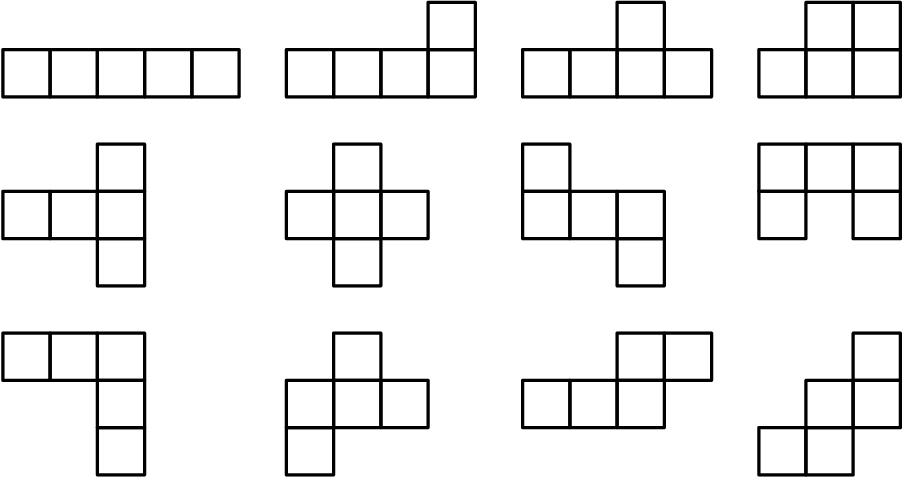
Show solution without answering
Key insight
Go through the twelve shapes one by one and look for a fold line, including slanted (diagonal) ones. Six shapes have one.
Solution
A shape has a line of reflectional symmetry if you can fold it along some line and the two halves land exactly on top of each other. The line can be across, up and down, or slanted at .
Go through the twelve shapes one at a time. The usual letter names are given to keep track.
Shapes that have a fold line:
- The straight bar of squares (I): fold it down the middle the long way, or across the middle square.
- The T shape: fold it down the middle of its stem.
- The U shape: fold it down the middle, between the two raised ends.
- The corner with two arms of squares each (V): fold along the slanted line through the corner square.
- The staircase (W): fold along the slanted line through its middle square.
- The plus sign (X): it has four fold lines.
Shapes that do not:
- The F, the L (a bar of with one square on the end), the N (a row of and a row of shifted over), the P (a block with one extra square), the Y (a bar of with one square sticking out from the second square), and the Z.
- The Z is the tricky one. It looks balanced, but that is because it matches itself when you turn it halfway around. Flipping it over gives an S, which is a different shape, so it has no fold line.
Counting the first list gives shapes.
The answer is .
Why this works
With only twelve shapes, a careful check of each one is the fastest method. Two things to watch for: a shape can match itself after a turn without having any fold line (like Z or N), and some fold lines are slanted, not level or upright (like in V and W). Test all four directions: across, up and down, and both diagonals.
Concise solution
A shorter write-up, the way contest solutions are usually written. It may take a different route from the solution above.
Check each shape for a mirror line, allowing horizontal, vertical, and diagonal axes.
Shapes with a line of symmetry:
- the straight bar (I): mirror along its length and across its middle;
- the T shape: mirror down its stem;
- the U shape: mirror between its two prongs;
- the L-shaped corner with equal arms of length (V): mirror along the diagonal through the corner;
- the staircase (W): mirror along the diagonal through the middle square;
- the plus sign (X): four mirror lines.
That is shapes.
Shapes without one: the F, the L (bar of four with one cell on the end), the N (offset and ), the P (a block with a tail), the Y (bar of four with one cell off the second square), and the Z. The Z looks symmetric but only returns to itself under a half-turn, not a reflection.
The answer is .
Review in the AoPS books
- Introduction to Geometry, Chapter 16: The More Things Change. . . (§16.1, §16.2, §16.3, §16.4)
- Prealgebra, Chapter 15: Problem-Solving Strategies (§15.2)
Similar problems
Problem © Mathematical Association of America (MAA), American Mathematics Competitions. Reproduced for non-commercial educational use. Solution and commentary are original to this site.