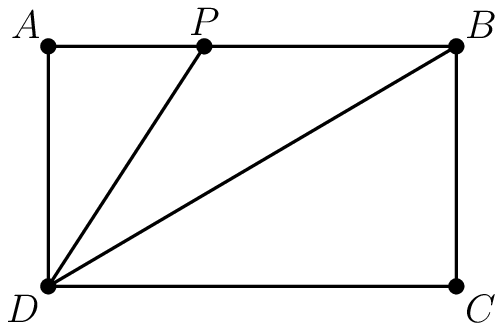
In rectangle , , is on , and and trisect . What is the perimeter of ?
- A)
- B)
- C)
- D)
- E)
Answer
B
Key insight
Trisecting the right angle at D makes ADP and ADB 30-60-90 triangles sharing the known leg AD = 1, so every side of triangle BDP is a 30-60-90 ratio.
Solution
is cut into three equal parts, so , and therefore .
Triangle has a right angle at and a angle at , with the leg adjacent to the angle. In a 30-60-90 triangle the short leg is the long leg divided by and the hypotenuse is twice the short leg:
Triangle has a right angle at and , so is now the short leg:
Then , and the perimeter of is
The answer is .
Why this works
A trisected right angle is a signal that every triangle in sight is 30-60-90, so one known length propagates to all the others through fixed ratios. Anchor each ratio on the side you know () and be careful about whether that side is the short leg or the long leg in each triangle. Segments on a shared side, like , come from subtraction.
Alternative approach
Since (complement of ) and , triangle is isosceles with . After finding and , the perimeter is with no need to compute .
The trap
Taking BP to be all of AB instead of AB minus AP, or swapping which leg is opposite the 30-degree angle.
Common mistakes
- Taking BP to be all of AB instead of AB minus AP, or swapping which leg is opposite the 30-degree angle.
- Writing by confusing the hypotenuse of with its long leg; the diagonal is .
- Leaving as and failing to match it to the rationalized forms in the choices.
Techniques
Set up the equation/formula and compute; no special trick needed