2000 AMC 10 Problem 7
In rectangle , , is on , and and trisect . What is the perimeter of ?
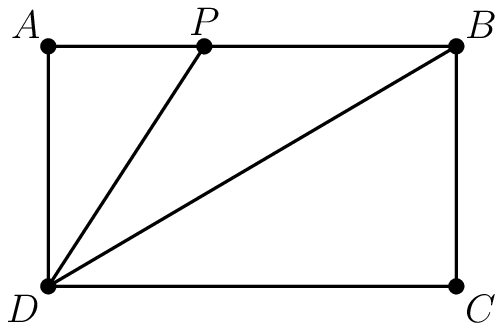
Show solution without answering
Key insight
Cutting the right angle at D into three parts gives 30 degree angles, so every triangle here is a 30-60-90 triangle and AD = 1 fixes all the other lengths.
Solution
1. Angle is a right angle, . Two lines cut it into three equal parts, so each part is :
2. Recall the 30-60-90 triangle: the sides are in the ratio . The short leg is across from the angle, the long leg is across from the angle, and the hypotenuse is twice the short leg.
3. Triangle . It has a right angle at and at . The side is across from the angle at , so it is the long leg. Divide by to get the short leg, then double:
4. Triangle . It has a right angle at and at . Now is across from the angle at , so it is the short leg:
5. Side . lies on , so is what is left of after removing :
6. Perimeter. Add the three sides of triangle :
The answer is .
Why this works
Cutting a right angle into three equal parts always makes and angles, so every right triangle in the picture is a 30-60-90 triangle. Then one known length gives all the others. In each triangle, first decide whether the known side is the short leg or the long leg; that is where most mistakes happen.
Alternative approach
Look at triangle itself. The angle at is , and the angle at is . Two equal angles mean two equal sides, so . With , the perimeter is , and you never need .
Concise solution
A shorter write-up, the way contest solutions are usually written. It may take a different route from the solution above.
is cut into three equal parts, so , and therefore .
Triangle has a right angle at and a angle at , with the leg adjacent to the angle. In a 30-60-90 triangle the short leg is the long leg divided by and the hypotenuse is twice the short leg:
Triangle has a right angle at and , so is now the short leg:
Then , and the perimeter of is
The answer is .
Review in the AoPS books
- Introduction to Geometry, Chapter 4: Perimeter and Area (§4.2)
- Introduction to Geometry, Chapter 2: Angles
- Introduction to Geometry, Chapter 6: Right Triangles (§6.1, §6.2, §6.3)
- Introduction to Geometry, Chapter 9: Polygons (§9.1, §9.2)
Similar problems
Problem © Mathematical Association of America (MAA), American Mathematics Competitions. Reproduced for non-commercial educational use. Solution and commentary are original to this site.