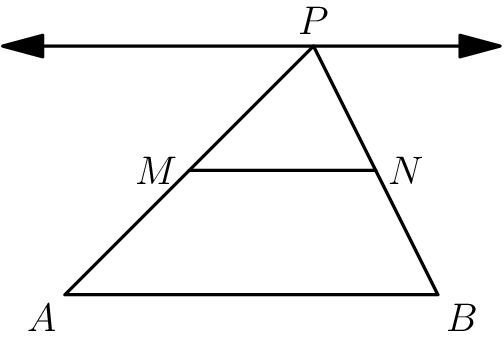
Points and are the midpoints of sides and of . As moves along a line that is parallel to side , how many of the four quantities listed below change?
(a) the length of the segment
(b) the perimeter of
(c) the area of
(d) the area of trapezoid
- A)
- B)
- C)
- D)
- E)
Answer
B
Key insight
P slides along a line parallel to AB, so its height above AB never changes; MN is always half of AB, so only the perimeter can vary.
Solution
Go through the four quantities one at a time.
(a) and are midpoints, so is a half-scale copy of and . Since and are fixed, never changes.
(b) Imagine dragging far to the right along its line. Both and grow without bound while stays put, so the perimeter changes.
(c) The area is , where is the distance from to line . That distance is the gap between two parallel lines, which is constant, so the area does not change.
(d) Trapezoid is with removed, and the small triangle has of the big one's area (linear ratio ). So the trapezoid is always of a constant area, which is constant.
Exactly one quantity, the perimeter, changes.
The answer is .
Why this works
Moving a vertex parallel to the opposite side is the classic area-preserving motion: the base and height are both untouched. Midpoints tie and the small triangle to the big one by a fixed ratio, so anything determined by and the height is frozen. Lengths of the slanted sides are the only free quantities, and pushing to an extreme position makes that visible.
The trap
Believing the area of triangle PAB changes because the triangle looks different as P moves, forgetting that base AB and its height are both fixed.
Common mistakes
- Believing the area of triangle PAB changes because the triangle looks different as P moves, forgetting that base AB and its height are both fixed.
- Thinking changes because and move; the points move, but their separation stays .
- Counting the trapezoid as changing since its slanted sides and change, even though its area does not.
Techniques
Use an invariant, parity, or coloring argument · Test small/specific values or special cases to find or verify the answer