2000 AMC 10 Problem 5
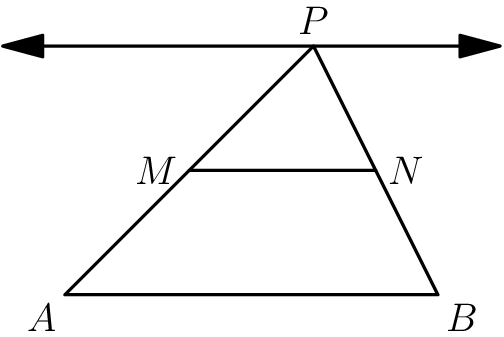
Points and are the midpoints of sides and of . As moves along a line that is parallel to side , how many of the four quantities listed below change?
(a) the length of the segment
(b) the perimeter of
(c) the area of
(d) the area of trapezoid
Show solution without answering
Key insight
P moves along a line parallel to AB, so its height above AB never changes. Since MN is always half of AB, only the perimeter can change.
Solution
Check the four quantities one at a time.
- (a) Length of . is halfway along and is halfway along . So triangle is a copy of triangle shrunk to half size, and is half of . Since and do not move, does not change.
- (b) Perimeter of triangle . Picture sliding very far to the right. The sides and become very long, while stays the same. So the perimeter changes.
- (c) Area of triangle . Area . Use as the base; it does not change. The height is the distance from down to line . is on a line parallel to , and two parallel lines stay the same distance apart everywhere, so the height does not change. The area does not change.
- (d) Area of trapezoid . The trapezoid is the big triangle with the small triangle cut off the top. The small triangle is half as wide and half as tall, so its area is of the big one. The trapezoid is always of the big triangle's area, which does not change. So the trapezoid's area does not change.
Only one quantity, the perimeter, changes.
The answer is .
Why this works
Sliding the top corner of a triangle along a line parallel to its base keeps both the base and the height the same, so the area stays fixed. Anything built from the midpoints is a fixed fraction of the big triangle, so it stays fixed too. Only the slanted sides are free to change, and moving to an extreme position makes that easy to see.
Concise solution
A shorter write-up, the way contest solutions are usually written. It may take a different route from the solution above.
Go through the four quantities one at a time.
(a) and are midpoints, so is a half-scale copy of and . Since and are fixed, never changes.
(b) Imagine dragging far to the right along its line. Both and grow without bound while stays put, so the perimeter changes.
(c) The area is , where is the distance from to line . That distance is the gap between two parallel lines, which is constant, so the area does not change.
(d) Trapezoid is with removed, and the small triangle has of the big one's area (linear ratio ). So the trapezoid is always of a constant area, which is constant.
Exactly one quantity, the perimeter, changes.
The answer is .
Review in the AoPS books
- Introduction to Geometry, Chapter 4: Perimeter and Area (§4.2)
- Introduction to Geometry, Chapter 3: Congruent Triangles
- Introduction to Geometry, Chapter 8: Quadrilaterals
- Introduction to Geometry, Chapter 6: Right Triangles (§6.1, §6.2, §6.3)
Similar problems
Problem © Mathematical Association of America (MAA), American Mathematics Competitions. Reproduced for non-commercial educational use. Solution and commentary are original to this site.