Triangles: Area & Pythagorean
Triangle area, Pythagorean theorem, special right triangles, triangle inequality
What you need to know
- Area. Area , with the height to base . With two sides , and the angle between them, area . An equilateral triangle with side has area . Example: sides and with a angle between them give area .
- Pythagorean Theorem. In a right triangle with legs , and hypotenuse , . The converse is true too: if , the angle across from is a right angle. Know the triples --, --, --, --, and their multiples, such as --.
- Special right triangles. A -- triangle has sides in the ratio . A -- triangle has sides , with the short leg across from . Example: a -- triangle with hypotenuse has legs and .
- Triangle Inequality. Any two sides add up to more than the third: , strictly. Example: , , is not a triangle, since .
- Acute, right, or obtuse? Let be the longest side. If , the triangle is acute; if equal, right; if less, obtuse. Example: , , is obtuse, since .
- Heron's Formula. Area , where is the semiperimeter (half the perimeter). Example: sides , , give and area .
How AMC 10 tests it
- Problems 3–10: a figure of squares and right triangles; find a length or area by dropping one perpendicular.
- "How many integers make a triangle with sides , , ?" or "...an obtuse triangle?"
- Mid-paper: two sides and an altitude, or a or angle. The altitude splits the triangle into two right triangles that share a leg.
- Shaded regions from overlapping triangles, or a triangle cut from a rectangle, found by subtraction.
Standard approaches
- Drop an altitude and write a Pythagorean equation on each side of it; subtracting them removes the altitude.
- Look for special right triangles or Pythagorean triples before working with square roots.
- Find the area in two ways (two base–height pairs) to get an unknown height. Example: the -- triangle has area , so the height to the hypotenuse has , and .
- For shaded regions, subtract simple pieces from a rectangle or triangle around the region.
Worked example
In triangle , , , and the altitude from to line has length . What is the sum of all possible values of ?
(A) (B) (C) (D) (E)
Solution. Let be the foot of the altitude, so .
Step 1. Right triangle has hypotenuse and leg , so it is a -- triangle and .
Step 2. Right triangle has hypotenuse and leg , so it is a -- triangle and .
Step 3. If lies between and , then . If lies outside segment , beyond (so angle is obtuse), then . Both triangles exist, so both values count.
Step 4. The sum is .
The answer is .
Pitfalls
- Forgetting the obtuse picture, where the foot of an altitude falls outside the triangle. In the example, that picture gives .
- Mixing up the legs of a -- triangle. The longer leg is across from and is times the shorter leg.
- Allowing (a flat triangle) when counting integer side lengths. Example: with sides and , the third side can be , , , , or , but not or .
Traps that recur
- Counting 50 or 51 values per coordinate (including boundary points, which are not interior), or forgetting to subtract the points that are also 60-ray partitional. (2011 AMC 10A #25)
- Reading 'the altitude to side AB' as a segment drawn from B, which would put P at B; the altitude meant is the one from the opposite vertex C, and its foot H is what fixes BP. (2025 AMC 10A #23)
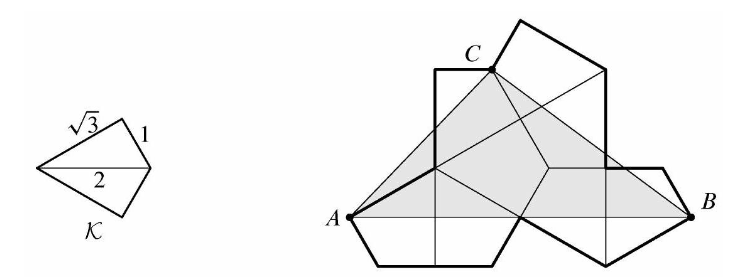
- Misreading the kite: its angles are 60°, 90°, 120°, 90° (the two √3 sides meet at 60°, the two unit sides at 120°), and its long diagonal is 2. (2024 AMC 10A #22)
- Guessing 1:1 because AC = CD and DE = EB look symmetric, or setting AD:DB = AC:DE = 4:3 as if it were an angle bisector. (2019 AMC 10B #16)
- 1.2012 AMC 10B #21
Four distinct points are arranged on a plane so that the segments connecting them have lengths , , , , , and . What is the ratio of to ?
- A)
- B)
- C)
- D)
- E)
- 2.2011 AMC 10B #18
Rectangle has and . Point is chosen on side so that . What is the degree measure of ?
- A)
- B)
- C)
- D)
- E)
- 3.2008 AMC 10A #18
A right triangle has perimeter 32 and area 20. What is the length of its hypotenuse?
- A)
- B)
- C)
- D)
- E)
- 4.2007 AMC 10B #17
Point is inside equilateral . Points , , and are the feet of the perpendiculars from to , , and , respectively. Given that , , and , what is ?
- A)
- B)
- C)
- D)
- E)
- 5.2005 AMC 10A #19
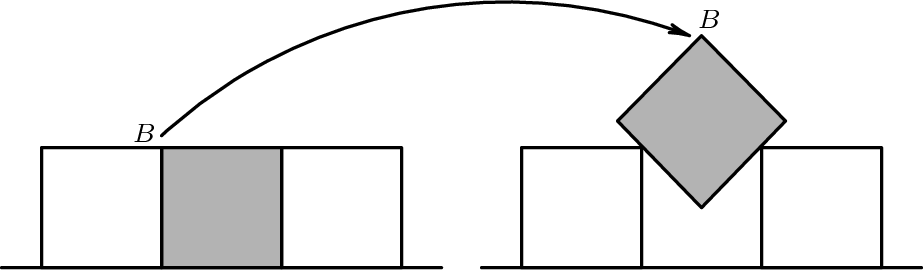
Three one-inch squares are placed with their bases on a line. The center square is lifted out and rotated , as shown. Then it is centered and lowered into its original location until it touches both of the adjoining squares. How many inches is the point from the line on which the bases of the original squares were placed?
- A)
- B)
- C)
- D)
- E)
- 6.2004 AMC 10B #18
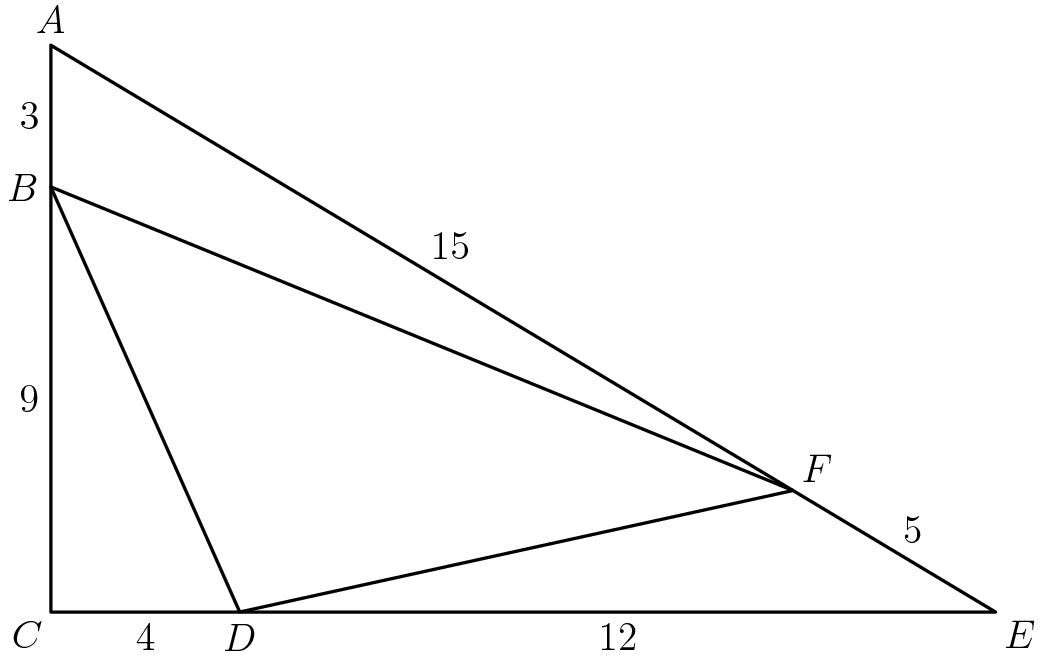
In the right triangle , we have , , and . Points , , and are located on , , and , respectively, so that , , and . What is the ratio of the area of to that of ?
- A)
- B)
- C)
- D)
- E)
- 7.2025 AMC 10A #23
Triangle has side lengths , , and . The bisector of and the altitude to side intersect at point What is ?
- A)
- B)
- C)
- D)
- E)
- 8.2024 AMC 10A #22
Let be the kite formed by joining two right triangles with legs and along a common hypotenuse. Eight copies of are used to form the polygon shown below. What is the area of triangle ?
- A)
- B)
- C)
- D)
- E)
- 9.2019 AMC 10B #16
In with a right angle at point lies in the interior of and point lies in the interior of so that and the ratio What is the ratio
- A)
- B)
- C)
- D)
- E)
- 10.2018 AMC 10A #23
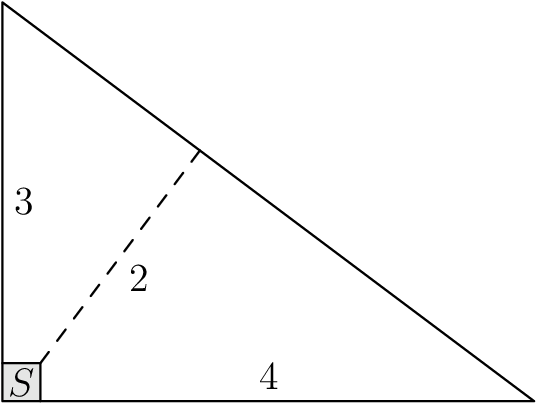
Farmer Pythagoras has a field in the shape of a right triangle. The right triangle's legs have lengths and units. In the corner where those sides meet at a right angle, he leaves a small unplanted square so that from the air it looks like the right angle symbol. The rest of the field is planted. The shortest distance from to the hypotenuse is units. What fraction of the field is planted?
- A)
- B)
- C)
- D)
- E)
- 11.2018 AMC 10B #17
In rectangle , and . Points and lie on , points and lie on , points and lie on , and points and lie on so that and the convex octagon is equilateral. The length of a side of this octagon can be expressed in the form , where , , and are integers and is not divisible by the square of any prime. What is ?
- A)
- B)
- C)
- D)
- E)
- 12.2017 AMC 10B #19
Let be an equilateral triangle. Extend side beyond to a point so that . Similarly, extend side beyond to a point so that , and extend side beyond to a point so that . What is the ratio of the area of to the area of ?
- A)
- B)
- C)
- D)
- E)
- 13.2015 AMC 10A #19
The isosceles right triangle has right angle at and area . The rays trisecting intersect at and . What is the area of ?
- A)
- B)
- C)
- D)
- E)
- 14.2014 AMC 10A #22
In rectangle , and . Let be a point on such that . What is ?
- A)
- B)
- C)
- D)
- E)
- 15.2005 AMC 10A #25
In we have , , and . Points and are on and respectively, with and . What is the ratio of the area of triangle to the area of the quadrilateral ?
- A)
- B)
- C)
- D)
- E)
- 16.2004 AMC 10A #20
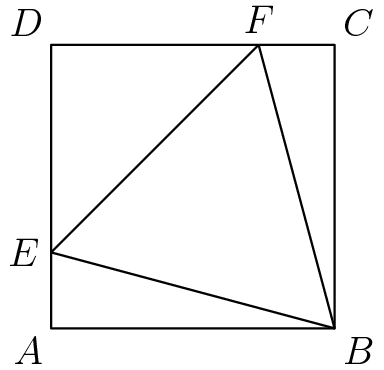
Points and are located on square so that is equilateral. What is the ratio of the area of to that of ?
- A)
- B)
- C)
- D)
- E)
- 17.2002 AMC 10A #23
Points and lie on a line, in that order, with and . Point is not on the line, and . The perimeter of is twice the perimeter of . Find .
- A)
- B)
- C)
- D)
- E)
- 18.2002 AMC 10B #22
Let be a right-angled triangle with . Let and be the midpoints of legs and , respectively. Given that and , find .
- A)
- B)
- C)
- D)
- E)
- 19.2001 AMC 10 #24
In trapezoid , and are perpendicular to , with , , and . What is ?
- A)
- B)
- C)
- D)
- E)
- 20.2011 AMC 10A #25
Let be a square region and an integer. A point in the interior of is called partitional if there are rays emanating from that divide into triangles of equal area. How many points are 100-ray partitional but not 60-ray partitional?
- A)
- B)
- C)
- D)
- E)
Problems © Mathematical Association of America (MAA), American Mathematics Competitions. Reproduced for non-commercial educational use. The topic note, tags and key insights are original to this site.