Triangles: Area & Pythagorean
Triangle area, Pythagorean theorem, special right triangles, triangle inequality
What you need to know
- Area. Area , with the height to base . With two sides , and the angle between them, area . An equilateral triangle with side has area . Example: sides and with a angle between them give area .
- Pythagorean Theorem. In a right triangle with legs , and hypotenuse , . The converse is true too: if , the angle across from is a right angle. Know the triples --, --, --, --, and their multiples, such as --.
- Special right triangles. A -- triangle has sides in the ratio . A -- triangle has sides , with the short leg across from . Example: a -- triangle with hypotenuse has legs and .
- Triangle Inequality. Any two sides add up to more than the third: , strictly. Example: , , is not a triangle, since .
- Acute, right, or obtuse? Let be the longest side. If , the triangle is acute; if equal, right; if less, obtuse. Example: , , is obtuse, since .
- Heron's Formula. Area , where is the semiperimeter (half the perimeter). Example: sides , , give and area .
How AMC 10 tests it
- Problems 3–10: a figure of squares and right triangles; find a length or area by dropping one perpendicular.
- "How many integers make a triangle with sides , , ?" or "...an obtuse triangle?"
- Mid-paper: two sides and an altitude, or a or angle. The altitude splits the triangle into two right triangles that share a leg.
- Shaded regions from overlapping triangles, or a triangle cut from a rectangle, found by subtraction.
Standard approaches
- Drop an altitude and write a Pythagorean equation on each side of it; subtracting them removes the altitude.
- Look for special right triangles or Pythagorean triples before working with square roots.
- Find the area in two ways (two base–height pairs) to get an unknown height. Example: the -- triangle has area , so the height to the hypotenuse has , and .
- For shaded regions, subtract simple pieces from a rectangle or triangle around the region.
Worked example
In triangle , , , and the altitude from to line has length . What is the sum of all possible values of ?
(A) (B) (C) (D) (E)
Solution. Let be the foot of the altitude, so .
Step 1. Right triangle has hypotenuse and leg , so it is a -- triangle and .
Step 2. Right triangle has hypotenuse and leg , so it is a -- triangle and .
Step 3. If lies between and , then . If lies outside segment , beyond (so angle is obtuse), then . Both triangles exist, so both values count.
Step 4. The sum is .
The answer is .
Pitfalls
- Forgetting the obtuse picture, where the foot of an altitude falls outside the triangle. In the example, that picture gives .
- Mixing up the legs of a -- triangle. The longer leg is across from and is times the shorter leg.
- Allowing (a flat triangle) when counting integer side lengths. Example: with sides and , the third side can be , , , , or , but not or .
Traps that recur
- Counting 50 or 51 values per coordinate (including boundary points, which are not interior), or forgetting to subtract the points that are also 60-ray partitional. (2011 AMC 10A #25)
- Reading 'the altitude to side AB' as a segment drawn from B, which would put P at B; the altitude meant is the one from the opposite vertex C, and its foot H is what fixes BP. (2025 AMC 10A #23)
- Misreading the kite: its angles are 60°, 90°, 120°, 90° (the two √3 sides meet at 60°, the two unit sides at 120°), and its long diagonal is 2. (2024 AMC 10A #22)
- Guessing 1:1 because AC = CD and DE = EB look symmetric, or setting AD:DB = AC:DE = 4:3 as if it were an angle bisector. (2019 AMC 10B #16)
- 1.2008 AMC 10A #14
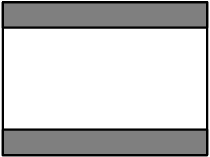
Older television screens have an aspect ratio of . That is, the ratio of the width to the height is . The aspect ratio of many movies is not , so they are sometimes shown on a television screen by "letterboxing" - darkening strips of equal height at the top and bottom of the screen, as shown. Suppose a movie has an aspect ratio of and is shown on an older television screen with a -inch diagonal. What is the height, in inches, of each darkened strip?
- A)
- B)
- C)
- D)
- E)
- 2.2007 AMC 10B #10
Two points and are in a plane. Let be the set of all points in the plane for which has area Which of the following describes
- A)
- B)
- C)
- D)
- E)
- 3.2006 AMC 10B #10
In a triangle with integer side lengths, one side is three times as long as a second side, and the length of the third side is . What is the greatest possible perimeter of the triangle?
- A)
- B)
- C)
- D)
- E)
- 4.2005 AMC 10A #8
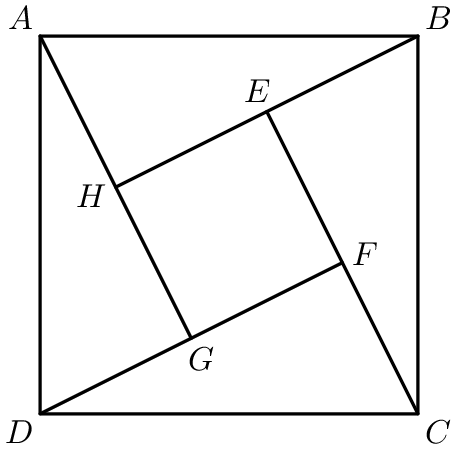
In the figure, the length of side of square is , is between and , and . What is the area of the inner square ?
- A)
- B)
- C)
- D)
- E)
- 5.2005 AMC 10B #14
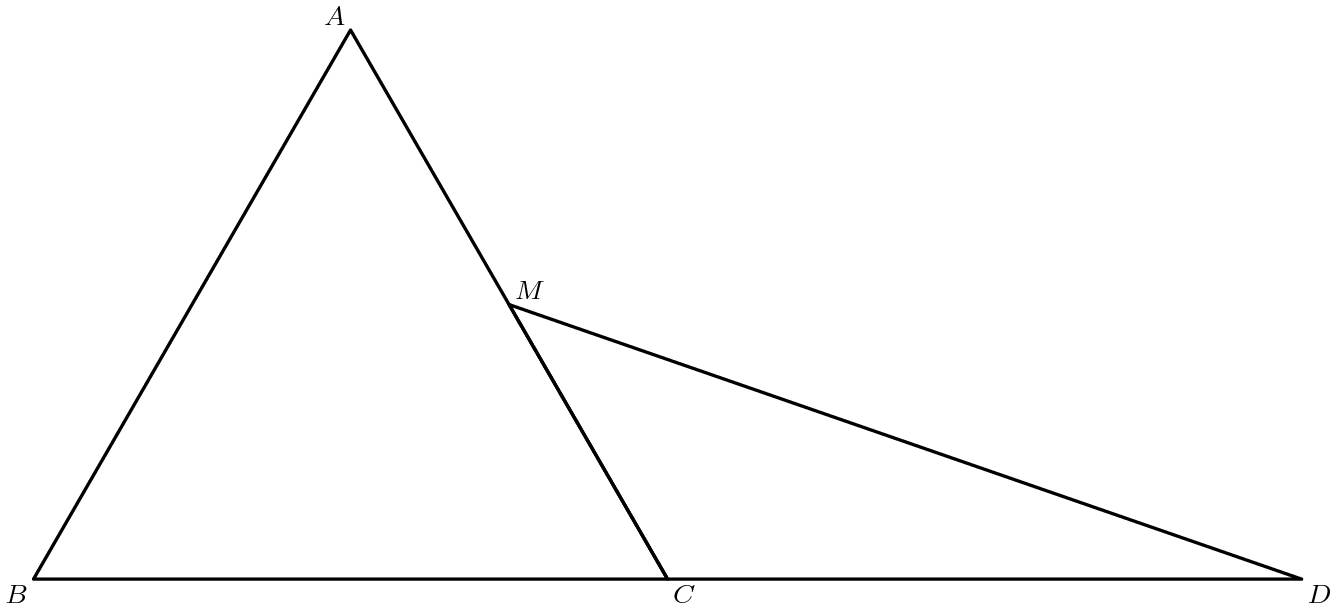
Equilateral has side length , is the midpoint of , and is the midpoint of . What is the area of ?
- A)
- B)
- C)
- D)
- E)
- 6.2005 AMC 10B #10
In , we have and . Suppose that is a point on line such that lies between and and . What is ?
- A)
- B)
- C)
- D)
- E)
- 7.2004 AMC 10A #9
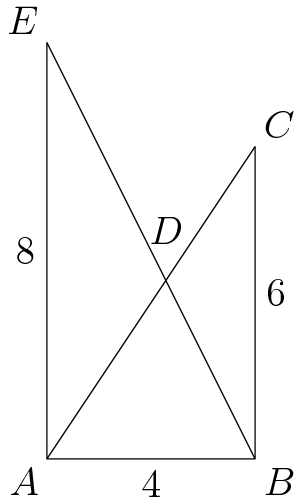
In the overlapping triangles and sharing common side , and are right angles, , , , and and intersect at . What is the difference between the areas of and ?
- A)
- B)
- C)
- D)
- E)
- 8.2003 AMC 10A #7
How many non-congruent triangles with perimeter have integer side lengths?
- A)
- B)
- C)
- D)
- E)
- 9.2002 AMC 10A #13
Given a triangle with side lengths 15, 20, and 25, find the triangle's shortest altitude.
- A)
- B)
- C)
- D)
- E)
- 10.2000 AMC 10 #10
The sides of a triangle with positive area have lengths , , and . The sides of a second triangle with positive area have lengths , , and . What is the smallest positive number that is not a possible value of ?
- A)
- B)
- C)
- D)
- E)
- 11.2000 AMC 10 #5
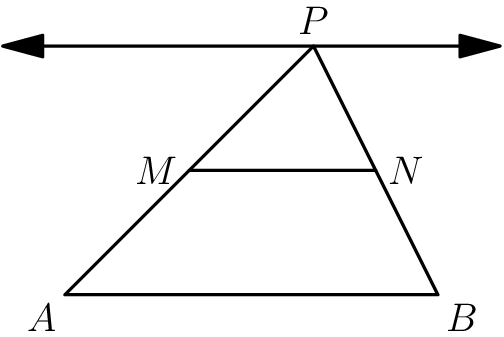
Points and are the midpoints of sides and of . As moves along a line that is parallel to side , how many of the four quantities listed below change?
(a) the length of the segment
(b) the perimeter of
(c) the area of
(d) the area of trapezoid
- A)
- B)
- C)
- D)
- E)
- 12.2000 AMC 10 #7
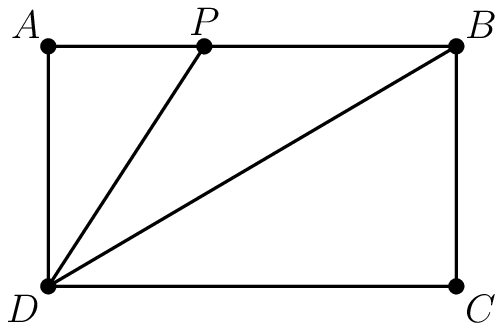
In rectangle , , is on , and and trisect . What is the perimeter of ?
- A)
- B)
- C)
- D)
- E)
- 13.2023 AMC 10A #11
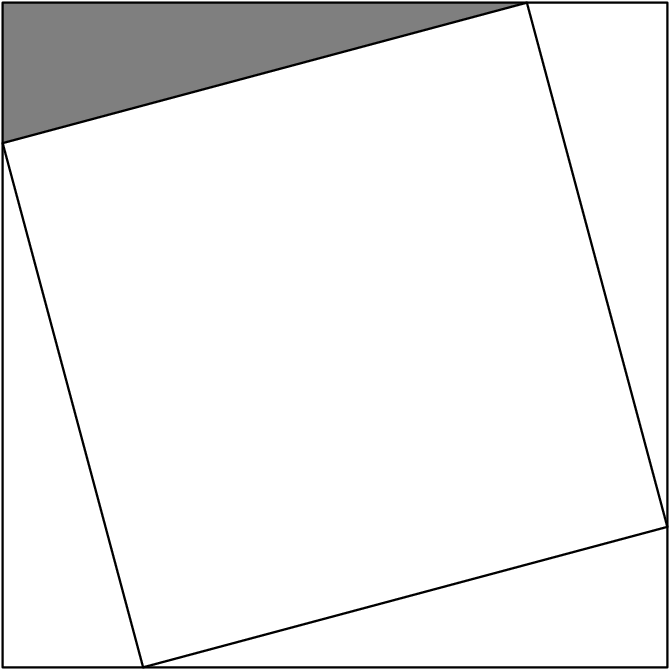
A square of area is inscribed in a square of area , creating four congruent triangles, as shown below. What is the ratio of the shorter leg to the longer leg in the shaded right triangle?
- A)
- B)
- C)
- D)
- E)
- 14.2023 AMC 10A #17
Let be a rectangle with and . Point and lie on and respectively so that all sides of and have integer lengths. What is the perimeter of ?
- A)
- B)
- C)
- D)
- E)
- 15.2020 AMC 10B #8
Points and lie in a plane with . How many locations for point in this plane are there such that the triangle with vertices , , and is a right triangle with area square units?
- A)
- B)
- C)
- D)
- E)
- 16.2019 AMC 10B #15
Right triangles and have areas 1 and 2, respectively. A side of is congruent to a side of , and a different side of is congruent to a different side of . What is the square of the product of the other (third) sides of and ?
- A)
- B)
- C)
- D)
- E)
- 17.2018 AMC 10A #16
Right triangle has leg lengths and . Including and , how many line segments with integer length can be drawn from vertex to a point on hypotenuse ?
- A)
- B)
- C)
- D)
- E)
- 18.2014 AMC 10B #15
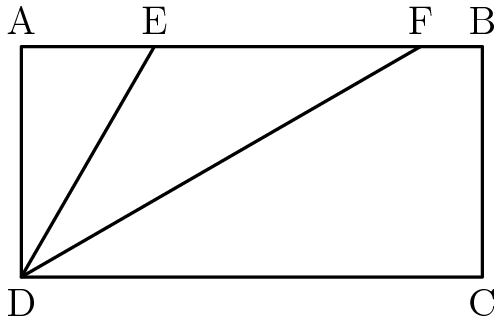
In rectangle , and points and lie on so that and trisect as shown. What is the ratio of the area of to the area of rectangle ?
- A)
- B)
- C)
- D)
- E)
- 19.2014 AMC 10B #13
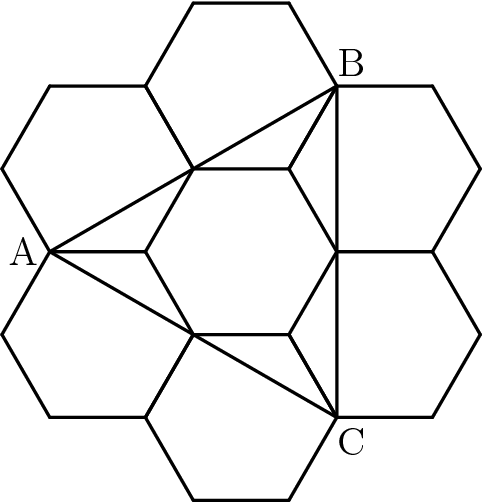
Six regular hexagons surround a regular hexagon of side length as shown. What is the area of ?
- A)
- B)
- C)
- D)
- E)
- 20.2012 AMC 10A #15
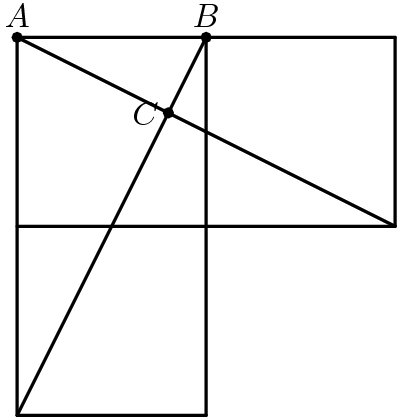
Three unit squares and two line segments connecting two pairs of vertices are shown. What is the area of ?
- A)
- B)
- C)
- D)
- E)
Answers
| # | Answer | The idea it turns on |
|---|---|---|
| 1 | D | A 4 to 3 screen with a 27-inch diagonal is a 3-4-5 triangle scaled up: 21.6 wide and 16.2 tall. The movie is 10.8 tall, leaving 5.4 for two strips. |
| 2 | A | The base BC is fixed, so area 1 fixes the height. Points at that distance from line BC form two parallel lines, one on each side. |
| 3 | A | With sides x, 3x and 15, the two shorter sides must add to more than 3x. So x + 15 > 3x, and x is at most 7. |
| 4 | C | The corner triangle on side AB has legs 1 and (1 + inner side). The Pythagorean theorem with 50 gives the inner side 6. |
| 5 | C | Use CD = 2 as the base. M is halfway up side AC, so its height above line BD is half the triangle's height, or half of root 3. |
| 6 | A | Drop a perpendicular from C; it lands at the middle of AB. Its length squared is 48, so its foot is 4 from D, and BD = 4 - 1. |
| 7 | B | Both big right triangles contain the same piece, triangle ABD. Take it away from each and the difference stays the same: 16 - 12 = 4. |
| 8 | B | The longest side must be shorter than the other two together, so it is less than half of 7. That makes it 3, and the others add to 4. |
| 9 | B | 15-20-25 is 3-4-5 made five times bigger, so it is a right triangle with area 150. The shortest height goes to the longest side: 300 divided by 25 is 12. |
| 10 | D | The third side must be strictly between 2 and 10. Two numbers in that range can differ by anything less than 8, but never by exactly 8. |
| 11 | B | P moves along a line parallel to AB, so its height above AB never changes. Since MN is always half of AB, only the perimeter can change. |
| 12 | B | Cutting the right angle at D into three parts gives 30 degree angles, so every triangle here is a 30-60-90 triangle and AD = 1 fixes all the other lengths. |
| 13 | C | The legs add to the big square's side and their squares add to 2. That gives their product, and sum plus product gives the ratio. |
| 14 | A | Go around the rectangle one right triangle at a time. Leg 30 forces 16-30-34; then leg 12 allows 5, 9 or 16, and only 9 makes the last triangle work. |
| 15 | D | The area forces R to be exactly 3 units from line PQ. Then check each place the right angle could be: at P, at Q, or at R. |
| 16 | A | The shared sides cannot play the same roles in both triangles, so the small triangle's hypotenuse must be a leg of the big one. That doubles a leg. |
| 17 | D | Sliding along the hypotenuse, the segment shrinks from 20 to the height (about 14.5), then grows to 21, hitting each whole number once per side. |
| 18 | A | Splitting the right angle at D into three equal parts gives 30 and 60 degree angles, so the 30-60-90 triangles fix where E and F land. |
| 19 | B | Measure from the center of the middle hexagon: each corner of triangle ABC is 2 units away, and the three corners are evenly spaced, so the triangle is equilateral. |
| 20 | B | AB has length 1, so only the height of C below AB matters. One segment drops 1 per 2 across, the other 2 per 1 across; they meet 2/5 down. |
Problems © Mathematical Association of America (MAA), American Mathematics Competitions. Reproduced for non-commercial educational use. The topic note, tags and key insights are original to this site.