Triangles: Area & Pythagorean
Triangle area, Pythagorean theorem, special right triangles, triangle inequality
What you need to know
- Area. Area , with the height to base . With two sides , and the angle between them, area . An equilateral triangle with side has area . Example: sides and with a angle between them give area .
- Pythagorean Theorem. In a right triangle with legs , and hypotenuse , . The converse is true too: if , the angle across from is a right angle. Know the triples --, --, --, --, and their multiples, such as --.
- Special right triangles. A -- triangle has sides in the ratio . A -- triangle has sides , with the short leg across from . Example: a -- triangle with hypotenuse has legs and .
- Triangle Inequality. Any two sides add up to more than the third: , strictly. Example: , , is not a triangle, since .
- Acute, right, or obtuse? Let be the longest side. If , the triangle is acute; if equal, right; if less, obtuse. Example: , , is obtuse, since .
- Heron's Formula. Area , where is the semiperimeter (half the perimeter). Example: sides , , give and area .
How AMC 10 tests it
- Problems 3–10: a figure of squares and right triangles; find a length or area by dropping one perpendicular.
- "How many integers make a triangle with sides , , ?" or "...an obtuse triangle?"
- Mid-paper: two sides and an altitude, or a or angle. The altitude splits the triangle into two right triangles that share a leg.
- Shaded regions from overlapping triangles, or a triangle cut from a rectangle, found by subtraction.
Standard approaches
- Drop an altitude and write a Pythagorean equation on each side of it; subtracting them removes the altitude.
- Look for special right triangles or Pythagorean triples before working with square roots.
- Find the area in two ways (two base–height pairs) to get an unknown height. Example: the -- triangle has area , so the height to the hypotenuse has , and .
- For shaded regions, subtract simple pieces from a rectangle or triangle around the region.
Worked example
In triangle , , , and the altitude from to line has length . What is the sum of all possible values of ?
(A) (B) (C) (D) (E)
Solution. Let be the foot of the altitude, so .
Step 1. Right triangle has hypotenuse and leg , so it is a -- triangle and .
Step 2. Right triangle has hypotenuse and leg , so it is a -- triangle and .
Step 3. If lies between and , then . If lies outside segment , beyond (so angle is obtuse), then . Both triangles exist, so both values count.
Step 4. The sum is .
The answer is .
Pitfalls
- Forgetting the obtuse picture, where the foot of an altitude falls outside the triangle. In the example, that picture gives .
- Mixing up the legs of a -- triangle. The longer leg is across from and is times the shorter leg.
- Allowing (a flat triangle) when counting integer side lengths. Example: with sides and , the third side can be , , , , or , but not or .
Traps that recur
- Counting 50 or 51 values per coordinate (including boundary points, which are not interior), or forgetting to subtract the points that are also 60-ray partitional. (2011 AMC 10A #25)
- Reading 'the altitude to side AB' as a segment drawn from B, which would put P at B; the altitude meant is the one from the opposite vertex C, and its foot H is what fixes BP. (2025 AMC 10A #23)
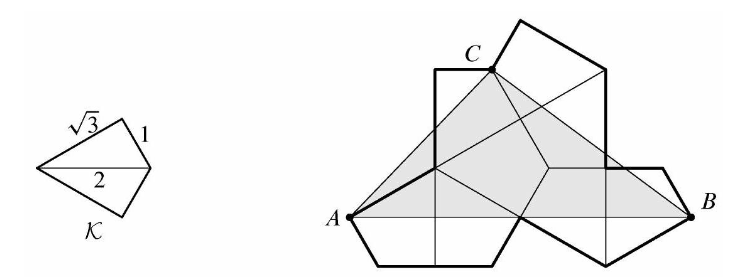
- Misreading the kite: its angles are 60°, 90°, 120°, 90° (the two √3 sides meet at 60°, the two unit sides at 120°), and its long diagonal is 2. (2024 AMC 10A #22)
- Guessing 1:1 because AC = CD and DE = EB look symmetric, or setting AD:DB = AC:DE = 4:3 as if it were an angle bisector. (2019 AMC 10B #16)
- 1.2017 AMC 10A #7
Jerry and Silvia wanted to go from the southwest corner of a square field to the northeast corner. Jerry walked due east and then due north to reach the goal, but Silvia headed northeast and reached the goal walking in a straight line. Which of the following is closest to how much shorter Silvia's trip was, compared to Jerry's trip?
- A)
- B)
- C)
- D)
- E)
- 2.2013 AMC 10A #3
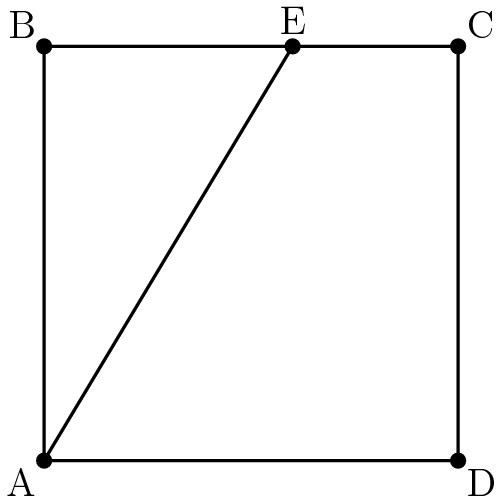
Square has side length . Point is on , and the area of is . What is ?
- A)
- B)
- C)
- D)
- E)
- 3.2005 AMC 10A #4
A rectangle with a diagonal of length is twice as long as it is wide. What is the area of the rectangle?
- A)
- B)
- C)
- D)
- E)
- 4.2004 AMC 10B #8
Minneapolis-St. Paul International Airport is miles southwest of downtown St. Paul and miles southeast of downtown Minneapolis. Which of the following is closest to the number of miles between downtown St. Paul and downtown Minneapolis?
- A)
- B)
- C)
- D)
- E)
- 5.2003 AMC 10B #6
Many television screens are rectangles that are measured by the length of their diagonals. The ratio of the horizontal length to the height in a standard television screen is . The horizontal length of a " -inch" television screen is closest, in inches, to which of the following?
- A)
- B)
- C)
- D)
- E)
- 6.2025 AMC 10A #3
How many isosceles triangles are there with positive area whose side lengths are all positive integers and whose longest side has length ?
- A)
- B)
- C)
- D)
- E)
- 7.2022 AMC 10A #5
Square has side length . Points , , , and each lie on a side of such that is an equilateral convex hexagon with side length . What is ?
- A)
- B)
- C)
- D)
- E)
- 8.2017 AMC 10A #10
Joy has thin rods, one each of every integer length from cm through cm. She places the rods with lengths cm, cm, and cm on a table. She then wants to choose a fourth rod that she can put with these three to form a quadrilateral with positive area. How many of the remaining rods can she choose as the fourth rod?
- A)
- B)
- C)
- D)
- E)
- 9.2015 AMC 10A #11
The ratio of the length to the width of a rectangle is : . If the rectangle has diagonal of length , then the area may be expressed as for some constant . What is ?
- A)
- B)
- C)
- D)
- E)
- 10.2015 AMC 10B #13
The line forms a triangle with the coordinate axes. What is the sum of the lengths of the altitudes of this triangle?
- A)
- B)
- C)
- D)
- E)
- 11.2014 AMC 10A #9
The two legs of a right triangle, which are altitudes, have lengths and . How long is the third altitude of the triangle?
- A)
- B)
- C)
- D)
- E)
- 12.2013 AMC 10B #7
Six points are equally spaced around a circle of radius 1. Three of these points are the vertices of a triangle that is neither equilateral nor isosceles. What is the area of this triangle?
- A)
- B)
- C)
- D)
- E)
- 13.2013 AMC 10A #15
Two sides of a triangle have lengths and . The length of the altitude to the third side is the average of the lengths of the altitudes to the two given sides. How long is the third side?
- A)
- B)
- C)
- D)
- E)
- 14.2012 AMC 10B #12
Point is due east of point . Point is due north of point . The distance between points and is , and . Point is meters due north of point . The distance is between which two integers?
- A)
- B)
- C)
- D)
- E)
- 15.2011 AMC 10A #11
Square has one vertex on each side of square . Point is on with . What is the ratio of the area of to the area of ?
{{}}
- A)
- B)
- C)
- D)
- E)
- 16.2010 AMC 10B #7
A triangle has side lengths , , and . A rectangle has width and area equal to the area of the triangle. What is the perimeter of this rectangle?
- A)
- B)
- C)
- D)
- E)
- 17.2010 AMC 10A #7
Crystal has a running course marked out for her daily run. She begins this run by heading due north for one mile. She then runs northeast for one mile, then southeast for one mile. The last portion of her run takes her on a straight line back to where she started. How far, in miles, is this last portion of her run?
- A)
- B)
- C)
- D)
- E)
- 18.2009 AMC 10B #12
Distinct points , , , and lie on a line, with . Points and lie on a second line, parallel to the first, with . A triangle with positive area has three of the six points as its vertices. How many possible values are there for the area of the triangle?
- A)
- B)
- C)
- D)
- E)
- 19.2009 AMC 10B #10
A flagpole is originally meters tall. A hurricane snaps the flagpole at a point meters above the ground so that the upper part, still attached to the stump, touches the ground meter away from the base. What is ?
- A)
- B)
- C)
- D)
- E)
- 20.2009 AMC 10A #12
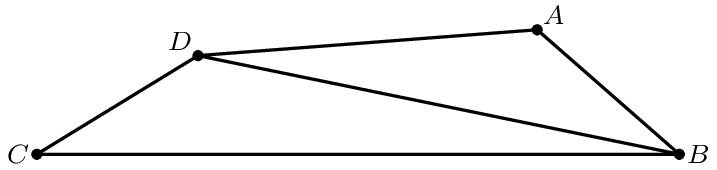
In quadrilateral , , , , , and is an integer. What is ?
- A)
- B)
- C)
- D)
- E)
- 21.2008 AMC 10A #14
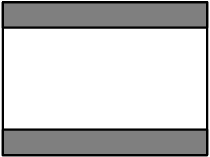
Older television screens have an aspect ratio of . That is, the ratio of the width to the height is . The aspect ratio of many movies is not , so they are sometimes shown on a television screen by "letterboxing" - darkening strips of equal height at the top and bottom of the screen, as shown. Suppose a movie has an aspect ratio of and is shown on an older television screen with a -inch diagonal. What is the height, in inches, of each darkened strip?
- A)
- B)
- C)
- D)
- E)
- 22.2007 AMC 10B #10
Two points and are in a plane. Let be the set of all points in the plane for which has area Which of the following describes
- A)
- B)
- C)
- D)
- E)
- 23.2006 AMC 10B #10
In a triangle with integer side lengths, one side is three times as long as a second side, and the length of the third side is . What is the greatest possible perimeter of the triangle?
- A)
- B)
- C)
- D)
- E)
- 24.2005 AMC 10A #8
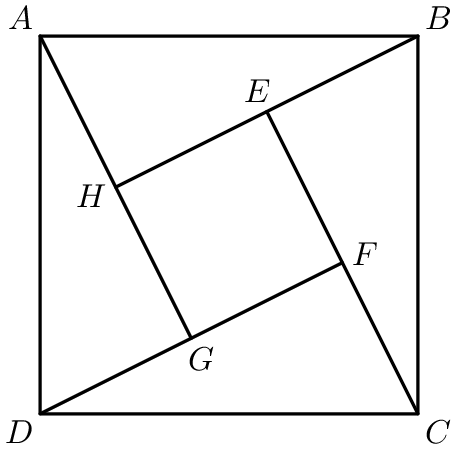
In the figure, the length of side of square is , is between and , and . What is the area of the inner square ?
- A)
- B)
- C)
- D)
- E)
- 25.2005 AMC 10B #14
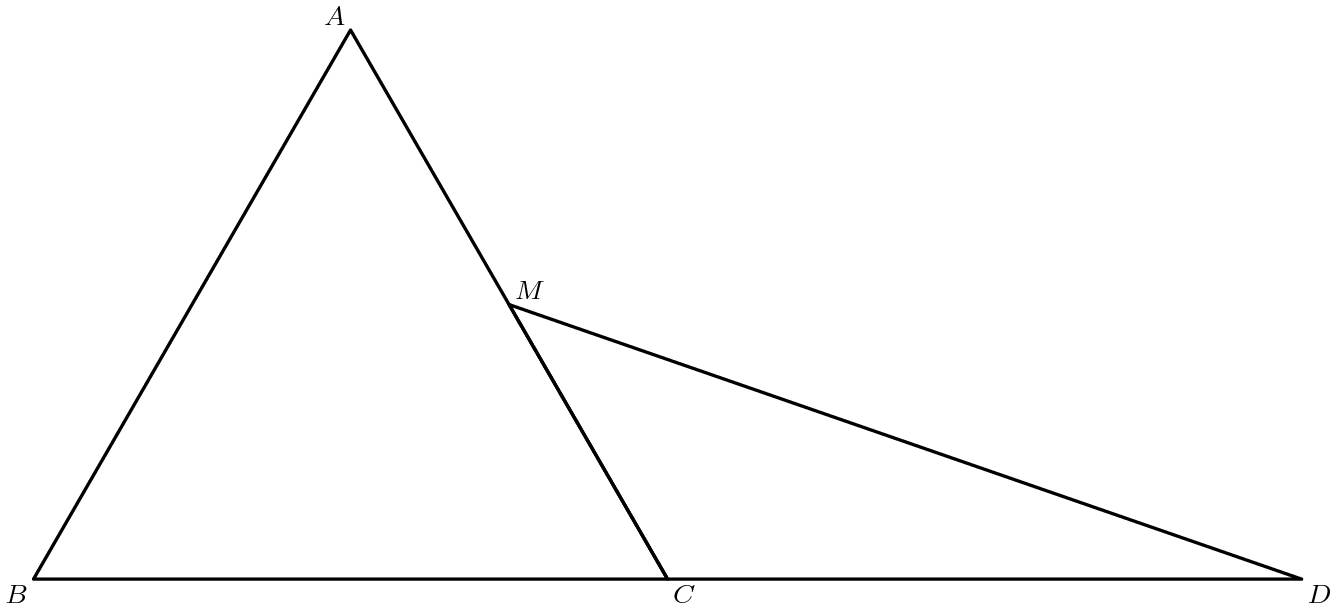
Equilateral has side length , is the midpoint of , and is the midpoint of . What is the area of ?
- A)
- B)
- C)
- D)
- E)
- 26.2005 AMC 10B #10
In , we have and . Suppose that is a point on line such that lies between and and . What is ?
- A)
- B)
- C)
- D)
- E)
- 27.2004 AMC 10A #9
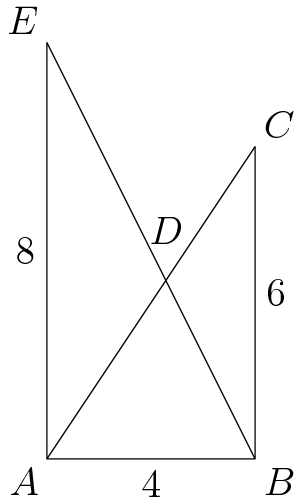
In the overlapping triangles and sharing common side , and are right angles, , , , and and intersect at . What is the difference between the areas of and ?
- A)
- B)
- C)
- D)
- E)
- 28.2003 AMC 10A #7
How many non-congruent triangles with perimeter have integer side lengths?
- A)
- B)
- C)
- D)
- E)
- 29.2002 AMC 10A #13
Given a triangle with side lengths 15, 20, and 25, find the triangle's shortest altitude.
- A)
- B)
- C)
- D)
- E)
- 30.2000 AMC 10 #10
The sides of a triangle with positive area have lengths , , and . The sides of a second triangle with positive area have lengths , , and . What is the smallest positive number that is not a possible value of ?
- A)
- B)
- C)
- D)
- E)
- 31.2000 AMC 10 #5
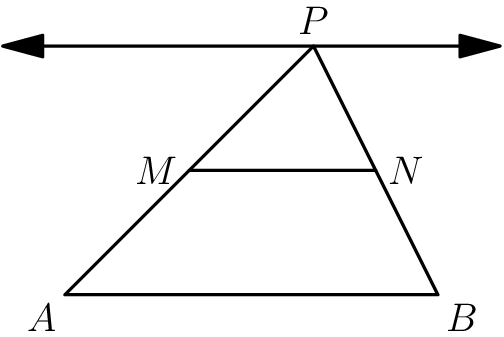
Points and are the midpoints of sides and of . As moves along a line that is parallel to side , how many of the four quantities listed below change?
(a) the length of the segment
(b) the perimeter of
(c) the area of
(d) the area of trapezoid
- A)
- B)
- C)
- D)
- E)
- 32.2000 AMC 10 #7
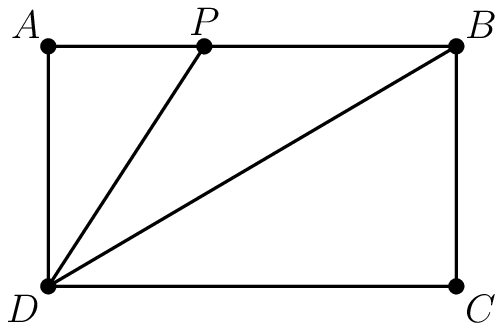
In rectangle , , is on , and and trisect . What is the perimeter of ?
- A)
- B)
- C)
- D)
- E)
- 33.2023 AMC 10A #11
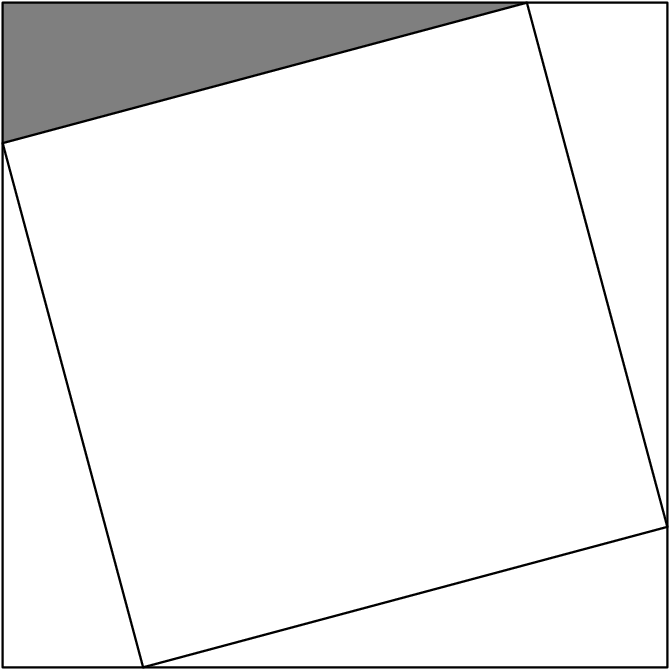
A square of area is inscribed in a square of area , creating four congruent triangles, as shown below. What is the ratio of the shorter leg to the longer leg in the shaded right triangle?
- A)
- B)
- C)
- D)
- E)
- 34.2023 AMC 10A #17
Let be a rectangle with and . Point and lie on and respectively so that all sides of and have integer lengths. What is the perimeter of ?
- A)
- B)
- C)
- D)
- E)
- 35.2020 AMC 10B #8
Points and lie in a plane with . How many locations for point in this plane are there such that the triangle with vertices , , and is a right triangle with area square units?
- A)
- B)
- C)
- D)
- E)
- 36.2019 AMC 10B #15
Right triangles and have areas 1 and 2, respectively. A side of is congruent to a side of , and a different side of is congruent to a different side of . What is the square of the product of the other (third) sides of and ?
- A)
- B)
- C)
- D)
- E)
- 37.2018 AMC 10A #16
Right triangle has leg lengths and . Including and , how many line segments with integer length can be drawn from vertex to a point on hypotenuse ?
- A)
- B)
- C)
- D)
- E)
- 38.2014 AMC 10B #15
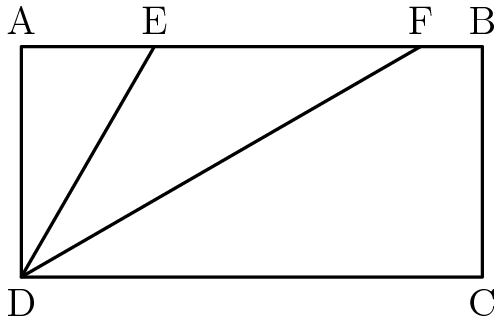
In rectangle , and points and lie on so that and trisect as shown. What is the ratio of the area of to the area of rectangle ?
- A)
- B)
- C)
- D)
- E)
- 39.2014 AMC 10B #13
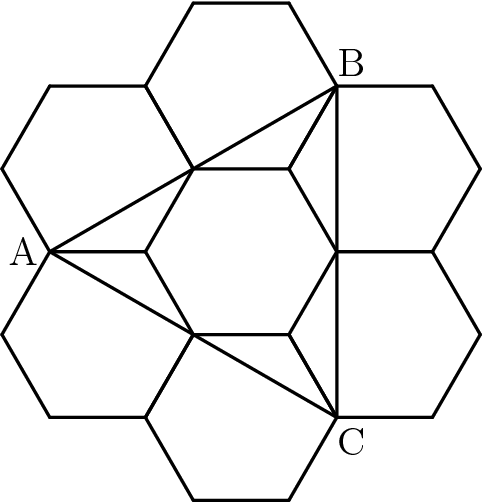
Six regular hexagons surround a regular hexagon of side length as shown. What is the area of ?
- A)
- B)
- C)
- D)
- E)
- 40.2012 AMC 10A #15
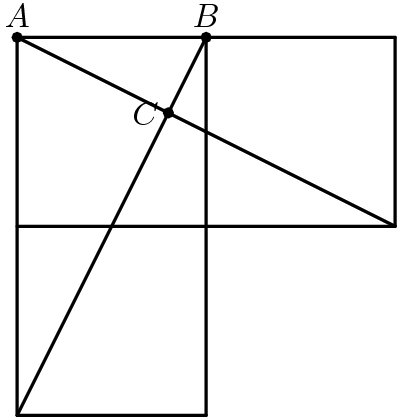
Three unit squares and two line segments connecting two pairs of vertices are shown. What is the area of ?
- A)
- B)
- C)
- D)
- E)
- 41.2012 AMC 10B #21
Four distinct points are arranged on a plane so that the segments connecting them have lengths , , , , , and . What is the ratio of to ?
- A)
- B)
- C)
- D)
- E)
- 42.2011 AMC 10B #18
Rectangle has and . Point is chosen on side so that . What is the degree measure of ?
- A)
- B)
- C)
- D)
- E)
- 43.2008 AMC 10A #18
A right triangle has perimeter 32 and area 20. What is the length of its hypotenuse?
- A)
- B)
- C)
- D)
- E)
- 44.2007 AMC 10B #17
Point is inside equilateral . Points , , and are the feet of the perpendiculars from to , , and , respectively. Given that , , and , what is ?
- A)
- B)
- C)
- D)
- E)
- 45.2005 AMC 10A #19
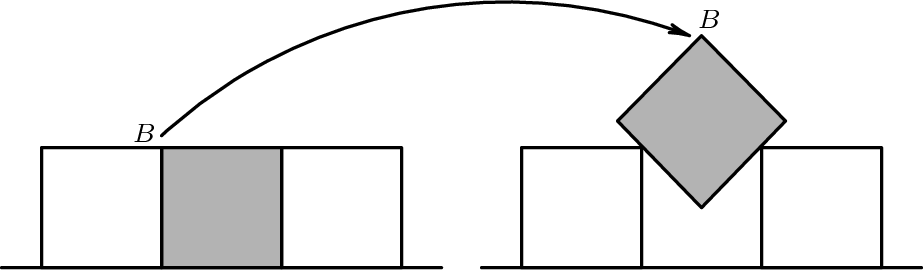
Three one-inch squares are placed with their bases on a line. The center square is lifted out and rotated , as shown. Then it is centered and lowered into its original location until it touches both of the adjoining squares. How many inches is the point from the line on which the bases of the original squares were placed?
- A)
- B)
- C)
- D)
- E)
- 46.2004 AMC 10B #18
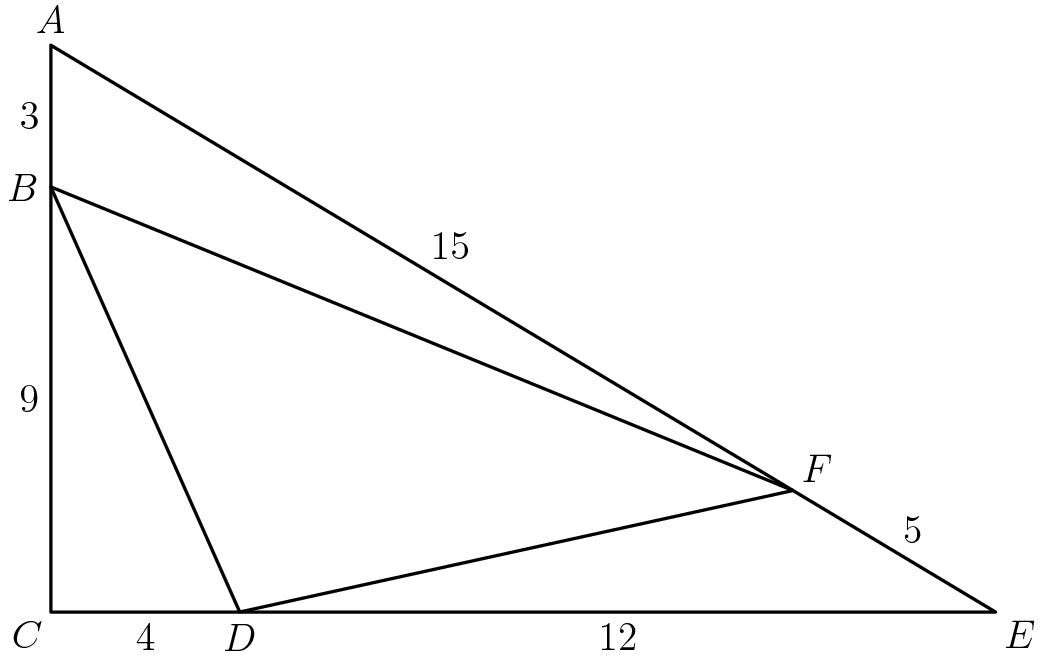
In the right triangle , we have , , and . Points , , and are located on , , and , respectively, so that , , and . What is the ratio of the area of to that of ?
- A)
- B)
- C)
- D)
- E)
- 47.2025 AMC 10A #23
Triangle has side lengths , , and . The bisector of and the altitude to side intersect at point What is ?
- A)
- B)
- C)
- D)
- E)
- 48.2024 AMC 10A #22
Let be the kite formed by joining two right triangles with legs and along a common hypotenuse. Eight copies of are used to form the polygon shown below. What is the area of triangle ?
- A)
- B)
- C)
- D)
- E)
- 49.2019 AMC 10B #16
In with a right angle at point lies in the interior of and point lies in the interior of so that and the ratio What is the ratio
- A)
- B)
- C)
- D)
- E)
- 50.2018 AMC 10A #23
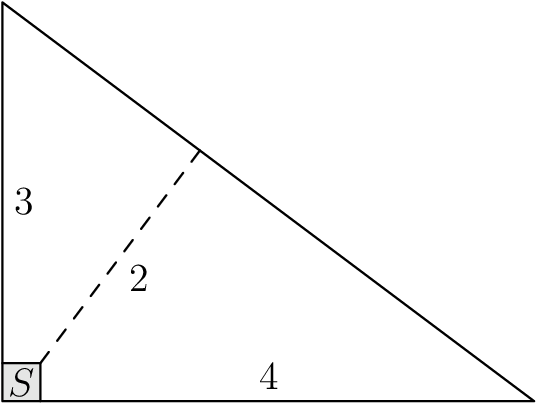
Farmer Pythagoras has a field in the shape of a right triangle. The right triangle's legs have lengths and units. In the corner where those sides meet at a right angle, he leaves a small unplanted square so that from the air it looks like the right angle symbol. The rest of the field is planted. The shortest distance from to the hypotenuse is units. What fraction of the field is planted?
- A)
- B)
- C)
- D)
- E)
- 51.2018 AMC 10B #17
In rectangle , and . Points and lie on , points and lie on , points and lie on , and points and lie on so that and the convex octagon is equilateral. The length of a side of this octagon can be expressed in the form , where , , and are integers and is not divisible by the square of any prime. What is ?
- A)
- B)
- C)
- D)
- E)
- 52.2017 AMC 10B #19
Let be an equilateral triangle. Extend side beyond to a point so that . Similarly, extend side beyond to a point so that , and extend side beyond to a point so that . What is the ratio of the area of to the area of ?
- A)
- B)
- C)
- D)
- E)
- 53.2015 AMC 10A #19
The isosceles right triangle has right angle at and area . The rays trisecting intersect at and . What is the area of ?
- A)
- B)
- C)
- D)
- E)
- 54.2014 AMC 10A #22
In rectangle , and . Let be a point on such that . What is ?
- A)
- B)
- C)
- D)
- E)
- 55.2005 AMC 10A #25
In we have , , and . Points and are on and respectively, with and . What is the ratio of the area of triangle to the area of the quadrilateral ?
- A)
- B)
- C)
- D)
- E)
- 56.2004 AMC 10A #20
Points and are located on square so that is equilateral. What is the ratio of the area of to that of ?
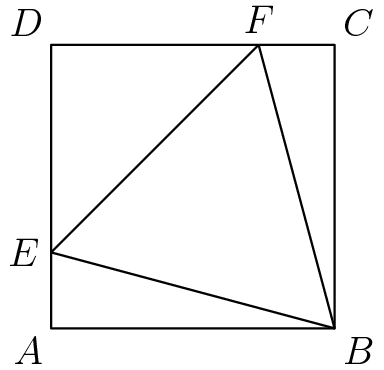
- A)
- B)
- C)
- D)
- E)
- 57.2002 AMC 10A #23
Points and lie on a line, in that order, with and . Point is not on the line, and . The perimeter of is twice the perimeter of . Find .
- A)
- B)
- C)
- D)
- E)
- 58.2002 AMC 10B #22
Let be a right-angled triangle with . Let and be the midpoints of legs and , respectively. Given that and , find .
- A)
- B)
- C)
- D)
- E)
- 59.2001 AMC 10 #24
In trapezoid , and are perpendicular to , with , , and . What is ?
- A)
- B)
- C)
- D)
- E)
- 60.2011 AMC 10A #25
Let be a square region and an integer. A point in the interior of is called partitional if there are rays emanating from that divide into triangles of equal area. How many points are 100-ray partitional but not 60-ray partitional?
- A)
- B)
- C)
- D)
- E)
Answers
| # | Answer | The idea it turns on |
|---|---|---|
| 1 | A | Pick an easy side length, 1. Jerry walks 2, Silvia walks the diagonal, about 1.41. She saves about 0.59 out of Jerry's 2, which is about 30%. |
| 2 | E | The corner of the square at B is a right angle, so AB and BE are the base and height of the triangle; half of 10 times BE equals 40. |
| 3 | B | With width w and length 2w, the Pythagorean theorem gives x squared = 5 w squared. The area 2 w squared is two fifths of that. |
| 4 | A | Seen from the airport, one city is northeast and the other northwest. That is a right angle, so use the Pythagorean theorem with legs 8 and 10. |
| 5 | D | A screen 4 wide and 3 tall has a diagonal of 5, so the width is always 4/5 of the diagonal: 4/5 of 27 is 21.6. |
| 6 | D | Split by which sides are equal. Two sides of 2025 works with any third side up to 2025. Two equal shorter sides must add to more than 2025. |
| 7 | C | The corner triangle at B has two equal legs, 1 - s, so its slanted side is (1 - s) times the square root of 2, which must equal s. |
| 8 | B | The longest side must be shorter than the other three combined. That allows lengths 6 through 24, minus the rods 7 and 15 already used. |
| 9 | C | Try the 3-by-4 rectangle: its diagonal is 5 and its area is 12. Area divided by diagonal squared is 12/25, and that stays the same at every size. |
| 10 | E | The triangle is a right triangle with sides 5, 12, 13. The two short sides are already altitudes, and the third altitude comes from the area: 60/13. |
| 11 | C | The missing altitude is the one drawn to the longest side. Find the area using the two legs, then use that same area with the longest side as the base. |
| 12 | B | The triangle with three different sides uses two neighbors and the point opposite one of them. Its long side is a diameter, so it has a right angle. |
| 13 | D | Every altitude equals twice the area divided by its side. Putting that into the averaging rule makes the area cancel and leaves an equation for the third side. |
| 14 | B | The 45-degree angle makes triangle ABC a right triangle with two equal legs of 10. Then AD is the long side of a right triangle with legs 10 and 30. |
| 15 | B | Make the side 8, so AE = 7 and EB = 1. Each corner triangle has legs 7 and 1; the inner square has area 49 + 1 = 50. |
| 16 | D | Cut the 10-10-12 triangle down the middle. Each half is a right triangle with sides 6, 8, 10, so the height is 8 and the area is 48. |
| 17 | C | The northeast mile and the southeast mile cancel each other's north-south part and together move her the square root of 2 miles east. |
| 18 | A | Every triangle has two corners on one line and one on the other, so its height never changes. Only the base length matters: 1, 2 or 3. |
| 19 | E | The stump, the ground, and the broken top form a right triangle with legs x and 1 and long side 5 - x. When you expand, the x-squared terms cancel. |
| 20 | C | In triangle BCD, BD + 5 must be more than 17, so BD > 12. In triangle ABD, BD < 5 + 9 = 14. So BD = 13. |
| 21 | D | A 4 to 3 screen with a 27-inch diagonal is a 3-4-5 triangle scaled up: 21.6 wide and 16.2 tall. The movie is 10.8 tall, leaving 5.4 for two strips. |
| 22 | A | The base BC is fixed, so area 1 fixes the height. Points at that distance from line BC form two parallel lines, one on each side. |
| 23 | A | With sides x, 3x and 15, the two shorter sides must add to more than 3x. So x + 15 > 3x, and x is at most 7. |
| 24 | C | The corner triangle on side AB has legs 1 and (1 + inner side). The Pythagorean theorem with 50 gives the inner side 6. |
| 25 | C | Use CD = 2 as the base. M is halfway up side AC, so its height above line BD is half the triangle's height, or half of root 3. |
| 26 | A | Drop a perpendicular from C; it lands at the middle of AB. Its length squared is 48, so its foot is 4 from D, and BD = 4 - 1. |
| 27 | B | Both big right triangles contain the same piece, triangle ABD. Take it away from each and the difference stays the same: 16 - 12 = 4. |
| 28 | B | The longest side must be shorter than the other two together, so it is less than half of 7. That makes it 3, and the others add to 4. |
| 29 | B | 15-20-25 is 3-4-5 made five times bigger, so it is a right triangle with area 150. The shortest height goes to the longest side: 300 divided by 25 is 12. |
| 30 | D | The third side must be strictly between 2 and 10. Two numbers in that range can differ by anything less than 8, but never by exactly 8. |
| 31 | B | P moves along a line parallel to AB, so its height above AB never changes. Since MN is always half of AB, only the perimeter can change. |
| 32 | B | Cutting the right angle at D into three parts gives 30 degree angles, so every triangle here is a 30-60-90 triangle and AD = 1 fixes all the other lengths. |
| 33 | C | The legs add to the big square's side and their squares add to 2. That gives their product, and sum plus product gives the ratio. |
| 34 | A | Go around the rectangle one right triangle at a time. Leg 30 forces 16-30-34; then leg 12 allows 5, 9 or 16, and only 9 makes the last triangle work. |
| 35 | D | The area forces R to be exactly 3 units from line PQ. Then check each place the right angle could be: at P, at Q, or at R. |
| 36 | A | The shared sides cannot play the same roles in both triangles, so the small triangle's hypotenuse must be a leg of the big one. That doubles a leg. |
| 37 | D | Sliding along the hypotenuse, the segment shrinks from 20 to the height (about 14.5), then grows to 21, hitting each whole number once per side. |
| 38 | A | Splitting the right angle at D into three equal parts gives 30 and 60 degree angles, so the 30-60-90 triangles fix where E and F land. |
| 39 | B | Measure from the center of the middle hexagon: each corner of triangle ABC is 2 units away, and the three corners are evenly spaced, so the triangle is equilateral. |
| 40 | B | AB has length 1, so only the height of C below AB matters. One segment drops 1 per 2 across, the other 2 per 1 across; they meet 2/5 down. |
| 41 | A | Two points 2a apart, each exactly a from a third point, force that third point to be the midpoint. The fourth point then makes an equilateral triangle. |
| 42 | E | Parallel sides make angle MDC equal angle AMD, so triangle MDC has two equal sides: CM = CD = 6. With CB = 3, angle CMB is 30. |
| 43 | B | Square the sum of the legs: it equals the hypotenuse squared plus 4 times the area. Since that sum is 32 minus the hypotenuse, the squares cancel. |
| 44 | D | Join P to the three corners. The three small triangles fill the big one, and adding their areas shows the triangle's height equals 1 + 2 + 3 = 6. |
| 45 | D | The tilted square rests on its neighbors' inner top corners, at height 1. Its bottom tip is half an inch lower, and B is one diagonal above the tip. |
| 46 | E | Find the middle triangle by cutting off the three corner triangles. Each corner triangle turns out to have area 18, and the big triangle has area 96. |
| 47 | D | Use Pythagoras twice to find where the altitude from C meets AB. The bisector from B then cuts that altitude in the ratio of the sides beside angle B. |
| 48 | B | Every kite corner is 60, 90 or 120 degrees, so all lengths come from 30-60-90 triangles: AB = 3 + 3 and C is 3√3/2 above AB. |
| 49 | A | The isosceles triangles copy the angles at A and B over to D, so angle CDE is a right angle. Then CDE is a 3-4-5 triangle and BC = 8. |
| 50 | D | Join the square's outer corner to the far corners. The pieces are the square, a height-2 triangle on the hypotenuse, and two thin triangles. |
| 51 | B | The octagon is the rectangle with four matching right triangles cut off its corners. Write both legs using the side length, then use the Pythagorean theorem. |
| 52 | E | Cut the big triangle into ABC plus three outside triangles. Each has sides 4s and 3s with a 120-degree angle, so area 12 times ABC. |
| 53 | D | Cut along the mirror line, the height from C. Each half is a right triangle with a 15-degree angle, and tan 15 degrees is 2 minus root 3. |
| 54 | E | Draw a 30-degree line from B; BE cuts that angle in half. The angle bisector rule gives CE, then DE is 10 root 3 and AE is 20. |
| 55 | D | Triangles ADE and ABC share the angle at A, so their areas compare as 19 times 14 against 25 times 42, which is 19 to 75. The rest is 56. |
| 56 | D | With side 1 and AE = CF = t, setting sides BE and EF equal gives (1 - t) squared = 2t, which makes the ratio exactly 2. |
| 57 | D | The line from E down to the middle of BC has length 8, so AE is the long side of a right triangle with legs 8 and AB + 6. |
| 58 | B | Call OM = x and ON = y. The two Pythagorean equations are mirror images; adding them gives x^2 + y^2 = 169, and XY is twice 13. |
| 59 | B | Draw a line from B straight across to CD. That right triangle has legs 7 and CD - AB, long side AB + CD, giving 4(AB)(CD) = 49. |
| 60 | C | The rays must pass through all four corners. That forces both coordinates of the point to be multiples of 2/n, so the question becomes counting grid points. |
Problems © Mathematical Association of America (MAA), American Mathematics Competitions. Reproduced for non-commercial educational use. The topic note, tags and key insights are original to this site.