Triangle Centers & Cevians
Medians, angle bisectors, altitudes, incenter/circumcenter/centroid, Heron, Stewart, angle bisector theorem
What you need to know
In triangle , let , , (each side is named for the corner across from it), and let , the semiperimeter.
- Angle Bisector Theorem. If the bisector of meets at , then . Example: , , give and .
- Incenter. The angle bisectors meet at the incenter , the center of the inscribed circle; . Example: if , then .
- Inradius and circumradius. The inscribed circle has radius . The circle through the three corners has radius . The area usually comes from Heron's Formula. Example: the -- triangle has and area , so and .
- Centroid. The medians (corner to midpoint of the opposite side) meet at the centroid, which divides each median , longer part next to the corner. They cut the triangle into six triangles of equal area. Example: a median of length splits into and .
- Stewart's Theorem. A cevian is a segment from a corner to the opposite side. For cevian of length , with and : . For an angle bisector there is a shortcut: .
- Tangent lengths. The two tangent segments from to the inscribed circle have length ; from , ; from , . Example: , , give and tangent lengths , , .
How AMC 10 tests it
- "A triangle has sides (or ); find the inradius or circumradius." Find the area first.
- An angle bisector meets the opposite side; find a piece of it, or the area of one part (areas are in the ratio ).
- Problems 18–24: a cevian length from Stewart's Theorem or the Law of Cosines, or tangent lengths of the inscribed circle that locate a point of tangency.
Standard approaches
- Find the area (Heron's Formula or a known height), then turn it into or .
- For a bisector, split the opposite side with the Angle Bisector Theorem, then use area ratios or Stewart's Theorem.
- For medians, use the centroid's ratio and the six equal-area triangles.
- Whenever there is an inscribed circle, write the tangent lengths , , on the figure.
Worked example
In triangle , , , and . The bisector of meets at . What is ?
(A) (B) (C) (D) (E)
Solution. Step 1. By the Angle Bisector Theorem, . The pieces add up to , so and .
Step 2. In Stewart's Theorem, , , , , :
Step 3. So , , and .
The answer is .
Pitfalls
- Using the whole perimeter instead of the semiperimeter in or in Heron's Formula. Example: the -- triangle has (not ), so .
- Assuming the bisector, median, and altitude from a corner are the same segment. They are only from the corner between the two equal sides of an isosceles triangle.
- Flipping the centroid's ratio to from the corner. The longer piece touches the corner.
Traps that recur
- Forgetting that triangle ADE has one quarter of the area (midpoints halve both sides) or applying the bisector ratio 5:1 to the areas the wrong way round. (2018 AMC 10A #24)
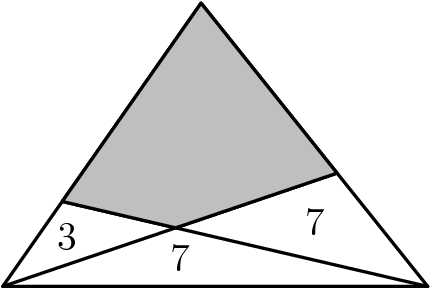
- Assuming the two lines are medians or that the quadrilateral is a parallelogram, or guessing the answer from 3 + 7 + 7 and a total of 34 or 35. (2006 AMC 10B #23)
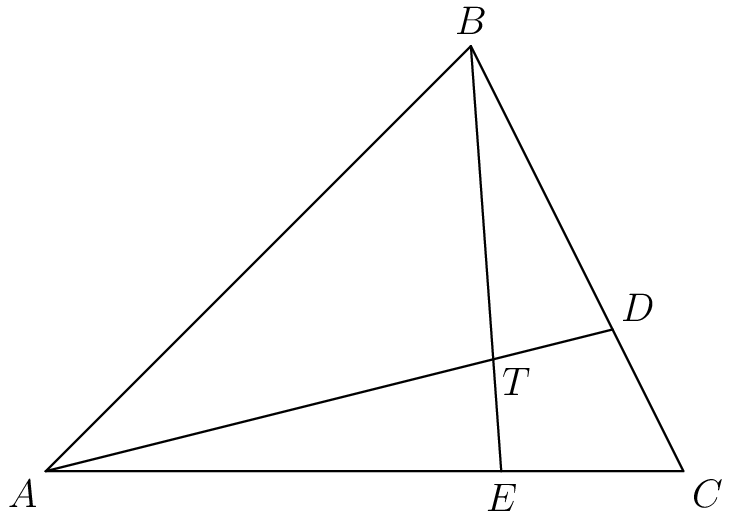
- Using masses from the two cevians on inconsistent scales (T must receive the same total from both), or reading off BD/CD = 4/11 and inverting the requested ratio. (2004 AMC 10B #20)
- Placing the circumcenter somewhere other than the midpoint of the hypotenuse, or computing r as area over perimeter (giving 1) instead of area over semiperimeter. (2004 AMC 10B #22)
- 1.2025 AMC 10B #13
The altitude to the hypotenuse of a right triangle is divided into two segments of lengths by the median to the shortest side of the triangle. What is the ratio ?
- A)
- B)
- C)
- D)
- E)
- 2.2022 AMC 10A #13
Let be a scalene triangle. Point lies on so that bisects The line through perpendicular to intersects the line through parallel to at point Suppose and What is
- A)
- B)
- C)
- D)
- E)
- 3.2020 AMC 10A #12
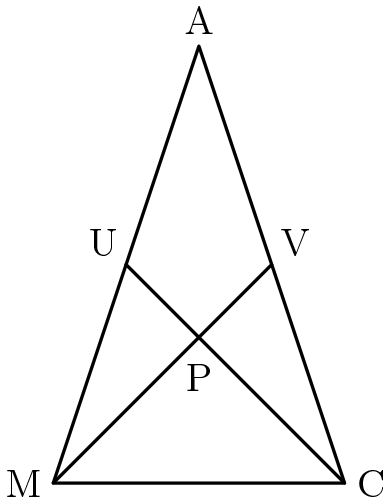
Triangle is isosceles with . Medians and are perpendicular to each other, and . What is the area of
- A)
- B)
- C)
- D)
- E)
- 4.2018 AMC 10B #12
Line segment is a diameter of a circle with . Point , not equal to or , lies on the circle. As point moves around the circle, the centroid (center of mass) of traces out a closed curve missing two points. To the nearest positive integer, what is the area of the region bounded by this curve?
- A)
- B)
- C)
- D)
- E)
- 5.2017 AMC 10B #21
In , , , , and is the midpoint of . What is the sum of the radii of the circles inscribed in and ?
- A)
- B)
- C)
- D)
- E)
- 6.2013 AMC 10B #16
In triangle , medians and intersect at , , , and . What is the area of ?
- A)
- B)
- C)
- D)
- E)
- 7.2010 AMC 10A #16
Nondegenerate has integer side lengths, is an angle bisector, , and . What is the smallest possible value of the perimeter?
- A)
- B)
- C)
- D)
- E)
- 8.2009 AMC 10B #20
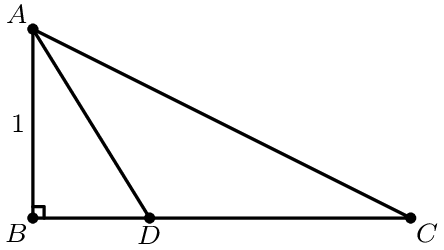
Triangle has a right angle at , , and . The angle bisector of intersects side at . What is ?
- A)
- B)
- C)
- D)
- E)
- 9.2018 AMC 10A #24
Triangle with and has area . Let be the midpoint of , and let be the midpoint of . The angle bisector of intersects and at and , respectively. What is the area of quadrilateral ?
- A)
- B)
- C)
- D)
- E)
- 10.2006 AMC 10B #23
A triangle is partitioned into three triangles and a quadrilateral by drawing two lines from vertices to their opposite sides. The areas of the three triangles are 3, 7, and 7, as shown. What is the area of the shaded quadrilateral?
- A)
- B)
- C)
- D)
- E)
- 11.2004 AMC 10B #22
A triangle with sides of 5, 12, and 13 has both an inscribed and a circumscribed circle. What is the distance between the centers of those circles?
- A)
- B)
- C)
- D)
- E)
- 12.2004 AMC 10B #20
In points and lie on and , respectively. If and intersect at so that and , what is ?
- A)
- B)
- C)
- D)
- E)
Problems © Mathematical Association of America (MAA), American Mathematics Competitions. Reproduced for non-commercial educational use. The topic note, tags and key insights are original to this site.