Transformations & Symmetry
Rotations, reflections, folding, tessellations, symmetric figures
What you need to know
- Moves that keep size and shape. Rotations (turns), reflections (flips), and translations (slides) do not change lengths, angles, or areas. A counterclockwise rotation about the origin sends to . Example: goes to , and both are from the origin.
- Reflecting across a line. If is the reflection of , the line is the perpendicular bisector of : it meets at a right angle, through its midpoint. Example: reflecting across the line gives , and the midpoint is on the line.
- Folding is reflecting across the crease. If a fold puts point on point , the crease is the perpendicular bisector of , and every length on the folded flap stays the same.
- Symmetry of regular polygons. A regular polygon with sides has lines of symmetry, and rotational symmetry of order : it looks the same after each of turns of about its center. Example: a square has lines of symmetry and matches itself after turns of , , , .
How AMC 10 tests it
- Problems 12–18: fold a rectangle or square so a corner lands on an edge, a midpoint, or the opposite corner; find the crease length or a folded segment.
- "Which figures have a line of symmetry, or rotational symmetry?" or counting the colorings of a grid that are symmetric.
- Turn a segment or triangle or about one of its corners; find the area it sweeps out, or its overlap with its image.
Standard approaches
- For folds, call the landing point , mark every length the fold keeps, and write one Pythagorean equation for the unknown crease position.
- When the problem says exactly which point lands on which, use coordinates and the perpendicular bisector.
- For swept areas, split the region into sectors centered at the center of rotation, plus triangles.
Worked example
Square has side length . The paper is folded so that vertex lands on the midpoint of side . The crease meets at and at . What is the length of ?
(A) (B) (C) (D) (E)
Solution. Place the square with , , , , so .
Step 1. The fold sends to , so the crease is the perpendicular bisector of . Every point on it is as far from as from , so and .
Step 2. Let . Then and . Right triangle gives
so and . That puts at .
Step 3. Let , so . Right triangles and give
so and . That puts at .
Step 4. From to is across and up:
The answer is .
Pitfalls
- Treating the crease as segment itself. The crease is the perpendicular bisector of .
- Making up new unknowns for the folded flap instead of reusing the lengths the fold keeps. In the example, is just .
- Writing for a counterclockwise turn. That is the clockwise turn. Example: counterclockwise, goes up to , not down to .
Traps that recur
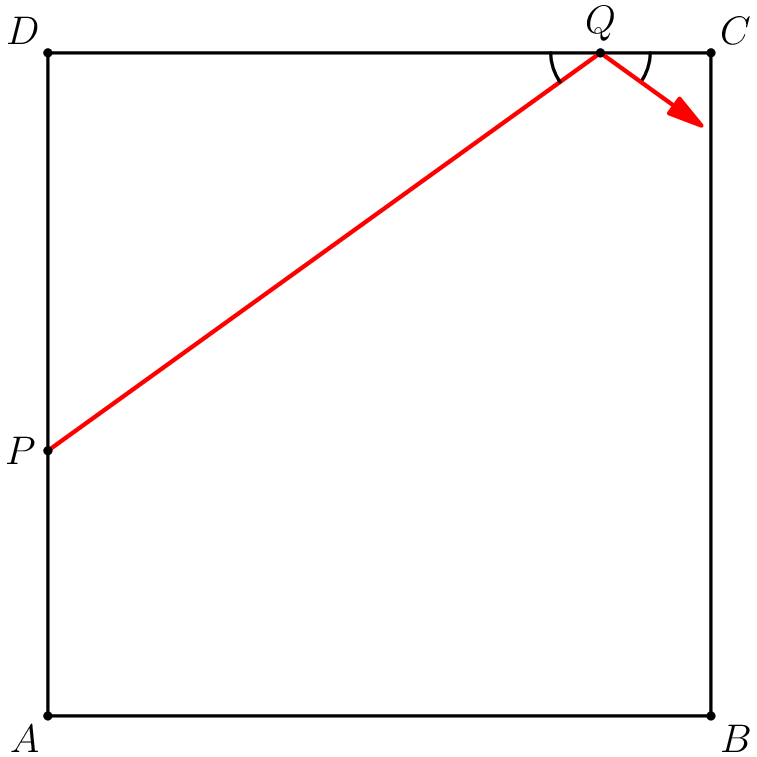
- Tracing the bounces one at a time, losing the thread after four or five reflections and concluding from the absence of an early corner that the path runs forever, which is (E). (2025 AMC 10B #25)
- Checking only even n (which first works at n = 720) and missing that an odd number of transformations, ending on a reflection, already returns the point at n = 359. (2022 AMC 10A #18)
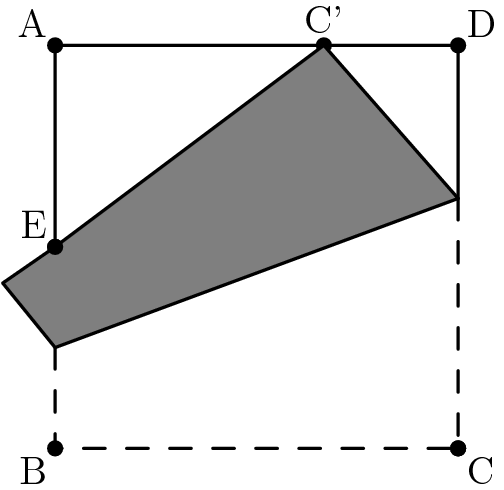
- Assuming AE = EC' or that the crease passes through E; E lies on the folded image of edge CB, not on the crease. (2021 AMC 10B #21)
- Forgetting that a rotation sandwiched between two reflections is reversed, or allowing sequences with one or three reflections. (2020 AMC 10A #23)
- 1.2023 AMC 10B #7
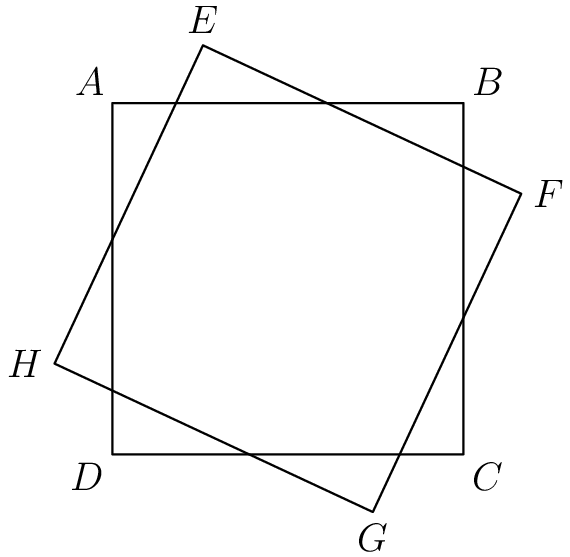
Square is rotated clockwise about its center to obtain square , as shown below. What is the degree measure of ?
- A)
- B)
- C)
- D)
- E)
- 2.2019 AMC 10A #8
The figure below shows line with a regular, infinite, recurring pattern of squares and line segments.
 How many of the following four kinds of rigid motion transformations of the plane in which this figure is drawn, other than the identity transformation, will transform this figure into itself?
- some rotation around a point of line
- some translation in the direction parallel to line
- the reflection across line
- some reflection across a line perpendicular to line
- A)
- B)
- C)
- D)
- E)
- 3.2016 AMC 10A #16
A triangle with vertices , , and is reflected about the -axis, then the image is rotated counterclockwise about the origin by to produce . Which of the following transformations will return to ?
- A)counterclockwise rotation about the origin by .
- B)clockwise rotation about the origin by .
- C)reflection about the -axis
- D)reflection about the line
- E)reflection about the -axis.
- 4.2015 AMC 10B #8
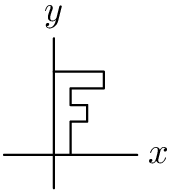
The letter F shown below is rotated clockwise around the origin, then reflected in the -axis, and then rotated a half turn around the origin. What is the final image?

- A)
- B)
- C)
- D)
- E)
- 5.2001 AMC 10 #5
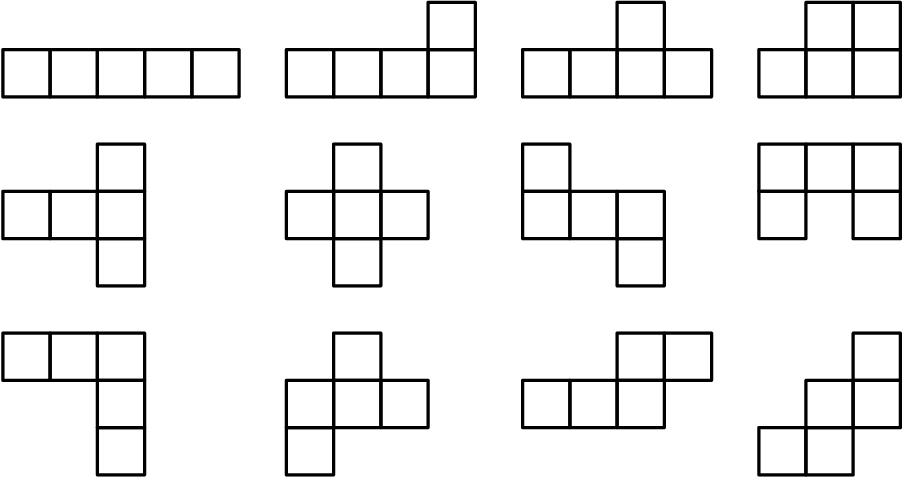
How many of the twelve pentominoes pictured below have at least one line of reflectional symmetry?
- A)
- B)
- C)
- D)
- E)
- 6.2024 AMC 10A #13
Two transformations are said to commute if applying the first followed by the second gives the same result as applying the second followed by the first. Consider these four transformations of the coordinate plane:
- a translation units to the right,
- a -rotation counterclockwise about the origin,
- a reflection across the -axis, and
- a dilation centered at the origin with scale factor
Of the pairs of distinct transformations from this list, how many commute?
- A)
- B)
- C)
- D)
- E)
- 7.2018 AMC 10A #13
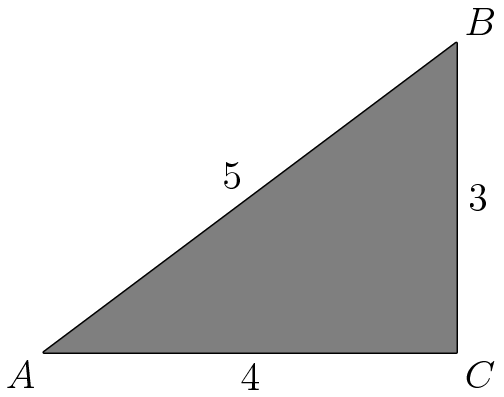
A paper triangle with sides of lengths and inches, as shown, is folded so that point falls on point . What is the length in inches of the crease?
- A)
- B)
- C)
- D)
- E)
- 8.2016 AMC 10B #20
A dilation of the plane—that is, a size transformation with a positive scale factor—sends the circle of radius centered at to the circle of radius centered at . What distance does the origin , move under this transformation?
- A)
- B)
- C)
- D)
- E)
- 9.2022 AMC 10A #18
Let be the transformation of the coordinate plane that first rotates the plane degrees counterclockwise around the origin and then reflects the plane across the -axis. What is the least positive integer such that performing the sequence of transformations returns the point back to itself?
- A)
- B)
- C)
- D)
- E)
- 10.2021 AMC 10B #21
A square piece of paper has side length and vertices and in that order. As shown in the figure, the paper is folded so that vertex meets edge at point , and edge at point . Suppose that . What is the perimeter of triangle
- A)
- B)
- C)
- D)
- E)
- 11.2020 AMC 10A #23
Let be the triangle in the coordinate plane with vertices and Consider the following five isometries (rigid transformations) of the plane: rotations of and counterclockwise around the origin, reflection across the -axis, and reflection across the -axis. How many of the sequences of three of these transformations (not necessarily distinct) will return to its original position? (For example, a rotation, followed by a reflection across the -axis, followed by a reflection across the -axis will return to its original position, but a rotation, followed by a reflection across the -axis, followed by another reflection across the -axis will not return to its original position.)
- A)
- B)
- C)
- D)
- E)
- 12.2014 AMC 10A #23
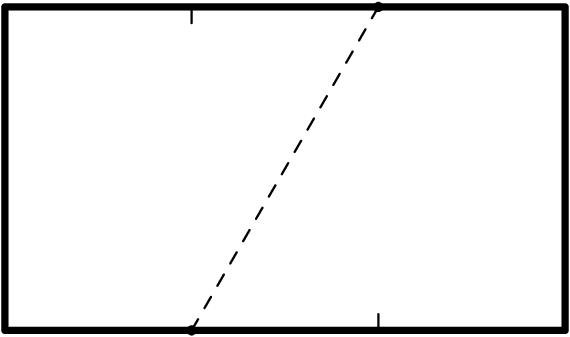
A rectangular piece of paper whose length is times the width has area . The paper is divided into three equal sections along the opposite lengths, and then a dotted line is drawn from the first divider to the second divider on the opposite side as shown. The paper is then folded flat along this dotted line to create a new shape with area . What is the ratio ?
- A)
- B)
- C)
- D)
- E)
- 13.2013 AMC 10A #20
A unit square is rotated about its center. What is the area of the region swept out by the interior of the square?
- A)
- B)
- C)
- D)
- E)
- 14.2008 AMC 10A #19
Rectangle lies in a plane with and . The rectangle is rotated clockwise about , then rotated clockwise about the point moved to after the first rotation. What is the length of the path traveled by point ?
- A)
- B)
- C)
- D)
- E)
- 15.2025 AMC 10B #25
Square has sides of length . Points and lie on and , respectively, with and . A path begins along the segment from to and continues by reflecting against the sides of (with congruent incoming and outgoing angles). If the path hits a vertex of the square, it terminates there; otherwise it continues forever. At which vertex does the path terminate?
- A)
- B)
- C)
- D)
- E)
Answers
| # | Answer | The idea it turns on |
|---|---|---|
| 1 | B | All eight corners lie on one circle around the center. Angle EAB is half of arc EB, and arc EB is 90 minus 20 = 70 degrees. |
| 2 | C | Watch the little tails. A mirror flip changes which way a tail slants; a half-turn does not. The lower row looks exactly like the upper row turned halfway around. |
| 3 | D | Follow the corners: every point (x, y) ends at (y, x). That is a reflection over y = x, and repeating it undoes it. |
| 4 | E | Follow one point through all three moves: (x, y) ends up at (y, x). So the three moves together just flip the F across the line y = x. |
| 5 | D | Go through the twelve shapes one by one and look for a fold line, including slanted (diagonal) ones. Six shapes have one. |
| 6 | C | Write each move as a rule for where (x, y) goes, then do each pair in both orders. Only three pairs give the same point both ways. |
| 7 | D | The crease is the line through the middle of AB at a right angle to it. It forms a small right triangle shaped like the paper. |
| 8 | C | The radii give scale factor 3/2. Use A and its image to find the center (-4, -6); then the origin moves to (2, 3), a distance of sqrt(13). |
| 9 | A | Track only the point's angle. Each step turns angle A into 180 - A - k, so every two steps together turn the point back 1 degree. |
| 10 | A | Folding keeps lengths, so the small right triangle at D has sides 1/3, 4/9, 5/9. Triangle AEC' has the same shape, 3/2 times as big, so its perimeter is 2. |
| 11 | A | T has no symmetry, so every point must return home. A reflection makes a mirror image, so there must be 0 or 2 reflections. Each case gives 6. |
| 12 | C | The fold line is tilted at 60 degrees, so the folded corner lands exactly on the opposite corner. The doubled part is an equilateral triangle, one third of the paper. |
| 13 | C | Where a corner travels, the region is a pie slice of the corner circle; elsewhere it is only what the first or last square covers. |
| 14 | C | Each turn moves P along a quarter circle. Its radius is the diagonal PR, root 40, for the first turn and the side PS = 6 for the second. |
| 15 | B | Flip the square instead of bouncing the path. The path becomes one straight line through a grid of squares, ending at the first grid corner it meets. |
Problems © Mathematical Association of America (MAA), American Mathematics Competitions. Reproduced for non-commercial educational use. The topic note, tags and key insights are original to this site.