Systems of Equations
Multi-variable systems, substitution/elimination, symmetric systems
What you need to know
- Elimination and substitution solve any linear system. Elimination adds or subtracts equations to remove a variable. Substitution solves one equation for a variable and plugs it into another.
- When does a linear system have exactly one solution? Take and . There is exactly one solution when . If , the two lines point the same way, so there is either no solution (parallel lines) or infinitely many (the same line). Example: and give and no solution, because would have to be both and .
- Symmetric systems (swapping and changes nothing) are about and . Once you know and , and are the two roots of . Example: and make , so and are and . With three variables, use , , and .
- Identities to know: and . Example: with and , and . Also .
- Cyclic systems. Adding all the equations gives the total; subtracting neighbors gives differences. Example: , , add to , so . Then , , and .
- Product systems. If , , and , multiply all three: . Take the square root (watch the sign), then divide back out. Example: , , give . For positive numbers , so , , and .
How AMC 10 tests it
- Problems 5–12: a word problem with two or three unknowns that asks for something like , which comes out of adding the equations.
- Problems 10–16: cyclic systems (, , , or the same with products).
- Problems 12–18: " and ; find ." You never need and themselves.
- A system with a letter in it: for which is there no solution, or infinitely many?
- Systems that come from a table, a Venn diagram, or a list of purchases, with one entry asked for.
Standard approaches
- Before solving, check whether the quantity asked for is a combination of the equations: add them all, subtract, or multiply some by numbers first.
- For symmetric systems, set and , and rewrite everything with and .
- Multiply or divide equations when they are products; add or subtract them when they are sums.
- Only as a last resort, substitute and solve for each variable. Then plug back in to check.
- For "how many solutions," think of the equations as graphs and count where they cross.
Worked example
Real numbers and satisfy and . What is ?
(A) (B) (C) (D) (E)
We never find and . We build up from and .
Find . , so and .
Find .
Multiply the two sums we know. Expanding,
The left side is . The extra piece is . So . The answer is .
Pitfalls
- Solving for and one at a time (here they are and ) when only and are needed.
- Sign slips in : the is subtracted.
- Losing the second solution after taking a square root ( means or ), or keeping a false one after squaring. Example: squaring gives or , but fails, since .
- Thinking means "no solution." It can also mean infinitely many. Example: and are the same line.
Traps that recur
- Adding the three equations to get ab + bc + ca + a + b + c = 247 and answering 247, forgetting to subtract a + b + c = −29. (2024 AMC 10A #23)
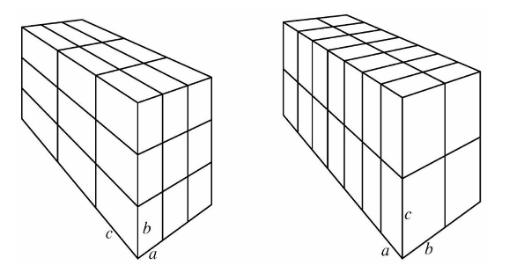
- Assuming the bricks keep their orientation, so that the new width 2a should be 3a + 1, which is impossible and stalls the whole problem. (2024 AMC 10B #25)
- Counting only systems with a zero row or a repeated row (302) and missing the 36 systems whose three distinct rows satisfy u + v = w. (2022 AMC 10B #18)
- Writing all eight equations and solving blindly; instead pair lines that share a variable so the unknown cancels immediately. (2001 AMC 10 #22)
- 1.2018 AMC 10B #4
A three-dimensional rectangular box with dimensions , , and has faces whose surface areas are and square units. What is ?
- A)
- B)
- C)
- D)
- E)
- 2.2012 AMC 10A #8
The sums of three whole numbers taken in pairs are , , and . What is the middle number?
- A)
- B)
- C)
- D)
- E)
- 3.2012 AMC 10A #6
The product of two positive numbers is . The reciprocal of one of these numbers is times the reciprocal of the other number. What is the sum of the two numbers?
- A)
- B)
- C)
- D)
- E)
- 4.2007 AMC 10A #5
The school store sells 7 pencils and 8 notebooks for . It also sells 5 pencils and 3 notebooks for . How much do 16 pencils and 10 notebooks cost?
- A)$1.76
- B)$5.84
- C)$6.00
- D)$6.16
- E)$6.32
- 5.2003 AMC 10A #13
The sum of three numbers is . The first is four times the sum of the other two. The second is seven times the third. What is the product of all three?
- A)
- B)
- C)
- D)
- E)
- 6.2002 AMC 10A #16
Let . What is ?
- A)
- B)
- C)
- D)
- E)
- 7.2002 AMC 10A #9
There are 3 numbers A, B, and C, such that , and . What is the average of A, B, and C?
- A)
- B)
- C)
- D)
- E)
- 8.2001 AMC 10 #10
If , , and are positive with , , and , then is
- A)
- B)
- C)
- D)
- E)
- 9.2015 AMC 10A #16
If , and , what is the value of ?
- A)
- B)
- C)
- D)
- E)
- 10.2024 AMC 10A #23
Integers , , and satisfy , , and . What is
- A)
- B)
- C)
- D)
- E)
- 11.2024 AMC 10B #25
Each of bricks (right rectangular prisms) has dimensions , where , , and are pairwise relatively prime positive integers. These bricks are arranged to form a block, as shown on the left below. A th brick with the same dimensions is introduced, and these bricks are reconfigured into a block, shown on the right. The new block is unit taller, unit wider, and unit deeper than the old one. What is ?
- A)
- B)
- C)
- D)
- E)
- 12.2022 AMC 10B #18
Consider systems of three linear equations with unknowns , , and , where each of the coefficients is either or and the system has a solution other than . For example, one such system is with a nonzero solution of . How many such systems of equations are there? (The equations in a system need not be distinct, and two systems containing the same equations in a different order are considered different.)
- A)
- B)
- C)
- D)
- E)
- 13.2001 AMC 10 #22
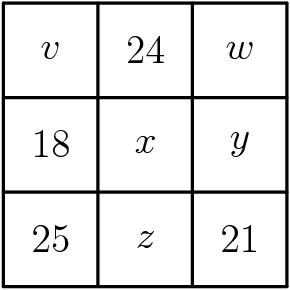
In the magic square shown, the sums of the numbers in each row, column, and diagonal are the same. Five of these numbers are represented by , , , , and . Find .
- A)
- B)
- C)
- D)
- E)
Problems © Mathematical Association of America (MAA), American Mathematics Competitions. Reproduced for non-commercial educational use. The topic note, tags and key insights are original to this site.