Solid Geometry
Volume, surface area, cubes, cones, spheres, cylinders, cross-sections, nets
What you need to know
- Volume and surface. Prism or cylinder: , where is the area of the base and the height. Pyramid or cone: . Sphere of radius : , surface area . Example: with radius and height , a cylinder holds and a cone .
- Scaling. Multiplying every length by multiplies areas by and volumes by . A cut parallel to the base of a cone or pyramid leaves a smaller cone or pyramid of the same shape. Example: doubling a cube's edges makes its surface area times and its volume times as big.
- Diagonals. A cube with edge has face diagonal and space diagonal (corner to opposite corner, through the inside) . An box has space diagonal . Example: a box has diagonal .
- Slicing a cube. A flat cut through a cube can give a triangle, a four-sided shape (square, rectangle, rhombus, parallelogram, trapezoid), a pentagon, or a hexagon. It never has more than six sides, since a cube has six faces. Cutting through the midpoints of six edges gives a regular hexagon.
- Paths on the surface. The shortest path along the outside becomes a straight line when you unfold the solid flat (into a net).
How AMC 10 tests it
- Early: the volume or surface area of a box, or how the surface area changes when unit cubes are removed from a corner (no change: faces are lost and are uncovered) or from an edge (it goes up by ).
- Water poured between containers, or a partly filled cone standing on its tip. Set the volumes equal and use scaling.
- Problems 15–22: a sphere or cylinder inside a cone (similar triangles in the cross-section through the axis), or an ant's shortest path on a box.
Standard approaches
- Draw the flat cross-section through the axis (the center line). Most solid problems become a triangle problem there.
- Use scaling before computing: similar solids with length ratio have volume ratio .
- For odd shapes, start from a full prism or box and subtract pyramids or corner tetrahedra (triangular pyramids).
- For surface paths, unfold the net and use the Pythagorean Theorem. Try several unfoldings and keep the shortest.
Worked example
An inverted cone (vertex down) has height and base radius . It contains water to a depth of . The water is poured into an empty cylinder of radius . What is the depth of the water in the cylinder?
(A) (B) (C) (D) (E)
Solution. Step 1. The water forms a smaller cone of the same shape. Its height is out of , so every length is scaled by , and its radius is .
Step 2. The water's volume is
(Check by scaling: the full cone holds , and .)
Step 3. In the cylinder, water of depth has volume . Setting gives .
The answer is .
Pitfalls
- Dropping the for a cone or pyramid, or using it for a cylinder.
- Scaling volume by or instead of when a cone is partly filled. Example: a cone standing on its tip, filled to half its height, holds of its volume, not . (Standing on its base, it would hold .)
- Mixing up a cone's slant height (along the slope) with its height (straight up). Example: radius and height give slant height .
Traps that recur
- Using the sphere's diameter as the slant height, or forgetting the middle term Rr in the frustum volume formula. (2014 AMC 10B #23)
- Assuming that filling to half the height fills half the container, so the rest takes about the same 35 minutes again and a guess is pushed toward the 70 in (A). (2025 AMC 10B #19)
- Counting edges as 12 times 4 = 48 without halving for the two faces each edge borders. (2023 AMC 10A #18)
- Assuming each semicircle is half a great circle of radius 2, which gives 8pi = pisqrt(64), not among the choices. (2023 AMC 10B #20)
- 1.2011 AMC 10B #22
A pyramid has a square base with sides of length and has lateral faces that are equilateral triangles. A cube is placed within the pyramid so that one face is on the base of the pyramid and its opposite face has all its edges on the lateral faces of the pyramid. What is the volume of this cube?
- A)
- B)
- C)
- D)
- E)
- 2.2011 AMC 10A #24
Two distinct regular tetrahedra have all their vertices among the vertices of the same unit cube. What is the volume of the region formed by the intersection of the tetrahedra?
- A)
- B)
- C)
- D)
- E)
- 3.2009 AMC 10B #22
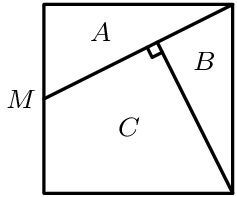
A cubical cake with edge length inches is iced on the sides and the top. It is cut vertically into three pieces as shown in this top view, where is the midpoint of a top edge. The piece whose top is triangle contains cubic inches of cake and square inches of icing. What is ?
- A)
- B)
- C)
- D)
- E)
- 4.2008 AMC 10A #21
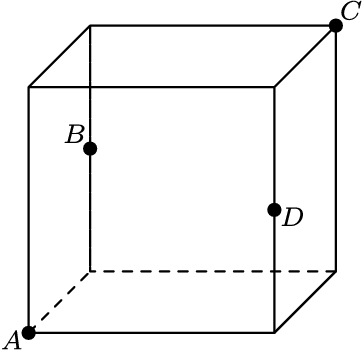
A cube with side length is sliced by a plane that passes through two diagonally opposite vertices and and the midpoints and of two opposite edges not containing or , as shown. What is the area of quadrilateral ?
- A)
- B)
- C)
- D)
- E)
- 5.2007 AMC 10B #23
A pyramid with a square base is cut by a plane that is parallel to its base and units from the base. The surface area of the smaller pyramid that is cut from the top is half the surface area of the original pyramid. What is the altitude of the original pyramid?
- A)
- B)
- C)
- D)
- E)
- 6.2006 AMC 10A #24
Centers of adjacent faces of a unit cube are joined to form a regular octahedron. What is the volume of this octahedron?
- A)
- B)
- C)
- D)
- E)
- 7.2004 AMC 10A #25
Three mutually tangent spheres of radius rest on a horizontal plane. A sphere of radius rests on them. What is the distance from the plane to the top of the larger sphere?
- A)
- B)
- C)
- D)
- E)
- 8.2014 AMC 10B #23
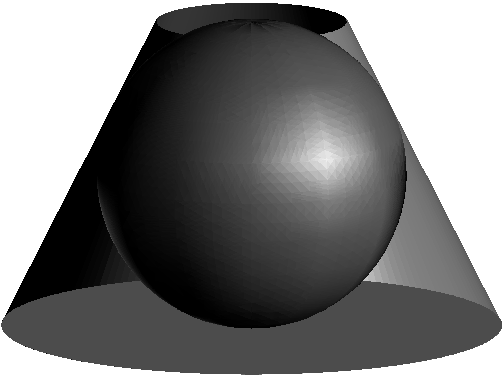
A sphere is inscribed in a truncated right circular cone as shown. The volume of the truncated cone is twice that of the sphere. What is the ratio of the radius of the bottom base of the truncated cone to the radius of the top base of the truncated cone?
- A)
- B)
- C)
- D)
- E)
Answers
| # | Answer | The idea it turns on |
|---|---|---|
| 1 | A | The pyramid's height is half the square root of 2. The level slice at the cube's height is a square, and it is exactly the cube's top face. |
| 2 | D | Each tetrahedron has volume 1/3. The other tetrahedron's faces cut off its four corners, each a half-size copy of volume 1/24, leaving 1/3 − 4/24 = 1/6. |
| 3 | B | The cuts are vertical, so the piece is triangle B stretched to height 2. Cake is twice B's area; icing is B's area plus a 2 by 2 side. |
| 4 | A | All four sides of ABCD are equal, so it is a rhombus. Its diagonals are the cube diagonal, root 3, and a face diagonal length, root 2. |
| 5 | E | The top piece is a shrunken copy of the pyramid. Half the area means every length, including the height, shrinks by a factor of the square root of 2. |
| 6 | B | Cut the octahedron into two pyramids with a square base halfway up the cube. That square's diagonal is 1, so its area is 1/2, and each pyramid is 1/2 tall. |
| 7 | B | Use the centers. The big center is 3 from each small center, above the middle of an equilateral triangle of side 2, 2 over root 3 from each corner. |
| 8 | E | Slice through the middle: a circle inside a trapezoid. Equal touching segments make the slanted side R + r, so sphere radius squared equals Rr. |
Problems © Mathematical Association of America (MAA), American Mathematics Competitions. Reproduced for non-commercial educational use. The topic note, tags and key insights are original to this site.