Solid Geometry
Volume, surface area, cubes, cones, spheres, cylinders, cross-sections, nets
What you need to know
- Volume and surface. Prism or cylinder: , where is the area of the base and the height. Pyramid or cone: . Sphere of radius : , surface area . Example: with radius and height , a cylinder holds and a cone .
- Scaling. Multiplying every length by multiplies areas by and volumes by . A cut parallel to the base of a cone or pyramid leaves a smaller cone or pyramid of the same shape. Example: doubling a cube's edges makes its surface area times and its volume times as big.
- Diagonals. A cube with edge has face diagonal and space diagonal (corner to opposite corner, through the inside) . An box has space diagonal . Example: a box has diagonal .
- Slicing a cube. A flat cut through a cube can give a triangle, a four-sided shape (square, rectangle, rhombus, parallelogram, trapezoid), a pentagon, or a hexagon. It never has more than six sides, since a cube has six faces. Cutting through the midpoints of six edges gives a regular hexagon.
- Paths on the surface. The shortest path along the outside becomes a straight line when you unfold the solid flat (into a net).
How AMC 10 tests it
- Early: the volume or surface area of a box, or how the surface area changes when unit cubes are removed from a corner (no change: faces are lost and are uncovered) or from an edge (it goes up by ).
- Water poured between containers, or a partly filled cone standing on its tip. Set the volumes equal and use scaling.
- Problems 15–22: a sphere or cylinder inside a cone (similar triangles in the cross-section through the axis), or an ant's shortest path on a box.
Standard approaches
- Draw the flat cross-section through the axis (the center line). Most solid problems become a triangle problem there.
- Use scaling before computing: similar solids with length ratio have volume ratio .
- For odd shapes, start from a full prism or box and subtract pyramids or corner tetrahedra (triangular pyramids).
- For surface paths, unfold the net and use the Pythagorean Theorem. Try several unfoldings and keep the shortest.
Worked example
An inverted cone (vertex down) has height and base radius . It contains water to a depth of . The water is poured into an empty cylinder of radius . What is the depth of the water in the cylinder?
(A) (B) (C) (D) (E)
Solution. Step 1. The water forms a smaller cone of the same shape. Its height is out of , so every length is scaled by , and its radius is .
Step 2. The water's volume is
(Check by scaling: the full cone holds , and .)
Step 3. In the cylinder, water of depth has volume . Setting gives .
The answer is .
Pitfalls
- Dropping the for a cone or pyramid, or using it for a cylinder.
- Scaling volume by or instead of when a cone is partly filled. Example: a cone standing on its tip, filled to half its height, holds of its volume, not . (Standing on its base, it would hold .)
- Mixing up a cone's slant height (along the slope) with its height (straight up). Example: radius and height give slant height .
Traps that recur
- Using the sphere's diameter as the slant height, or forgetting the middle term Rr in the frustum volume formula. (2014 AMC 10B #23)
- Assuming that filling to half the height fills half the container, so the rest takes about the same 35 minutes again and a guess is pushed toward the 70 in (A). (2025 AMC 10B #19)
- Counting edges as 12 times 4 = 48 without halving for the two faces each edge borders. (2023 AMC 10A #18)
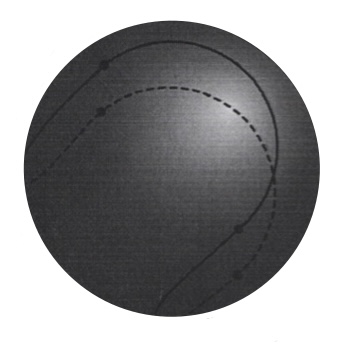
- Assuming each semicircle is half a great circle of radius 2, which gives 8pi = pisqrt(64), not among the choices. (2023 AMC 10B #20)
- 1.2010 AMC 10A #17
A solid cube has side length inches. A -inch by -inch square hole is cut into the center of each face. The edges of each cut are parallel to the edges of the cube, and each hole goes all the way through the cube. What is the volume, in cubic inches, of the remaining solid?
- A)
- B)
- C)
- D)
- E)
- 2.2008 AMC 10B #19
A cylindrical tank with radius feet and height feet is lying on its side. The tank is filled with water to a depth of feet. What is the volume of water, in cubic feet?
- A)
- B)
- C)
- D)
- E)
- 3.2007 AMC 10A #21
A sphere is inscribed in a cube that has a surface area of square meters. A second cube is then inscribed within the sphere. What is the surface area in square meters of the inner cube?
- A)
- B)
- C)
- D)
- E)
- 4.2004 AMC 10A #19
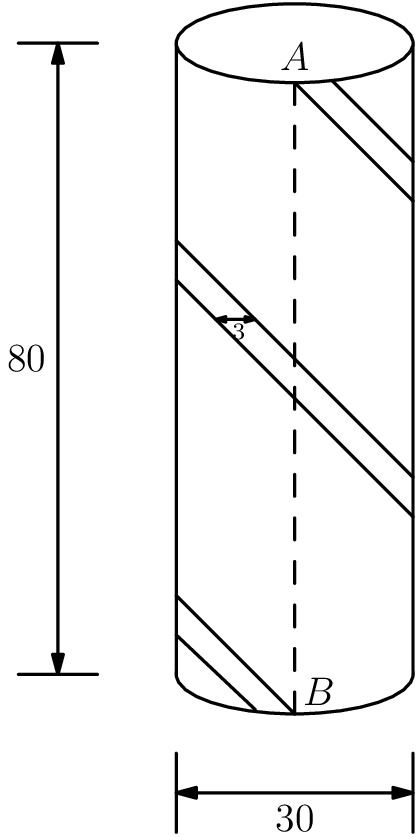
A white cylindrical silo has a diameter of 30 feet and a height of 80 feet. A red stripe with a horizontal width of 3 feet is painted on the silo, as shown, making two complete revolutions around it. What is the area of the stripe in square feet?
- A)
- B)
- C)
- D)
- E)
- 5.2003 AMC 10B #17
An ice cream cone consists of a sphere of vanilla ice cream and a right circular cone that has the same diameter as the sphere. If the ice cream melts, it will exactly fill the cone. Assume that the melted ice cream occupies of the volume of the frozen ice cream. What is the ratio of the cone's height to its radius? (Note: a cone with radius and height has volume and a sphere with radius has volume .)
- A)
- B)
- C)
- D)
- E)
- 6.2003 AMC 10A #10
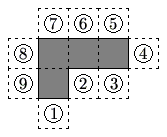
The polygon enclosed by the solid lines in the figure consists of 4 congruent squares joined edge-to-edge. One more congruent square is attached to an edge at one of the nine positions indicated. How many of the nine resulting polygons can be folded to form a cube with one face missing?
- A)
- B)
- C)
- D)
- E)
- 7.2002 AMC 10A #18
A x x cube is made of normal dice. Each die's opposite sides sum to . What is the smallest possible sum of all of the values visible on the faces of the large cube?
- A)
- B)
- C)
- D)
- E)
- 8.2001 AMC 10 #17
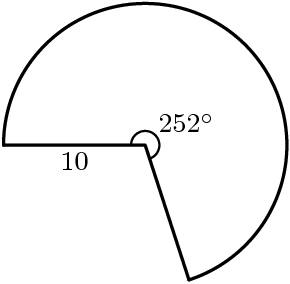
Which of the cones listed below can be formed from a sector of a circle of radius by aligning the two straight sides?
- A)
- B)
- C)
- D)
- E)
- 9.2001 AMC 10 #21
A right circular cylinder with its diameter equal to its height is inscribed in a right circular cone. The cone has diameter and altitude , and the axes of the cylinder and cone coincide. Find the radius of the cylinder.
- A)
- B)
- C)
- D)
- E)
- 10.2025 AMC 10B #19
A container has a square bottom, a open square top, and four congruent trapezoidal sides, as shown. Starting when the container is empty, a hose that runs water at a constant rate takes minutes to fill the container up to the midline of the trapezoids.
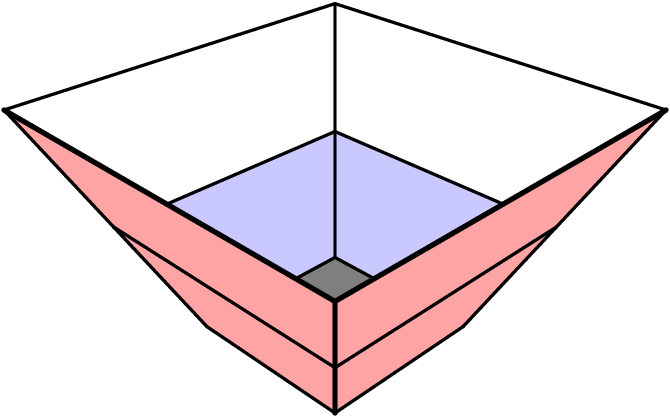
How many more minutes will it take to fill the remainder of the container?
- A)
- B)
- C)
- D)
- E)
- 11.2023 AMC 10B #20
Four congruent semicircles are drawn on the surface of a sphere with radius , as shown, creating a close curve that divides the surface into two congruent regions. The length of the curve is . What is ?
- A)
- B)
- C)
- D)
- E)
- 12.2023 AMC 10A #18
A rhombic dodecahedron is a solid with congruent rhombus faces. At every vertex, or edges meet, depending on the vertex. How many vertices have exactly edges meet?
- A)
- B)
- C)
- D)
- E)
- 13.2022 AMC 10A #21
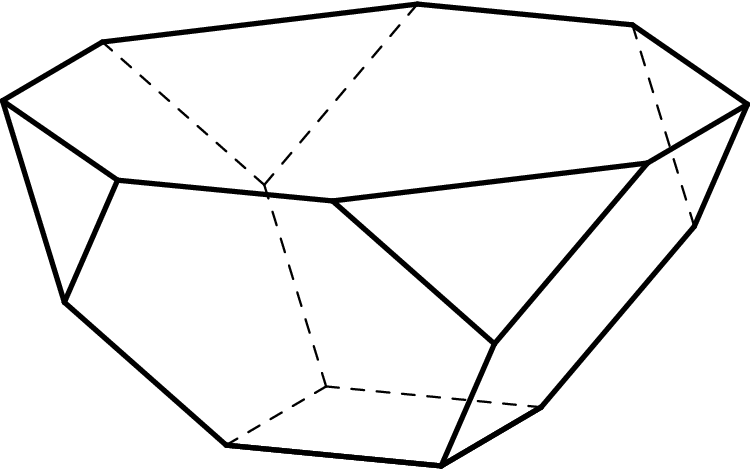
A bowl is formed by attaching four regular hexagons of side to a square of side . The edges of the adjacent hexagons coincide, as shown in the figure. What is the area of the octagon obtained by joining the top eight vertices of the four hexagons, situated on the rim of the bowl?
- A)
- B)
- C)
- D)
- E)
- 14.2021 AMC Fall 10A #22
Inside a right circular cone with base radius and height are three congruent spheres with radius . Each sphere is tangent to the other two spheres and also tangent to the base and side of the cone. What is ?
- A)
- B)
- C)
- D)
- E)
- 15.2020 AMC 10B #20
Let be a right rectangular prism (box) with edges lengths and , together with its interior. For real , let be the set of points in -dimensional space that lie within a distance of some point in . The volume of can be expressed as , where and are positive real numbers. What is
- A)
- B)
- C)
- D)
- E)
- 16.2019 AMC 10A #21
A sphere with center has radius 6. A triangle with sides of length , , and is situated in space so that each of its sides are tangent to the sphere. What is the distance between and the plane determined by the triangle?
- A)
- B)
- C)
- D)
- E)
- 17.2015 AMC 10A #21
Tetrahedron has , , , , , and . What is the volume of the tetrahedron?
- A)
- B)
- C)
- D)
- E)
- 18.2014 AMC 10A #19
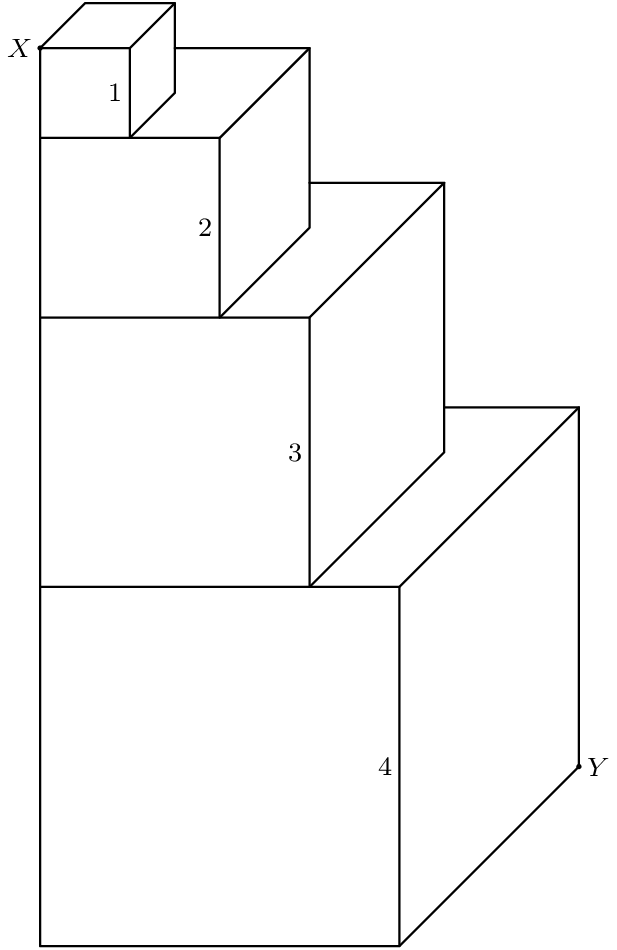
Four cubes with edge lengths , , , and are stacked as shown. What is the length of the portion of contained in the cube with edge length ?
- A)
- B)
- C)
- D)
- E)
- 19.2013 AMC 10A #22
Six spheres of radius are positioned so that their centers are at the vertices of a regular hexagon of side length . The six spheres are internally tangent to a larger sphere whose center is the center of the hexagon. An eighth sphere is externally tangent to the six smaller spheres and internally tangent to the larger sphere. What is the radius of this eighth sphere?
- A)
- B)
- C)
- D)
- E)
- 20.2012 AMC 10B #23
A solid tetrahedron is sliced off a wooden unit cube by a plane passing through two nonadjacent vertices on one face and one vertex on the opposite face not adjacent to either of the first two vertices. The tetrahedron is discarded and the remaining portion of the cube is placed on a table with the cut surface face down. What is the height of this object?
- A)
- B)
- C)
- D)
- E)
Answers
| # | Answer | The idea it turns on |
|---|---|---|
| 1 | A | Slice the cube into lengths 1/2, 2, 1/2 each way. Only the twelve edge bars and eight corner pieces survive the holes: 6 + 1 = 7. |
| 2 | E | Look at the tank's round end. The water is a one-third slice of the circle minus a triangle. Multiply that area by the length 9. |
| 3 | C | One length is passed along: the outer cube's edge equals the sphere's diameter, which equals the long diagonal through the inner cube, corner to opposite corner. |
| 4 | C | Unroll the silo into a flat rectangle. The stripe becomes slanted strips 3 feet wide climbing 80 feet in total, so its area is 3 times 80. |
| 5 | B | The melted ice cream is 3/4 of the sphere's volume, which simplifies to pi times r cubed. Setting that equal to the cone's volume gives height = 3 times radius. |
| 6 | E | Fold the four solid squares first. They make a bottom and three walls, so a fifth square works exactly when it folds onto one of the two faces still missing. |
| 7 | D | Corner dice show 3 faces, edge dice 2, face-center dice 1. Faces 1, 2 and 3 meet at one corner of a die, so each die shows its smallest numbers. |
| 8 | C | Rolled up, the sector's radius of 10 becomes the cone's slant side, and its curved edge, of length 14 pi, wraps around the base circle. |
| 9 | B | Slice straight down through the center: the cone becomes a triangle, the cylinder a square, and the small triangle above the square has the same shape as the big one. |
| 10 | D | Extend the slanted sides to a point: the container is a pyramid with its tip cut off, and volume below a square of side s grows like s³. |
| 11 | A | The four corners where the semicircles meet are evenly spaced around the sphere's equator. Neighboring corners are 2 times root 2 apart, so each semicircle has radius root 2. |
| 12 | D | Count edges from the faces (12 times 4, halved), then vertices from Euler's formula. Counting edge ends two ways gives the split into 3-edge and 4-edge vertices. |
| 13 | B | The rim is level, so its area equals its shadow seen from above. A shared hexagon edge shows each top edge sits 1 unit outside the square. |
| 14 | B | The centers form an equilateral triangle of side 2r at height r, so each is 2r over root 3 from the axis. Then slice through one center. |
| 15 | B | The region is the box, plus slabs on the six faces, plus quarter-cylinders along the twelve edges, plus eighth-balls at the eight corners. Each kind gives one power of r. |
| 16 | D | The sphere cuts the triangle's plane in a circle that touches all three sides, which is the inscribed circle, radius 4. Then use a right triangle with hypotenuse 6. |
| 17 | C | Faces ABC and ABD are matching 3-4-5 right triangles on side AB. Their heights to AB meet at one point, and CD shows they are perpendicular. |
| 18 | A | XY runs corner to corner through the stack and has length 2 root 33. The edge-3 cube covers heights 4 to 7, which is 3/10 of the drop. |
| 19 | B | The big sphere has radius 3. The eighth center sits straight above the hexagon's center, giving a right triangle with legs 2 and 3 - r, hypotenuse r + 1. |
| 20 | D | The line from the removed corner to the opposite corner stands straight up from the cut face. Take the cut-off corner's height, 1/√3, away from √3. |
Problems © Mathematical Association of America (MAA), American Mathematics Competitions. Reproduced for non-commercial educational use. The topic note, tags and key insights are original to this site.