Sequences & Series
Arithmetic/geometric sequences, recursions, sums, telescoping sums
What you need to know
We write for the th term of a sequence, so is the first term.
- Arithmetic sequences go up by the same amount each time (the common difference). The th term is . The sum of the first terms is : the number of terms times the average of the first and last. Example: for , and .
- Geometric sequences multiply by the same number each time (the common ratio). Then and . Example: for , and .
- Infinite geometric series. If is between and , the sum that goes on forever is . Example: .
- Sums to memorize. . . . Example: with these are , , and .
- Telescoping. Write each term as a difference so that neighbors cancel and only the ends survive. The key split is (this is partial fractions). Example: .
- Recursions often repeat. When each term is made from the one before, compute terms until one repeats. From there the sequence cycles. If the cycle goes all the way back to , only the remainder of the index divided by the cycle length (the period) matters. If some terms come before the cycle starts, count from the start of the cycle instead: adding the squares of the digits, starting from , gives , a cycle of length that starts at . Example: and give , with period . Since , .
- Three-term tests. is arithmetic exactly when . For numbers that are not zero, is geometric exactly when . Example: is arithmetic () and is geometric ().
How AMC 10 tests it
- Problems 3–10: a direct question about an arithmetic sequence (one term, a sum, or the number of terms).
- Problems 8–15: ", ; find ." Compute a few terms, spot the cycle, and use the remainder of the index.
- Problems 10–18: an arithmetic or geometric sequence hidden in a story (rows of seats, a bouncing ball), sometimes an infinite geometric series.
- Problems 14–20: a telescoping sum of fractions, or of terms like . Rewrite each term as a difference, such as .
- Mixed conditions (" is arithmetic and is geometric") that turn into a small system of equations.
Standard approaches
- Decide the type: arithmetic, geometric, telescoping, or recursive. For a recursion, write out the first five or six terms.
- For an arithmetic sum, use (number of terms) (average term). Count the terms as .
- For a sum of fractions, or a product, try to write each term as a difference of neighboring pieces, like .
- For a term with a huge index, find the period or a formula, then reduce the index.
- Use the answer choices as a check: whole number or not, even or odd, or the pattern from small cases.
Worked example
Define and for . What is the product ?
(A) (B) (C) (D) (E)
Compute terms until one repeats.
Since , the terms repeat in blocks of : .
Multiply one block. .
Count the blocks. . So the terms are full blocks, each multiplying to , then two extra terms: and .
The whole product is . The answer is .
Pitfalls
- Off-by-one when counting terms: is steps past . Example: for , , not .
- Using when is not between and . Example: has no sum, but the formula would give .
- Reducing the index wrongly. With period and a cycle that starts at , an index that is a multiple of (remainder , like ) matches , not a nonexistent .
- Telescoping without tracking which terms survive at both ends, or dropping the factor in front: , not .
Traps that recur
- Trying to compute terms exactly, or bounding with only one side of the ratio and landing in the wrong interval. (2019 AMC 10B #24)
- Reading 'the average drops by 1' as 'each term drops by 1' and running the sequence down from around 2025 to 1, which points at choice (E). (2025 AMC 10B #17)
- Assuming the ratio must be an integer (b = 1440, digit sum 9) or grabbing 9/8 (b = 810) without checking that 15 and 16 both divide 720. (2024 AMC 10A #19)
- Assuming every row has the same common difference (a linear function Bi + Cj + A), which cannot fit the four given values; the row differences themselves form an arithmetic progression. (2024 AMC 10A #21)
- 1.2011 AMC 10B #10
Consider the set of numbers . The ratio of the largest element of the set to the sum of the other ten elements of the set is closest to which integer?
- A)
- B)
- C)
- D)
- E)
- 2.2009 AMC 10A #9
Positive integers , , and , with , form a geometric sequence with an integer ratio. What is ?
- A)
- B)
- C)
- D)
- E)
- 3.2008 AMC 10B #13
For each positive integer , the mean of the first terms of a sequence is . What is the 2008th term of the sequence?
- A)
- B)
- C)
- D)
- E)
- 4.2008 AMC 10B #11
Suppose that is a sequence of real numbers satisfying ,
and that and . What is ?
- A)
- B)
- C)
- D)
- E)
- 5.2004 AMC 10B #10
A grocer makes a display of cans in which the top row has one can and each lower row has two more cans than the row above it. If the display contains cans, how many rows does it contain?
- A)
- B)
- C)
- D)
- E)
- 6.2004 AMC 10A #7
A grocer stacks oranges in a pyramid-like stack whose rectangular base is oranges by oranges. Each orange above the first level rests in a pocket formed by four oranges below. The stack is completed by a single row of oranges. How many oranges are in the stack?
- A)
- B)
- C)
- D)
- E)
- 7.2003 AMC 10B #8
The second and fourth terms of a geometric sequence are and . Which of the following is a possible first term?
- A)
- B)
- C)
- D)
- E)
- 8.2001 AMC 10 #11
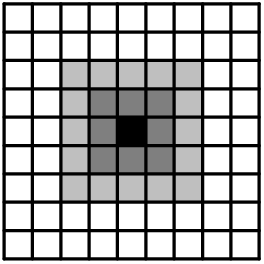
Consider the dark square in an array of unit squares, part of which is shown. The first ring of squares around this center square contains unit squares. The second ring contains unit squares. If we continue this process, the number of unit squares in the ring is
- A)
- B)
- C)
- D)
- E)
- 9.2000 AMC 10 #12
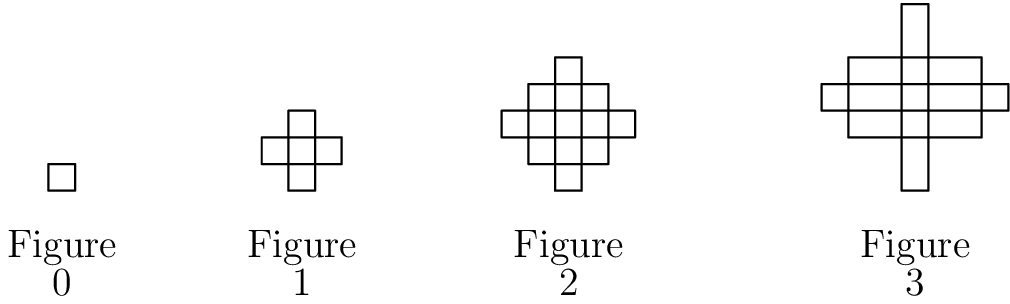
Figures , , , and consist of , , , and nonoverlapping unit squares, respectively. If the pattern were continued, how many nonoverlapping unit squares would there be in figure 100?
- A)
- B)
- C)
- D)
- E)
- 10.2025 AMC 10B #15
The sum can be expressed as , where and are relatively prime positive integers. What is ?
- A)
- B)
- C)
- D)
- E)
- 11.2025 AMC 10A #11
The sequence is arithmetic. The sequence is geometric. Both sequences are strictly increasing and contain only integers, and is as small as possible. What is the value of ?
- A)
- B)
- C)
- D)
- E)
- 12.2025 AMC 10A #13
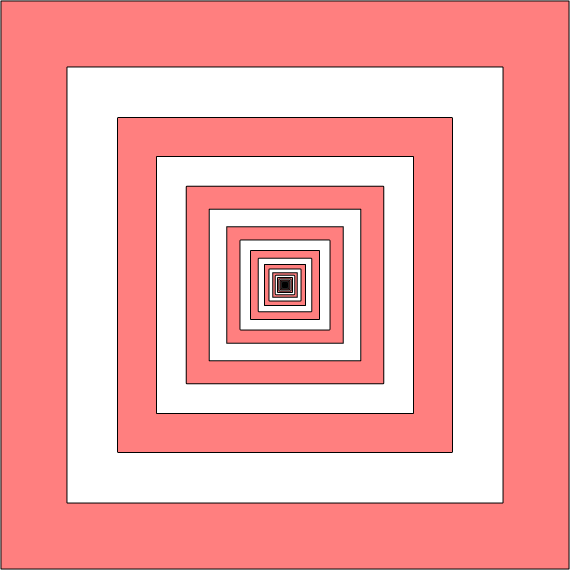
In the figure below, the outside square contains infinitely many squares, each of them with the same center and sides parallel to the outside square. The ratio of the side length of a square to the side length of the next inner square is , where The spaces between squares are alternately shaded as shown in the figure (which is not necessarily drawn to scale).
The area of the shaded portion of the figure is of the area of the original square. What is ?
- A)
- B)
- C)
- D)
- E)
- 13.2025 AMC 10B #18
What is the ones digit of the sum (Recall that represents the greatest integer less than or equal to .)
- A)
- B)
- C)
- D)
- E)
- 14.2025 AMC 10A #19
An array of numbers is constructed beginning with the numbers in the top row. Each adjacent pair of numbers is summed to produce a number in the next row. Each row begins and ends with and , respectively.
If the process continues, one of the rows will sum to . In that row, what is the third number from the left?
- A)
- B)
- C)
- D)
- E)
- 15.2023 AMC 10A #15
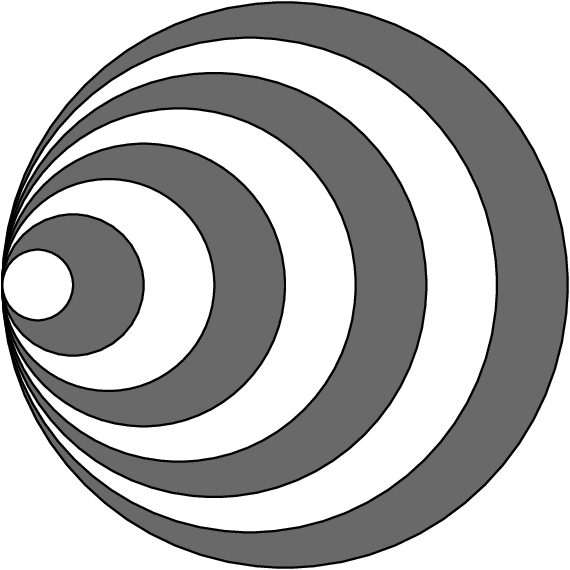
An even number of circles are nested, starting with a radius of and increasing by each time, all sharing a common point. The region between every other circle is shaded, starting with the region inside the circle of radius but outside the circle of radius An example showing circles is displayed below. What is the least number of circles needed to make the total shaded area at least ?
- A)
- B)
- C)
- D)
- E)
- 16.2022 AMC 10B #15
Let be the sum of the first terms of an arithmetic sequence that has a common difference of . The quotient does not depend on . What is ?
- A)
- B)
- C)
- D)
- E)
- 17.2019 AMC 10B #18
Henry decides one morning to do a workout, and he walks of the way from his home to his gym. The gym is kilometers away from Henry's home. At that point, he changes his mind and walks of the way from where he is back toward home. When he reaches that point, he changes his mind again and walks of the distance from there back toward the gym. If Henry keeps changing his mind when he has walked of the distance toward either the gym or home from the point where he last changed his mind, he will get very close to walking back and forth between a point kilometers from home and a point kilometers from home. What is ?
- A)
- B)
- C)
- D)
- E)
- 18.2019 AMC 10A #15
A sequence of numbers is defined recursively by , , and for all . Then can be written as , where and are relatively prime positive integers. What is
- A)
- B)
- C)
- D)
- E)
- 19.2018 AMC 10B #20
A function is defined recursively by and for all integers . What is ?
- A)
- B)
- C)
- D)
- E)
- 20.2016 AMC 10B #16
The sum of an infinite geometric series is a positive number , and the second term in the series is . What is the smallest possible value of
- A)
- B)
- C)
- D)
- E)
Answers
| # | Answer | The idea it turns on |
|---|---|---|
| 1 | B | The ten smaller numbers add up to 1,111,111,111. Nine times that is 9,999,999,999, just 1 short of the largest number, so the ratio is almost exactly 9. |
| 2 | B | The ratio squared must divide 2009 = 7 x 7 x 41, so the ratio is 7 and a = 2009 / 49 = 41. |
| 3 | B | If the first n terms average n, they add up to n times n. Each term is the jump from one square to the next: the odd numbers. |
| 4 | B | The missing term between the two known ones is the fourth term. Call it a, build the fifth and sixth terms from it, and set the sixth equal to 128. |
| 5 | D | The rows hold 1, 3, 5, 7, ... cans, and adding up the first few odd numbers always gives a perfect square. So 100 cans means 10 rows. |
| 6 | C | Each orange sits in a gap between four below, so each layer shrinks by one both ways: 5 by 8, 4 by 7, down to 1 by 4. |
| 7 | B | From the 2nd term to the 4th you multiply by the ratio twice, so the ratio squared is 3. The ratio may be negative. |
| 8 | C | Split a ring into its four sides. The nth ring has two rows of 2n+1 squares and two columns of 2n-1 squares, which adds up to 8n. |
| 9 | C | Figure n has n squared plus (n+1) squared unit squares, so figure 100 has 100 squared plus 101 squared, which is 20201. |
| 10 | D | The bottom factors as k(k+2)(k+4). Each term is one quarter of the difference 1/(k(k+2)) − 1/((k+2)(k+4)), so the sum cancels down to its first two pieces. |
| 11 | E | The geometric sequence 1, p, q, z makes z a perfect cube. The arithmetic one makes z one more than a multiple of 3. Test cubes 8, 27, 64. |
| 12 | D | Each shaded ring is a shrunken copy of the one two rings further out, so the shaded areas add up to 1/(1 + k squared). |
| 13 | D | The value n appears 2n + 1 times, from n² to just before (n+1)². So add n(2n + 1) for n = 1 to 44, plus 45. |
| 14 | A | Each row adds up to twice the row above, so 12,288 is the sum of row 13. Then follow only the second and third numbers down to that row. |
| 15 | E | Each shaded ring is the difference of two circles, and those areas are 3, 7, 11, ... times pi. With n rings the total is n(2n + 1) times pi. |
| 16 | D | The ratio stays the same for every n only if the first term is 1. Then the terms are the odd numbers, and their sums are perfect squares. |
| 17 | C | In the long run Henry bounces between two fixed turning points. Walking toward the gym from A must end at B, and walking home from B must end at A. |
| 18 | E | Flip every term upside down. The flipped terms go up by the same amount each time: 1, 7/3, 11/3, 15/3, and so on. |
| 19 | B | Work out the first dozen values. Every 6 steps the value goes up by exactly 6, so jump from f(2) to f(2018) in steps of 6. |
| 20 | E | With second term 1 and ratio r, the sum is S = 1/(r(1 - r)). The bottom is largest, 1/4, at r = 1/2, so S is at least 4. |
Problems © Mathematical Association of America (MAA), American Mathematics Competitions. Reproduced for non-commercial educational use. The topic note, tags and key insights are original to this site.