Sequences & Series
Arithmetic/geometric sequences, recursions, sums, telescoping sums
What you need to know
We write for the th term of a sequence, so is the first term.
- Arithmetic sequences go up by the same amount each time (the common difference). The th term is . The sum of the first terms is : the number of terms times the average of the first and last. Example: for , and .
- Geometric sequences multiply by the same number each time (the common ratio). Then and . Example: for , and .
- Infinite geometric series. If is between and , the sum that goes on forever is . Example: .
- Sums to memorize. . . . Example: with these are , , and .
- Telescoping. Write each term as a difference so that neighbors cancel and only the ends survive. The key split is (this is partial fractions). Example: .
- Recursions often repeat. When each term is made from the one before, compute terms until one repeats. From there the sequence cycles. If the cycle goes all the way back to , only the remainder of the index divided by the cycle length (the period) matters. If some terms come before the cycle starts, count from the start of the cycle instead: adding the squares of the digits, starting from , gives , a cycle of length that starts at . Example: and give , with period . Since , .
- Three-term tests. is arithmetic exactly when . For numbers that are not zero, is geometric exactly when . Example: is arithmetic () and is geometric ().
How AMC 10 tests it
- Problems 3–10: a direct question about an arithmetic sequence (one term, a sum, or the number of terms).
- Problems 8–15: ", ; find ." Compute a few terms, spot the cycle, and use the remainder of the index.
- Problems 10–18: an arithmetic or geometric sequence hidden in a story (rows of seats, a bouncing ball), sometimes an infinite geometric series.
- Problems 14–20: a telescoping sum of fractions, or of terms like . Rewrite each term as a difference, such as .
- Mixed conditions (" is arithmetic and is geometric") that turn into a small system of equations.
Standard approaches
- Decide the type: arithmetic, geometric, telescoping, or recursive. For a recursion, write out the first five or six terms.
- For an arithmetic sum, use (number of terms) (average term). Count the terms as .
- For a sum of fractions, or a product, try to write each term as a difference of neighboring pieces, like .
- For a term with a huge index, find the period or a formula, then reduce the index.
- Use the answer choices as a check: whole number or not, even or odd, or the pattern from small cases.
Worked example
Define and for . What is the product ?
(A) (B) (C) (D) (E)
Compute terms until one repeats.
Since , the terms repeat in blocks of : .
Multiply one block. .
Count the blocks. . So the terms are full blocks, each multiplying to , then two extra terms: and .
The whole product is . The answer is .
Pitfalls
- Off-by-one when counting terms: is steps past . Example: for , , not .
- Using when is not between and . Example: has no sum, but the formula would give .
- Reducing the index wrongly. With period and a cycle that starts at , an index that is a multiple of (remainder , like ) matches , not a nonexistent .
- Telescoping without tracking which terms survive at both ends, or dropping the factor in front: , not .
Traps that recur
- Trying to compute terms exactly, or bounding with only one side of the ratio and landing in the wrong interval. (2019 AMC 10B #24)
- Reading 'the average drops by 1' as 'each term drops by 1' and running the sequence down from around 2025 to 1, which points at choice (E). (2025 AMC 10B #17)
- Assuming the ratio must be an integer (b = 1440, digit sum 9) or grabbing 9/8 (b = 810) without checking that 15 and 16 both divide 720. (2024 AMC 10A #19)
- Assuming every row has the same common difference (a linear function Bi + Cj + A), which cannot fit the four given values; the row differences themselves form an arithmetic progression. (2024 AMC 10A #21)
- 1.2017 AMC 10A #1
What is the value of ?
- A)
- B)
- C)
- D)
- E)
- 2.2015 AMC 10A #7
How many terms are there in the arithmetic sequence , , , . . ., , ?
- A)
- B)
- C)
- D)
- E)
- 3.2011 AMC 10A #4
Let and be the following sums of arithmetic sequences: What is the value of ?
- A)
- B)
- C)
- D)
- E)
- 4.2006 AMC 10B #1
What is ?
- A)
- B)
- C)
- D)
- E)
- 5.2004 AMC 10B #3
At each basketball practice last week, Jenny made twice as many free throws as she made at the previous practice. At her fifth practice she made free throws. How many free throws did she make at the first practice?
- A)
- B)
- C)
- D)
- E)
- 6.2003 AMC 10A #1
What is the difference between the sum of the first even counting numbers and the sum of the first odd counting numbers?
- A)
- B)
- C)
- D)
- E)
- 7.2003 AMC 10B #3
The sum of consecutive even integers is less than the sum of the first consecutive odd counting numbers. What is the smallest of the even integers?
- A)
- B)
- C)
- D)
- E)
- 8.2025 AMC 10B #3
A Pascal-like triangle has as the top row and followed by as the second row. In each subsequent row the first number is , the last number is , and, as in the standard Pascal's Triangle, each other number in the row is the sum of the two numbers directly above it. The first four rows are shown below:
What is the sum of the digits of the sum of the numbers in the th row?
- A)
- B)
- C)
- D)
- E)
- 9.2025 AMC 10A #5
Consider the sequence of positive integers
What is the th term in this sequence?
- A)
- B)
- C)
- D)
- E)
- 10.2024 AMC 10B #5
In the following expression, Melanie changed some of the plus signs to minus signs: When the new expression was evaluated, it was negative. What is the least number of plus signs that Melanie could have changed to minus signs?
- A)
- B)
- C)
- D)
- E)
- 11.2024 AMC 10A #10
Consider the following operation. Given a positive integer , if is a multiple of , then you replace by . If is not a multiple of , then you replace by . For example, beginning with , this procedure gives . Suppose you start with . What value results if you perform this operation exactly times?
- A)
- B)
- C)
- D)
- E)
- 12.2024 AMC 10B #4
Balls numbered 1, 2, 3, ... are deposited in 5 bins, labeled A, B, C, D, and E, using the following procedure. Ball 1 is deposited in bin A, and balls 2 and 3 are deposited in bin B. The next 3 balls are deposited in bin C, the next 4 in bin D, and so on, cycling back to bin A after balls are deposited in bin E. (For example, balls numbered 22, 23, ..., 28 are deposited in bin B at step 7 of this process.) In which bin is ball 2024 deposited?
- A)
- B)
- C)
- D)
- E)
- 13.2022 AMC 10B #9
The sum can be expressed as , where and are positive integers. What is ?
- A)
- B)
- C)
- D)
- E)
- 14.2021 AMC 10A #4
A cart rolls down a hill, travelling inches the first second and accelerating so that during each successive -second time interval, it travels inches more than during the previous -second interval. The cart takes seconds to reach the bottom of the hill. How far, in inches, does it travel?
- A)
- B)
- C)
- D)
- E)
- 15.2020 AMC 10A #8
What is the value of
- A)
- B)
- C)
- D)
- E)
- 16.2020 AMC 10A #7
The integers from to inclusive, can be arranged to form a -by- square in which the sum of the numbers in each row, the sum of the numbers in each column, and the sum of the numbers along each of the main diagonals are all the same. What is the value of this common sum?
- A)
- B)
- C)
- D)
- E)
- 17.2018 AMC 10B #8
Sara makes a staircase out of toothpicks as shown:
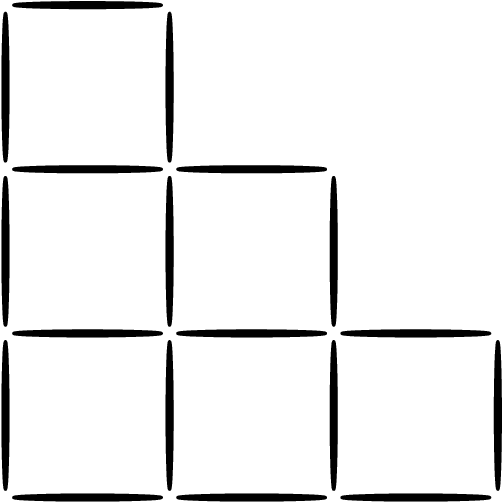
This is a -step staircase and uses toothpicks. How many steps would be in a staircase that used toothpicks?
- A)
- B)
- C)
- D)
- E)
- 18.2016 AMC 10A #9
A triangular array of coins has coin in the first row, coins in the second row, coins in the third row, and so on up to coins in the th row. What is the sum of the digits of ?
- A)
- B)
- C)
- D)
- E)
- 19.2013 AMC 10B #13
Jo and Blair take turns counting from to one more than the last number said by the other person. Jo starts by saying " ", so Blair follows by saying " " . Jo then says " " , and so on. What is the 53rd number said?
- A)
- B)
- C)
- D)
- E)
- 20.2012 AMC 10A #10
Mary divides a circle into sectors. The central angles of these sectors, measured in degrees, are all integers and they form an arithmetic sequence. What is the degree measure of the smallest possible sector angle?
- A)
- B)
- C)
- D)
- E)
- 21.2011 AMC 10B #10
Consider the set of numbers . The ratio of the largest element of the set to the sum of the other ten elements of the set is closest to which integer?
- A)
- B)
- C)
- D)
- E)
- 22.2009 AMC 10A #9
Positive integers , , and , with , form a geometric sequence with an integer ratio. What is ?
- A)
- B)
- C)
- D)
- E)
- 23.2008 AMC 10B #13
For each positive integer , the mean of the first terms of a sequence is . What is the 2008th term of the sequence?
- A)
- B)
- C)
- D)
- E)
- 24.2008 AMC 10B #11
Suppose that is a sequence of real numbers satisfying ,
and that and . What is ?
- A)
- B)
- C)
- D)
- E)
- 25.2004 AMC 10B #10
A grocer makes a display of cans in which the top row has one can and each lower row has two more cans than the row above it. If the display contains cans, how many rows does it contain?
- A)
- B)
- C)
- D)
- E)
- 26.2004 AMC 10A #7
A grocer stacks oranges in a pyramid-like stack whose rectangular base is oranges by oranges. Each orange above the first level rests in a pocket formed by four oranges below. The stack is completed by a single row of oranges. How many oranges are in the stack?
- A)
- B)
- C)
- D)
- E)
- 27.2003 AMC 10B #8
The second and fourth terms of a geometric sequence are and . Which of the following is a possible first term?
- A)
- B)
- C)
- D)
- E)
- 28.2001 AMC 10 #11
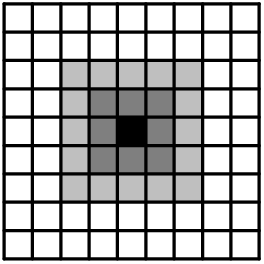
Consider the dark square in an array of unit squares, part of which is shown. The first ring of squares around this center square contains unit squares. The second ring contains unit squares. If we continue this process, the number of unit squares in the ring is
- A)
- B)
- C)
- D)
- E)
- 29.2000 AMC 10 #12
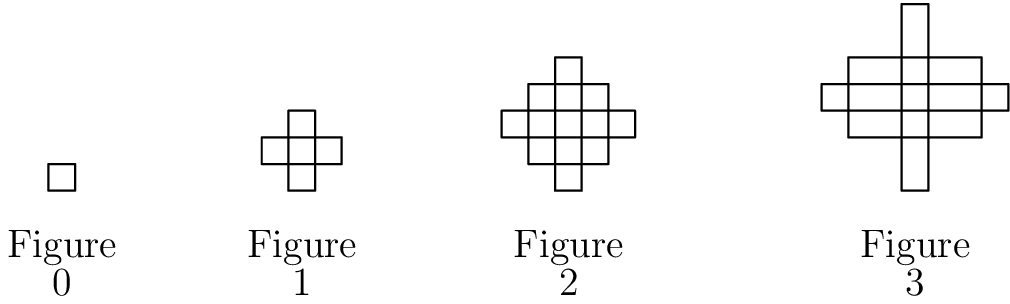
Figures , , , and consist of , , , and nonoverlapping unit squares, respectively. If the pattern were continued, how many nonoverlapping unit squares would there be in figure 100?
- A)
- B)
- C)
- D)
- E)
- 30.2025 AMC 10B #15
The sum can be expressed as , where and are relatively prime positive integers. What is ?
- A)
- B)
- C)
- D)
- E)
- 31.2025 AMC 10A #11
The sequence is arithmetic. The sequence is geometric. Both sequences are strictly increasing and contain only integers, and is as small as possible. What is the value of ?
- A)
- B)
- C)
- D)
- E)
- 32.2025 AMC 10A #13
In the figure below, the outside square contains infinitely many squares, each of them with the same center and sides parallel to the outside square. The ratio of the side length of a square to the side length of the next inner square is , where The spaces between squares are alternately shaded as shown in the figure (which is not necessarily drawn to scale).
The area of the shaded portion of the figure is of the area of the original square. What is ?

- A)
- B)
- C)
- D)
- E)
- 33.2025 AMC 10B #18
What is the ones digit of the sum (Recall that represents the greatest integer less than or equal to .)
- A)
- B)
- C)
- D)
- E)
- 34.2025 AMC 10A #19
An array of numbers is constructed beginning with the numbers in the top row. Each adjacent pair of numbers is summed to produce a number in the next row. Each row begins and ends with and , respectively.
If the process continues, one of the rows will sum to . In that row, what is the third number from the left?
- A)
- B)
- C)
- D)
- E)
- 35.2023 AMC 10A #15
An even number of circles are nested, starting with a radius of and increasing by each time, all sharing a common point. The region between every other circle is shaded, starting with the region inside the circle of radius but outside the circle of radius An example showing circles is displayed below. What is the least number of circles needed to make the total shaded area at least ?

- A)
- B)
- C)
- D)
- E)
- 36.2022 AMC 10B #15
Let be the sum of the first terms of an arithmetic sequence that has a common difference of . The quotient does not depend on . What is ?
- A)
- B)
- C)
- D)
- E)
- 37.2019 AMC 10B #18
Henry decides one morning to do a workout, and he walks of the way from his home to his gym. The gym is kilometers away from Henry's home. At that point, he changes his mind and walks of the way from where he is back toward home. When he reaches that point, he changes his mind again and walks of the distance from there back toward the gym. If Henry keeps changing his mind when he has walked of the distance toward either the gym or home from the point where he last changed his mind, he will get very close to walking back and forth between a point kilometers from home and a point kilometers from home. What is ?
- A)
- B)
- C)
- D)
- E)
- 38.2019 AMC 10A #15
A sequence of numbers is defined recursively by , , and for all . Then can be written as , where and are relatively prime positive integers. What is
- A)
- B)
- C)
- D)
- E)
- 39.2018 AMC 10B #20
A function is defined recursively by and for all integers . What is ?
- A)
- B)
- C)
- D)
- E)
- 40.2016 AMC 10B #16
The sum of an infinite geometric series is a positive number , and the second term in the series is . What is the smallest possible value of
- A)
- B)
- C)
- D)
- E)
- 41.2011 AMC 10A #17
In the eight-term sequence , the value of is 5 and the sum of any three consecutive terms is 30. What is ?
- A)
- B)
- C)
- D)
- E)
- 42.2009 AMC 10A #15
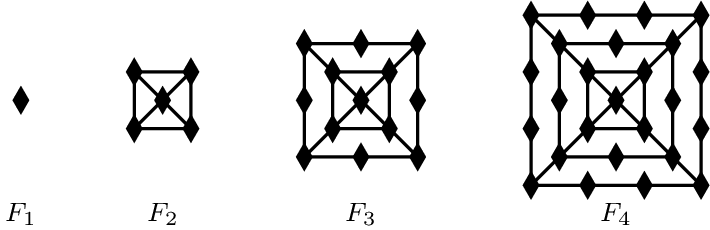
The figures , , , and shown are the first in a sequence of figures. For , is constructed from by surrounding it with a square and placing one more diamond on each side of the new square than had on each side of its outside square. For example, figure has diamonds. How many diamonds are there in figure ?
- A)
- B)
- C)
- D)
- E)
- 43.2009 AMC 10B #14
On Monday, Millie puts a quart of seeds, of which are millet, into a bird feeder. On each successive day she adds another quart of the same mix of seeds without removing any seeds that are left. Each day the birds eat only of the millet in the feeder, but they eat all of the other seeds. On which day, just after Millie has placed the seeds, will the birds find that more than half the seeds in the feeder are millet?
- A)
- B)
- C)
- D)
- E)
- 44.2006 AMC 10A #14
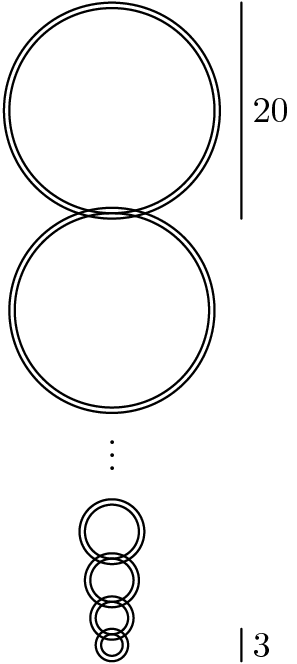
A number of linked rings, each cm thick, are hanging on a peg. The top ring has an outside diameter of cm. The outside diameter of each of the outer rings is cm less than that of the ring above it. The bottom ring has an outside diameter of cm. What is the distance, in cm, from the top of the top ring to the bottom of the bottom ring?
- A)
- B)
- C)
- D)
- E)
- 45.2006 AMC 10B #18
Let be a sequence for which , , and for each positive integer . What is ?
- A)
- B)
- C)
- D)
- E)
- 46.2005 AMC 10A #17
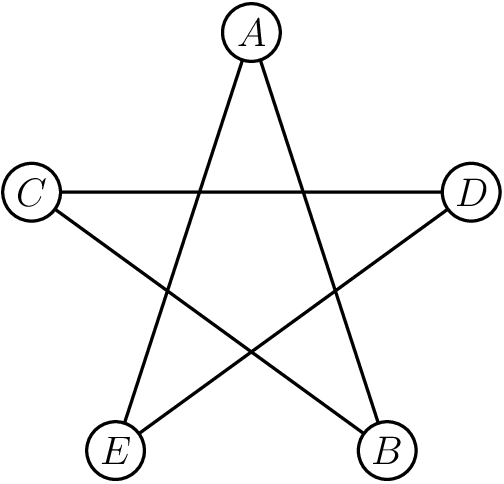
In the five-sided star shown, the letters , , , , and are replaced by the numbers , , , , and , although not necessarily in this order. The sums of the numbers at the ends of the line segments , , , , and form an arithmetic sequence, although not necessarily in this order. What is the middle term of the arithmetic sequence?
- A)
- B)
- C)
- D)
- E)
- 47.2005 AMC 10B #11
The first term of a sequence is . Each succeeding term is the sum of the cubes of the digits of the previous term. What is the term of the sequence?
- A)
- B)
- C)
- D)
- E)
- 48.2004 AMC 10A #18
A sequence of three real numbers forms an arithmetic progression with a first term of . If is added to the second term and is added to the third term, the three resulting numbers form a geometric progression. What is the smallest possible value for the third term in the geometric progression?
- A)
- B)
- C)
- D)
- E)
- 49.2004 AMC 10B #19
In the sequence , , , , each term after the third is found by subtracting the previous term from the sum of the two terms that precede that term. For example, the fourth term is . What is the term in this sequence?
- A)
- B)
- C)
- D)
- E)
- 50.2002 AMC 10B #19
Suppose that is an arithmetic sequence with What is the value of
- A)
- B)
- C)
- D)
- E)
- 51.2025 AMC 10B #17
Consider a decreasing sequence of positive integers that satisfies the following two conditions:
The average (arithmetic mean) of the first terms in the sequence is
For all the average of the first terms in the sequence is less than the average of the first terms in the sequence.
What is the greatest possible value of
- A)
- B)
- C)
- D)
- E)
- 52.2024 AMC 10A #19
The first three terms of a geometric sequence are the integers and , where . What is the sum of the digits of the least possible value of ?
- A)
- B)
- C)
- D)
- E)
- 53.2024 AMC 10A #21
The numbers, in order, of each row and the numbers, in order, of each column of a array of integers form an arithmetic progression of length . The numbers in positions , , and are , , , and , respectively. What number is in position ?
- A)
- B)
- C)
- D)
- E)
- 54.2024 AMC 10B #23
The Fibonacci numbers are defined by and for What is
- A)
- B)
- C)
- D)
- E)
- 55.2023 AMC 10B #23
An arithmetic sequence of positive integers has terms, initial term , and common difference . Carl wrote down all the terms in this sequence correctly except for one term, which was off by . The sum of the terms he wrote down was . What is ?
- A)
- B)
- C)
- D)
- E)
- 56.2022 AMC 10A #20
A four-term sequence is formed by adding each term of a four-term arithmetic sequence of positive integers to the corresponding term of a four-term geometric sequence of positive integers. The first three terms of the resulting four-term sequence are , , and . What is the fourth term of this sequence?
- A)
- B)
- C)
- D)
- E)
- 57.2019 AMC 10A #23
Travis has to babysit the terrible Thompson triplets. Knowing that they love big numbers, Travis devises a counting game for them. First Tadd will say the number , then Todd must say the next two numbers ( and ), then Tucker must say the next three numbers ( , , ), then Tadd must say the next four numbers ( , , , ), and the process continues to rotate through the three children in order, each saying one more number than the previous child did, until the number is reached. What is the th number said by Tadd?
- A)
- B)
- C)
- D)
- E)
- 58.2015 AMC 10B #24
Aaron the ant walks on the coordinate plane according to the following rules. He starts at the origin facing to the east and walks one unit, arriving at . For , right after arriving at the point , if Aaron can turn left and walk one unit to an unvisited point , he does that. Otherwise, he walks one unit straight ahead to reach . Thus the sequence of points continues , and so on in a counterclockwise spiral pattern. What is ?
- A)
- B)
- C)
- D)
- E)
- 59.2014 AMC 10A #24
A sequence of natural numbers is constructed by listing the first , then skipping one, listing the next , skipping , listing , skipping , and, on the th iteration, listing and skipping . The sequence begins . What is the number in the sequence?
- A)
- B)
- C)
- D)
- E)
- 60.2013 AMC 10B #21
Two non-decreasing sequences of nonnegative integers have different first terms. Each sequence has the property that each term, beginning with the third, is the sum of the previous two terms, and the seventh term of each sequence is . What is the smallest possible value of ?
- A)
- B)
- C)
- D)
- E)
- 61.2010 AMC 10B #24
A high school basketball game between the Raiders and Wildcats was tied at the end of the first quarter. The number of points scored by the Raiders in each of the four quarters formed an increasing geometric sequence, and the number of points scored by the Wildcats in each of the four quarters formed an increasing arithmetic sequence. At the end of the fourth quarter, the Raiders had won by one point. Neither team scored more than points. What was the total number of points scored by the two teams in the first half?
- A)
- B)
- C)
- D)
- E)
- 62.2004 AMC 10B #21
Let ; ; ; and ; ; ; be two arithmetic progressions. The set is the union of the first terms of each sequence. How many distinct numbers are in ?
- A)
- B)
- C)
- D)
- E)
- 63.2003 AMC 10B #24
The first four terms in an arithmetic sequence are , , , and , in that order. What is the fifth term?
- A)
- B)
- C)
- D)
- E)
- 64.2002 AMC 10B #23
Let be a sequence of integers such that and for all positive integers and Then is
- A)
- B)
- C)
- D)
- E)
- 65.2019 AMC 10B #24
Define a sequence recursively by and for all nonnegative integers Let be the least positive integer such that In which of the following intervals does lie?
- A)
- B)
- C)
- D)
- E)
Answers
| # | Answer | The idea it turns on |
|---|---|---|
| 1 | C | Start with the innermost parentheses and work outward. Each layer doubles the number and adds 1, giving 3, 7, 15, 31, 63, 127. |
| 2 | B | From 13 to 73 is a climb of 60, which is 20 jumps of 3. Twenty jumps connect 21 numbers, because you also count the starting number. |
| 3 | A | The two sums share every even number from 12 to 100. Those cancel when you subtract, leaving just 102 minus 10. |
| 4 | C | The terms go -1, 1, -1, 1, and so on. Each neighboring pair adds to 0, and 2006 terms make 1003 whole pairs. |
| 5 | A | From practice 1 to practice 5 there are only four doublings. Undo them by halving 48 four times. |
| 6 | D | Match the first even number with the first odd number, the second with the second, and so on. Each even number is exactly 1 more than its odd partner. |
| 7 | B | The first 8 odd numbers add to 64, so the five even numbers add to 60. Their middle one is the average, 12, so the smallest is 8. |
| 8 | D | From the second row on, each row's total is exactly double the one before, so the totals go 11, 22, 44, … and the 11th row totals 5632. |
| 9 | E | Break the sequence into groups that each end with 1, count how many terms the first few groups hold, then walk forward to position 2025. |
| 10 | B | The full sum is 2500. Flipping a plus to a minus takes away twice that number, so the flipped numbers must add up to more than 1250. |
| 11 | C | Work out the first ten or so steps. From step 6 the values repeat 20, 30, 10, so step 100 matches step 7, which is 30. |
| 12 | D | Step 63 ends at ball 2016, so ball 2024 is in step 64. Bins repeat every 5 steps, and step 64 lands on bin D. |
| 13 | D | Each term k/(k+1)! equals 1/k! minus 1/(k+1)!. Adding them, almost everything cancels, leaving 1 − 1/2022!. |
| 14 | D | The distances 5, 12, 19, ... grow by 7 each second. Find the distance in second 30, then add all thirty by pairing the first with the last. |
| 15 | B | Cut the sum into 50 groups of four. The groups add to 2, 10, 18, and so on, going up by 8 each time. Add those 50 numbers. |
| 16 | C | The five rows together use every number exactly once. So five times the row sum equals the total of all 25 numbers, which is 50. The row sum is 10. |
| 17 | C | Half the toothpicks are horizontal. Column by column the horizontal ones number 2, 3, 4, and so on, so find how many columns make 90. |
| 18 | D | The rows add up to N(N+1)/2 coins, so N times (N+1) is 4032. Since 63 squared is close to 4032, try 63 times 64, which is exactly 4032. |
| 19 | E | Turn k says k numbers, so after 9 turns 45 numbers have been said. The 53rd number is the 8th number of turn 10, which is 8. |
| 20 | C | The 12 angles add to 360, so 2a + 11d = 60. A bigger step d means a smaller first angle; d must be even, so try d = 4. |
| 21 | B | The ten smaller numbers add up to 1,111,111,111. Nine times that is 9,999,999,999, just 1 short of the largest number, so the ratio is almost exactly 9. |
| 22 | B | The ratio squared must divide 2009 = 7 x 7 x 41, so the ratio is 7 and a = 2009 / 49 = 41. |
| 23 | B | If the first n terms average n, they add up to n times n. Each term is the jump from one square to the next: the odd numbers. |
| 24 | B | The missing term between the two known ones is the fourth term. Call it a, build the fifth and sixth terms from it, and set the sixth equal to 128. |
| 25 | D | The rows hold 1, 3, 5, 7, ... cans, and adding up the first few odd numbers always gives a perfect square. So 100 cans means 10 rows. |
| 26 | C | Each orange sits in a gap between four below, so each layer shrinks by one both ways: 5 by 8, 4 by 7, down to 1 by 4. |
| 27 | B | From the 2nd term to the 4th you multiply by the ratio twice, so the ratio squared is 3. The ratio may be negative. |
| 28 | C | Split a ring into its four sides. The nth ring has two rows of 2n+1 squares and two columns of 2n-1 squares, which adds up to 8n. |
| 29 | C | Figure n has n squared plus (n+1) squared unit squares, so figure 100 has 100 squared plus 101 squared, which is 20201. |
| 30 | D | The bottom factors as k(k+2)(k+4). Each term is one quarter of the difference 1/(k(k+2)) − 1/((k+2)(k+4)), so the sum cancels down to its first two pieces. |
| 31 | E | The geometric sequence 1, p, q, z makes z a perfect cube. The arithmetic one makes z one more than a multiple of 3. Test cubes 8, 27, 64. |
| 32 | D | Each shaded ring is a shrunken copy of the one two rings further out, so the shaded areas add up to 1/(1 + k squared). |
| 33 | D | The value n appears 2n + 1 times, from n² to just before (n+1)². So add n(2n + 1) for n = 1 to 44, plus 45. |
| 34 | A | Each row adds up to twice the row above, so 12,288 is the sum of row 13. Then follow only the second and third numbers down to that row. |
| 35 | E | Each shaded ring is the difference of two circles, and those areas are 3, 7, 11, ... times pi. With n rings the total is n(2n + 1) times pi. |
| 36 | D | The ratio stays the same for every n only if the first term is 1. Then the terms are the odd numbers, and their sums are perfect squares. |
| 37 | C | In the long run Henry bounces between two fixed turning points. Walking toward the gym from A must end at B, and walking home from B must end at A. |
| 38 | E | Flip every term upside down. The flipped terms go up by the same amount each time: 1, 7/3, 11/3, 15/3, and so on. |
| 39 | B | Work out the first dozen values. Every 6 steps the value goes up by exactly 6, so jump from f(2) to f(2018) in steps of 6. |
| 40 | E | With second term 1 and ratio r, the sum is S = 1/(r(1 - r)). The bottom is largest, 1/4, at r = 1/2, so S is at least 4. |
| 41 | C | Two overlapping groups of three share two terms, so each term equals the term three places later. So H equals B, and A + B = 30 − 5. |
| 42 | E | Each new ring with n diamonds per side holds 4(n - 1) diamonds, so F_20 = 1 + 4(1 + 2 + ... + 19) = 761. |
| 43 | D | After each refill there is always exactly 3/4 quart of other seeds, since the birds eat them all. Track only the millet until it passes 3/4 quart. |
| 44 | B | Each ring hangs on the one above, so the holes line up end to end. Add the holes, 18 down to 1, plus 1 cm at each end. |
| 45 | E | Write out terms until 2 and 3 appear again. The sequence repeats every 6 terms, and 2006 leaves remainder 2, so use the second term. |
| 46 | D | Each letter is on exactly two segments, so the five sums add to twice 30, which is 60. The middle of five evenly spaced numbers is their average, 12. |
| 47 | E | Write out terms until one repeats. From term 2 on, the sequence cycles 133, 55, 250 every 3 terms, and term 2005 lands on 250, like term 4. |
| 48 | A | The new numbers are 9, 11 + d and 29 + 2d. Making them geometric gives d = 10 or d = -14; the second gives third term 1. |
| 49 | C | List the first ten terms. The even-numbered terms drop by 2 each time: 2002, 2000, 1998, ... After 1001 drops, term 2004 is 0. |
| 50 | C | Each term in the second block is 100 steps after its partner in the first, so it is 100d bigger. The sums differ by 10000d = 100. |
| 51 | B | The average of the first k terms is 2028 − k, so their total is k(2028 − k). Subtracting totals shows later terms drop by 2. |
| 52 | E | The middle term squared equals the product of the outer terms, so ab = 720². Make a the largest divisor of 720² below 720. |
| 53 | C | Measure from the bottom-right 0. Column 5 goes up in equal steps, and the row steps themselves change by equal amounts, so each entry is P·u + v·(Q + R·u). |
| 54 | B | The ten fractions come out to whole numbers 1, 3, 4, 7, 11, ... and each one is the sum of the two before it, just like Fibonacci numbers. |
| 55 | B | The real sum is 221 or 223. The number of terms divides twice the sum and is at most 14, since steps are at least 2. Only 13 fits. |
| 56 | E | Subtracting neighboring terms twice removes the arithmetic part and leaves b(r - 1) squared = 28. So the ratio r is 2 or 3. |
| 57 | C | Tadd speaks in every third turn, saying 1, 4, 7, ... numbers. Add these to find which turn holds his 2019th number, then find where that turn starts. |
| 58 | D | At square step numbers the ant sits at a spiral corner. Step 1936 is at (-22, 22); then 44 steps down and 35 steps right. |
| 59 | A | The 500,000th listed number is 500,000 plus how many numbers were skipped before it. Up to that point, 1 + 2 + ... + 996 = 496,506 numbers were skipped. |
| 60 | C | The seventh term is 5a + 8b. Two different starts give the same seventh term only if one start is 8 more in a and 5 less in b. |
| 61 | E | The 100-point limit leaves the Raiders few options, such as 1, 2, 4, 8 or 8, 12, 18, 27. Only 5, 10, 20, 40 fits a Wildcats total one lower. |
| 62 | A | Shared numbers start at 16 and go up by 21, but only up to 6010, where the first list ends. That gives 286 to subtract. |
| 63 | E | Each step adds -2y, so the 3rd and 4th terms are x - 3y and x - 5y. Dividing xy = x - 3y by y gives y = -3/5. |
| 64 | D | Put n = 1: each term is the previous one plus the next counting number. That gives 1, 3, 6, 10, ..., the triangular numbers, so a_12 = 78. |
| 65 | C | Track how far each term is above 4. That distance shrinks by a factor between 9/10 and 10/11 each step, so powers of those fractions bound m. |
Problems © Mathematical Association of America (MAA), American Mathematics Competitions. Reproduced for non-commercial educational use. The topic note, tags and key insights are original to this site.