Sequences & Series
Arithmetic/geometric sequences, recursions, sums, telescoping sums
What you need to know
We write for the th term of a sequence, so is the first term.
- Arithmetic sequences go up by the same amount each time (the common difference). The th term is . The sum of the first terms is : the number of terms times the average of the first and last. Example: for , and .
- Geometric sequences multiply by the same number each time (the common ratio). Then and . Example: for , and .
- Infinite geometric series. If is between and , the sum that goes on forever is . Example: .
- Sums to memorize. . . . Example: with these are , , and .
- Telescoping. Write each term as a difference so that neighbors cancel and only the ends survive. The key split is (this is partial fractions). Example: .
- Recursions often repeat. When each term is made from the one before, compute terms until one repeats. From there the sequence cycles. If the cycle goes all the way back to , only the remainder of the index divided by the cycle length (the period) matters. If some terms come before the cycle starts, count from the start of the cycle instead: adding the squares of the digits, starting from , gives , a cycle of length that starts at . Example: and give , with period . Since , .
- Three-term tests. is arithmetic exactly when . For numbers that are not zero, is geometric exactly when . Example: is arithmetic () and is geometric ().
How AMC 10 tests it
- Problems 3–10: a direct question about an arithmetic sequence (one term, a sum, or the number of terms).
- Problems 8–15: ", ; find ." Compute a few terms, spot the cycle, and use the remainder of the index.
- Problems 10–18: an arithmetic or geometric sequence hidden in a story (rows of seats, a bouncing ball), sometimes an infinite geometric series.
- Problems 14–20: a telescoping sum of fractions, or of terms like . Rewrite each term as a difference, such as .
- Mixed conditions (" is arithmetic and is geometric") that turn into a small system of equations.
Standard approaches
- Decide the type: arithmetic, geometric, telescoping, or recursive. For a recursion, write out the first five or six terms.
- For an arithmetic sum, use (number of terms) (average term). Count the terms as .
- For a sum of fractions, or a product, try to write each term as a difference of neighboring pieces, like .
- For a term with a huge index, find the period or a formula, then reduce the index.
- Use the answer choices as a check: whole number or not, even or odd, or the pattern from small cases.
Worked example
Define and for . What is the product ?
(A) (B) (C) (D) (E)
Compute terms until one repeats.
Since , the terms repeat in blocks of : .
Multiply one block. .
Count the blocks. . So the terms are full blocks, each multiplying to , then two extra terms: and .
The whole product is . The answer is .
Pitfalls
- Off-by-one when counting terms: is steps past . Example: for , , not .
- Using when is not between and . Example: has no sum, but the formula would give .
- Reducing the index wrongly. With period and a cycle that starts at , an index that is a multiple of (remainder , like ) matches , not a nonexistent .
- Telescoping without tracking which terms survive at both ends, or dropping the factor in front: , not .
Traps that recur
- Trying to compute terms exactly, or bounding with only one side of the ratio and landing in the wrong interval. (2019 AMC 10B #24)
- Reading 'the average drops by 1' as 'each term drops by 1' and running the sequence down from around 2025 to 1, which points at choice (E). (2025 AMC 10B #17)
- Assuming the ratio must be an integer (b = 1440, digit sum 9) or grabbing 9/8 (b = 810) without checking that 15 and 16 both divide 720. (2024 AMC 10A #19)
- Assuming every row has the same common difference (a linear function Bi + Cj + A), which cannot fit the four given values; the row differences themselves form an arithmetic progression. (2024 AMC 10A #21)
- 1.2017 AMC 10A #1
What is the value of ?
- A)
- B)
- C)
- D)
- E)
- 2.2015 AMC 10A #7
How many terms are there in the arithmetic sequence , , , . . ., , ?
- A)
- B)
- C)
- D)
- E)
- 3.2011 AMC 10A #4
Let and be the following sums of arithmetic sequences: What is the value of ?
- A)
- B)
- C)
- D)
- E)
- 4.2006 AMC 10B #1
What is ?
- A)
- B)
- C)
- D)
- E)
- 5.2004 AMC 10B #3
At each basketball practice last week, Jenny made twice as many free throws as she made at the previous practice. At her fifth practice she made free throws. How many free throws did she make at the first practice?
- A)
- B)
- C)
- D)
- E)
- 6.2003 AMC 10B #3
The sum of consecutive even integers is less than the sum of the first consecutive odd counting numbers. What is the smallest of the even integers?
- A)
- B)
- C)
- D)
- E)
- 7.2003 AMC 10A #1
What is the difference between the sum of the first even counting numbers and the sum of the first odd counting numbers?
- A)
- B)
- C)
- D)
- E)
- 8.2025 AMC 10A #5
Consider the sequence of positive integers
What is the th term in this sequence?
- A)
- B)
- C)
- D)
- E)
- 9.2025 AMC 10B #3
A Pascal-like triangle has as the top row and followed by as the second row. In each subsequent row the first number is , the last number is , and, as in the standard Pascal's Triangle, each other number in the row is the sum of the two numbers directly above it. The first four rows are shown below:
What is the sum of the digits of the sum of the numbers in the th row?
- A)
- B)
- C)
- D)
- E)
- 10.2024 AMC 10B #4
Balls numbered 1, 2, 3, ... are deposited in 5 bins, labeled A, B, C, D, and E, using the following procedure. Ball 1 is deposited in bin A, and balls 2 and 3 are deposited in bin B. The next 3 balls are deposited in bin C, the next 4 in bin D, and so on, cycling back to bin A after balls are deposited in bin E. (For example, balls numbered 22, 23, ..., 28 are deposited in bin B at step 7 of this process.) In which bin is ball 2024 deposited?
- A)
- B)
- C)
- D)
- E)
- 11.2024 AMC 10A #10
Consider the following operation. Given a positive integer , if is a multiple of , then you replace by . If is not a multiple of , then you replace by . For example, beginning with , this procedure gives . Suppose you start with . What value results if you perform this operation exactly times?
- A)
- B)
- C)
- D)
- E)
- 12.2024 AMC 10B #5
In the following expression, Melanie changed some of the plus signs to minus signs: When the new expression was evaluated, it was negative. What is the least number of plus signs that Melanie could have changed to minus signs?
- A)
- B)
- C)
- D)
- E)
- 13.2022 AMC 10B #9
The sum can be expressed as , where and are positive integers. What is ?
- A)
- B)
- C)
- D)
- E)
- 14.2021 AMC 10A #4
A cart rolls down a hill, travelling inches the first second and accelerating so that during each successive -second time interval, it travels inches more than during the previous -second interval. The cart takes seconds to reach the bottom of the hill. How far, in inches, does it travel?
- A)
- B)
- C)
- D)
- E)
- 15.2020 AMC 10A #7
The integers from to inclusive, can be arranged to form a -by- square in which the sum of the numbers in each row, the sum of the numbers in each column, and the sum of the numbers along each of the main diagonals are all the same. What is the value of this common sum?
- A)
- B)
- C)
- D)
- E)
- 16.2020 AMC 10A #8
What is the value of
- A)
- B)
- C)
- D)
- E)
- 17.2018 AMC 10B #8
Sara makes a staircase out of toothpicks as shown:
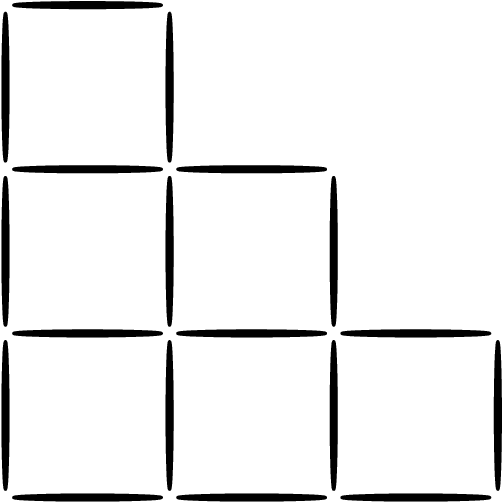
This is a -step staircase and uses toothpicks. How many steps would be in a staircase that used toothpicks?
- A)
- B)
- C)
- D)
- E)
- 18.2016 AMC 10A #9
A triangular array of coins has coin in the first row, coins in the second row, coins in the third row, and so on up to coins in the th row. What is the sum of the digits of ?
- A)
- B)
- C)
- D)
- E)
- 19.2013 AMC 10B #13
Jo and Blair take turns counting from to one more than the last number said by the other person. Jo starts by saying " ", so Blair follows by saying " " . Jo then says " " , and so on. What is the 53rd number said?
- A)
- B)
- C)
- D)
- E)
- 20.2012 AMC 10A #10
Mary divides a circle into sectors. The central angles of these sectors, measured in degrees, are all integers and they form an arithmetic sequence. What is the degree measure of the smallest possible sector angle?
- A)
- B)
- C)
- D)
- E)
Problems © Mathematical Association of America (MAA), American Mathematics Competitions. Reproduced for non-commercial educational use. The topic note, tags and key insights are original to this site.