Quadrilaterals & Polygon Areas
Areas of quadrilaterals/polygons, trapezoids, shoelace, decomposition, hexagons
What you need to know
- Area formulas. Trapezoid: , where , are the parallel sides and is the distance between them. Parallelogram: . Rhombus or kite: , half the product of the diagonals. Example: parallel sides and with height give ; diagonals and give a rhombus of area .
- Any quadrilateral. If the diagonals and cross at angle , the area is . Example: diagonals and crossing at give .
- Shoelace Theorem. For corners listed in order around the shape, area . Example: , , , give .
- Regular hexagon. With side , it is six equilateral triangles, so its area is . Its long diagonal (through the center) is , and its short diagonal (skipping one corner) is . Example: gives area and diagonals and .
- Trapezoid with its diagonals. If the diagonals cross at , the two triangles on the parallel sides are similar, and the two triangles on the legs have equal area.
- Pick's Theorem. For a polygon whose corners are lattice points (both coordinates integers), area , where counts the lattice points inside and those on the boundary. Example: the rectangle from to has and , so its area is .
How AMC 10 tests it
- Early: the area of a figure on a grid. Count squares, use Shoelace or Pick, or subtract right triangles from a rectangle around it.
- A trapezoid given by its bases and legs. Drop perpendiculars; often a -- triangle gives the height.
- A square with points on its sides, joined to make a quadrilateral inside; find the ratio of the areas.
- Regular hexagons: the area of a triangle on three of its corners, or one hexagon inside another. The answer contains .
Standard approaches
- Cut along a diagonal or drop perpendiculars to make rectangles and right triangles.
- Find the area of a big simple region and subtract the unwanted pieces.
- For figures on a grid or given by coordinates, use Shoelace directly.
- For a trapezoid with its diagonals, get all four small areas from one, using the ratio of the bases.
Worked example
Trapezoid has , , and . The diagonals meet at , and the area of triangle is . What is the area of the trapezoid?
(A) (B) (C) (D) (E)
Solution. Write for the area of triangle .
Step 1. Since , triangles and have equal angles, so they are similar, with ratio . Areas go by the square of the ratio: .
Step 2. The similarity also gives . Triangles and share the corner , and their bases and lie on line , so they have the same height. Their areas are in the ratio of their bases: .
Step 3. The two side triangles have equal area, so as well.
Step 4. Add the four pieces:
The answer is .
Pitfalls
- Using the slanted leg of a trapezoid as its height. Example: a leg of that runs sideways gives height .
- Listing corners out of order in Shoelace. That measures a different, self-crossing shape.
- Using when the diagonals are not perpendicular.
Traps that recur
- Building the frame side from 3/7 alone (e.g. 1 + 6/7 or similar), which produces the decoy answers with 49 in the denominator. (2023 AMC 10A #24)
- Assuming R must be parallel to the 1x3 rectangle or to the unit square, which finds only one of the two configurations. (2021 AMC Fall 10B #25)
- Trying to find the trapezoid's dimensions or P's location; only the ratio is determined, and the height h cancels immediately in the differences of squares. (2022 AMC 10A #23)
- Assuming the pentagon is regular, or adding four equilateral triangles plus a 'middle region' without noticing that segments FC and GD cross. (2021 AMC 10B #20)
- 1.2022 AMC 10B #2
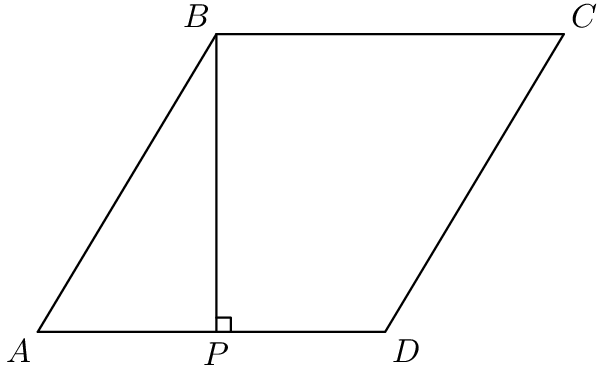
In rhombus , point lies on segment so that , , and . What is the area of ? (Note: The figure is not drawn to scale.)
- A)
- B)
- C)
- D)
- E)
- 2.2021 AMC Fall 10B #2
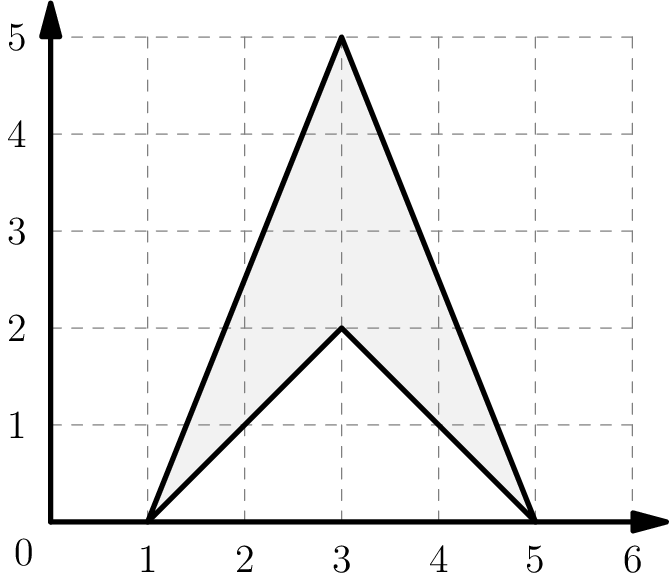
What is the area of the shaded figure shown below?
- A)
- B)
- C)
- D)
- E)
- 3.2017 AMC 10A #3
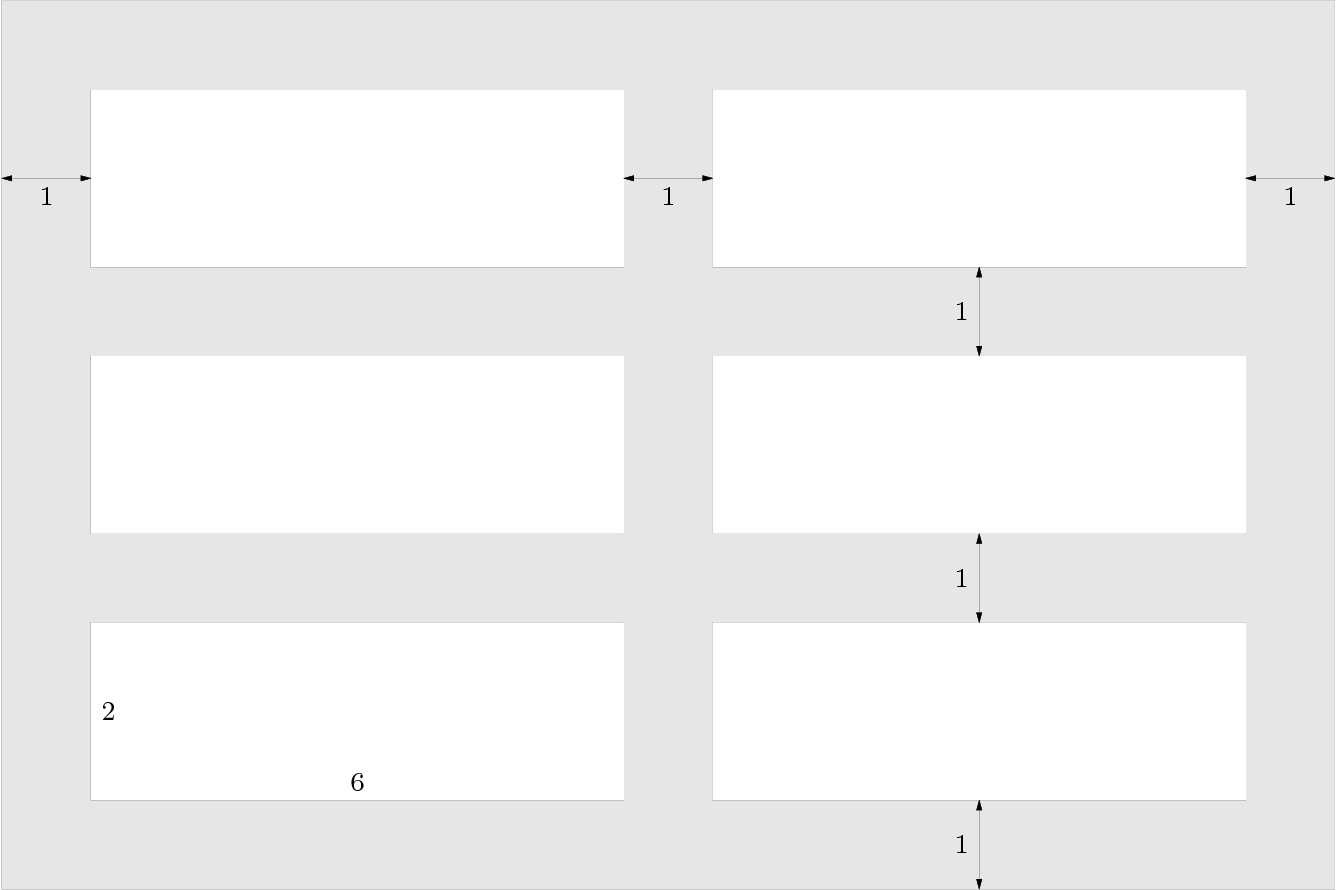
Tamara has three rows of two -feet by -feet flower beds in her garden. The beds are separated and also surrounded by -foot-wide walkways, as shown on the diagram. What is the total area of the walkways, in square feet?
- A)
- B)
- C)
- D)
- E)
- 4.2012 AMC 10B #2
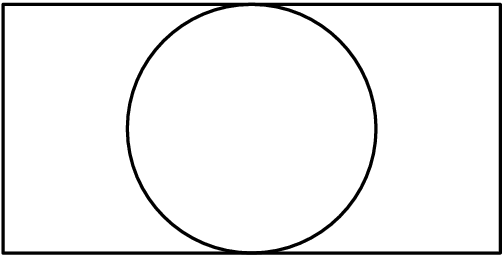
A circle of radius 5 is inscribed in a rectangle as shown. The ratio of the length of the rectangle to its width is 2:1. What is the area of the rectangle?
- A)
- B)
- C)
- D)
- E)
- 5.2012 AMC 10A #2
A square with side length is cut in half, creating two congruent rectangles. What are the dimensions of one of these rectangles?
- A)
- B)
- C)
- D)
- E)
- 6.2010 AMC 10A #2
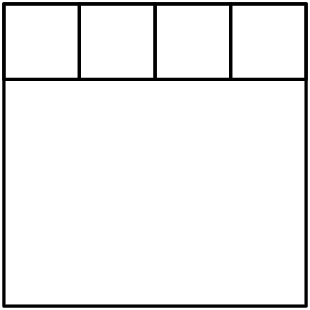
Four identical squares and one rectangle are placed together to form one large square as shown. The length of the rectangle is how many times as large as its width?
- A)
- B)
- C)
- D)
- E)
- 7.2009 AMC 10B #4
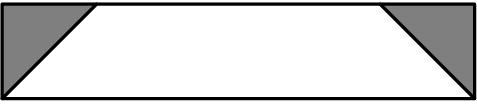
A rectangular yard contains two flower beds in the shape of congruent isosceles right triangles. The remainder of the yard has a trapezoidal shape, as shown. The parallel sides of the trapezoid have lengths and meters. What fraction of the yard is occupied by the flower beds?
- A)
- B)
- C)
- D)
- E)
- 8.2019 AMC 10B #8
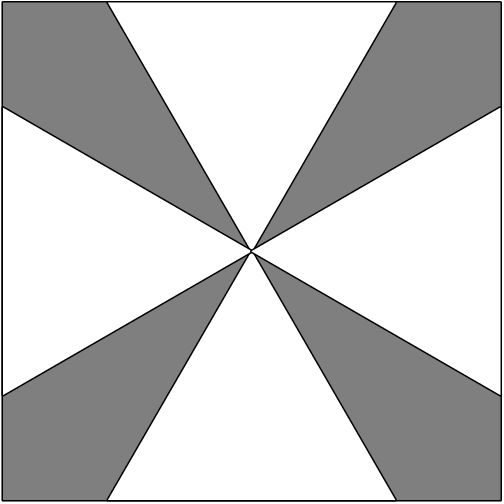
The figure below shows a square and four equilateral triangles, with each triangle having a side lying on a side of the square, such that each triangle has side length and the third vertices of the triangles meet at the center of the square. The region inside the square but outside the triangles is shaded. What is the area of the shaded region?
- A)
- B)
- C)
- D)
- E)
- 9.2016 AMC 10A #10
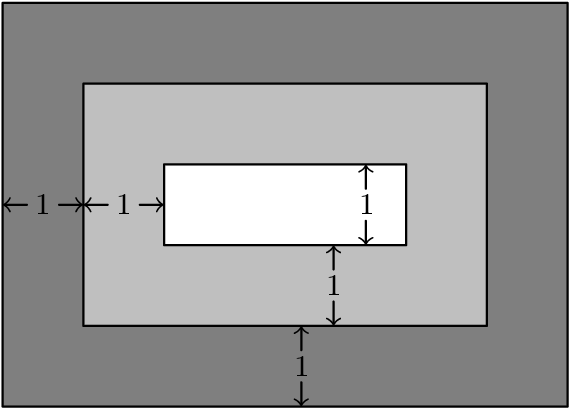
A rug is made with three different colors as shown. The areas of the three differently colored regions form an arithmetic progression. The inner rectangle is one foot wide, and each of the two shaded regions is foot wide on all four sides. What is the length in feet of the inner rectangle?
- A)
- B)
- C)
- D)
- E)
- 10.2009 AMC 10A #14
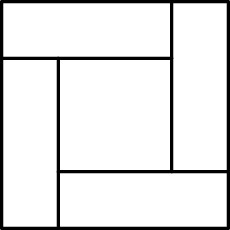
Four congruent rectangles are placed as shown. The area of the outer square is times that of the inner square. What is the ratio of the length of the longer side of each rectangle to the length of its shorter side?
- A)
- B)
- C)
- D)
- E)
- 11.2008 AMC 10A #10
Each of the sides of a square with area is bisected, and a smaller square is constructed using the bisection points as vertices. The same process is carried out on to construct an even smaller square . What is the area of ?
- A)
- B)
- C)
- D)
- E)
- 12.2006 AMC 10A #7
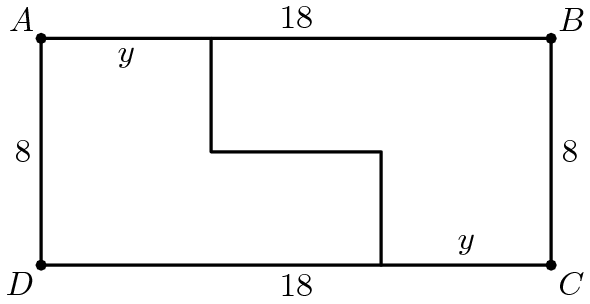
The rectangle is cut into two congruent hexagons, as shown, in such a way that the two hexagons can be repositioned without overlap to form a square. What is ?
- A)
- B)
- C)
- D)
- E)
- 13.2003 AMC 10B #4
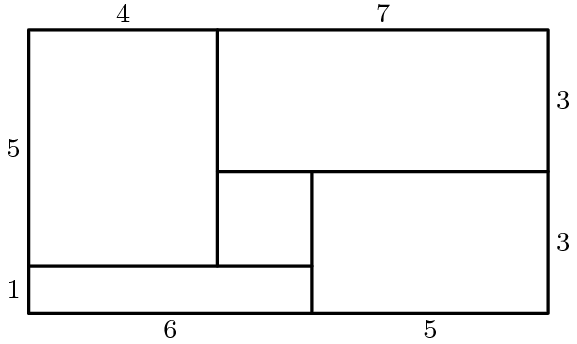
Rose fills each of the rectangular regions of her rectangular flower bed with a different type of flower. The lengths, in feet, of the rectangular regions in her flower bed are as shown in the figure. She plants one flower per square foot in each region. Asters cost each, begonias each, cannas each, dahlias each, and Easter lilies each. What is the least possible cost, in dollars, for her garden?
- A)
- B)
- C)
- D)
- E)
- 14.2002 AMC 10A #8
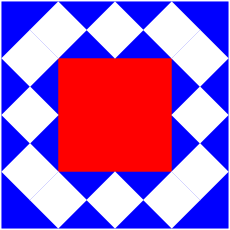
Betsy designed a flag using blue triangles, small white squares, and a red center square, as shown. Let be the total area of the blue triangles, the total area of the white squares, and the area of the red square. Which of the following is correct?
- A)
- B)
- C)
- D)
- E)
- 15.2022 AMC 10B #16
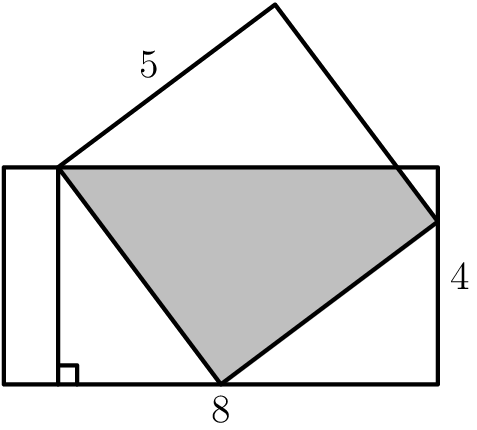
The diagram below shows a rectangle with side lengths and and a square with side length . Three vertices of the square lie on three different sides of the rectangle, as shown. What is the area of the region inside both the square and the rectangle?
- A)
- B)
- C)
- D)
- E)
- 16.2022 AMC 10A #10
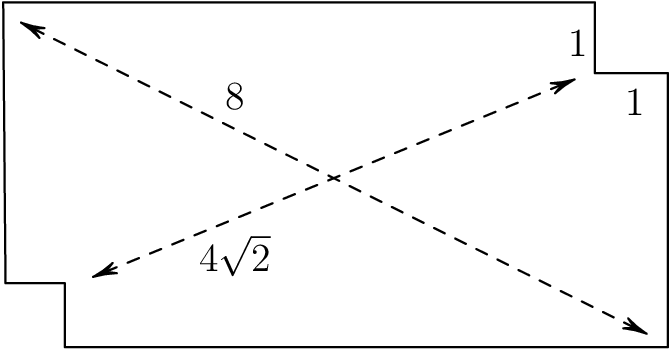
Daniel finds a rectangular index card and measures its diagonal to be centimeters. Daniel then cuts out equal squares of side cm at two opposite corners of the index card and measures the distance between the two closest vertices of these squares to be centimeters, as shown below. What is the area of the original index card?
- A)
- B)
- C)
- D)
- E)
- 17.2016 AMC 10A #11
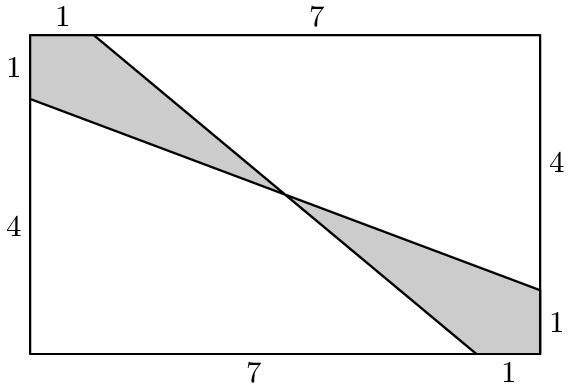
Find the area of the shaded region.
- A)
- B)
- C)
- D)
- E)
- 18.2014 AMC 10A #16
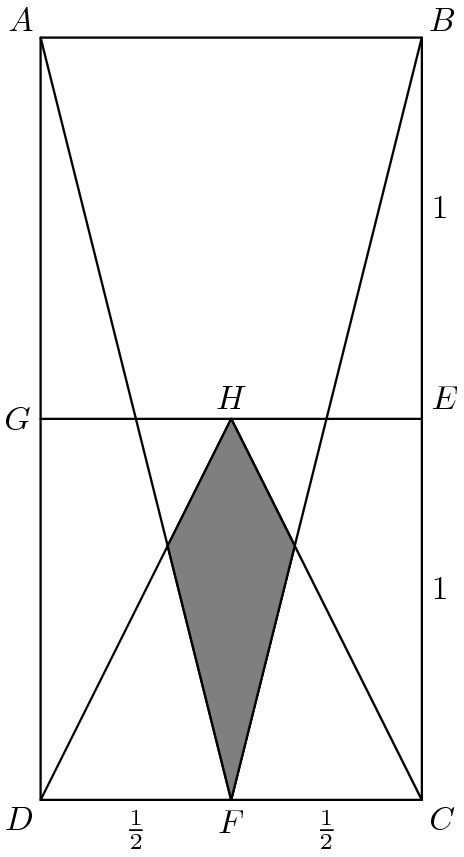
In rectangle , , , and points , , and are midpoints of , , and , respectively. Point is the midpoint of . What is the area of the shaded region?
- A)
- B)
- C)
- D)
- E)
- 19.2014 AMC 10A #13
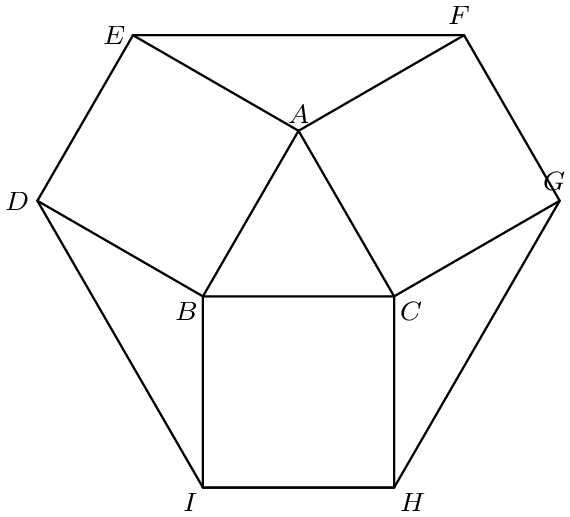
Equilateral has side length , and squares , , lie outside the triangle. What is the area of hexagon ?
- A)
- B)
- C)
- D)
- E)
- 20.2013 AMC 10B #15
A wire is cut into two pieces, one of length and the other of length . The piece of length is bent to form an equilateral triangle, and the piece of length is bent to form a regular hexagon. The triangle and the hexagon have equal area. What is ?
- A)
- B)
- C)
- D)
- E)
Answers
| # | Answer | The idea it turns on |
|---|---|---|
| 1 | D | All four sides of a rhombus are equal, so AB = 5. That makes triangle ABP a 3-4-5 right triangle, and its side BP = 4 is the height. |
| 2 | B | Fill in the notch to get a big triangle, then take the notch back out; both triangles sit on the same base of length 4. |
| 3 | B | Find the size of the whole garden, including every walkway strip, then subtract the six flower beds. What is left over is the walkway. |
| 4 | E | The circle touches the top and bottom of the rectangle, so the width equals the circle's diameter, 10. The length is twice that, 20. |
| 5 | E | A cut straight through the middle splits one side of 8 into two 4s and leaves the other side at 8. |
| 6 | B | Give the small square side 1. The big square is then 4 by 4, and the rectangle under the row is 4 long and 3 tall. |
| 7 | C | The two triangles use up 25 - 15 = 10 meters of the top edge, so each has legs of 5, which is also the yard's width. |
| 8 | B | Each triangle stands on a side and its tip reaches the center, so its height is half the square's side. So the square has side 2 times root 3. |
| 9 | B | With inner length x, the colored areas are x, 2x + 6 and 2x + 14. Equal gaps need x + 6 = 8, so x = 2. |
| 10 | A | The outer square's side is a + b and the inner square's is a - b. Four times the area means twice the side. |
| 11 | E | Joining the midpoints of a square cuts off four corner triangles worth half its area. So each new square is half the last: 16, 8, 4. |
| 12 | A | Moving pieces does not change area, so the square has area 144 and side 12. The long edge 18 − y of each hexagon becomes a side of the square. |
| 13 | A | Find the five areas from the figure (21, 20, 15, 6, 4). To spend the least, put the cheapest flower in the biggest region and the priciest in the smallest. |
| 14 | A | Cut the flag into 16 equal small squares. The 4 middle ones are red, and each of the 12 border squares is exactly half white and half blue. |
| 15 | D | The square's side from the bottom edge to the top edge is 5 long and rises 4, so it is tilted like a 3-4-5 triangle. Subtract the corner sticking out. |
| 16 | E | Call the sides a and b. The two measurements give a squared plus b squared = 64 and a + b = 10; the area ab follows directly. |
| 17 | D | Turning the picture half a turn about the rectangle's center leaves it unchanged, so the slanted lines cross at the center and the two shaded pieces are equal. |
| 18 | E | Put the rectangle on a grid. The shaded shape is a kite with a tall diagonal of length 1 and a crossing diagonal of length 1/3. |
| 19 | C | Cut the hexagon into the triangle, the three squares, and three thin gap triangles. Each gap triangle has two sides of length 1 with a 120-degree angle between them. |
| 20 | B | Write each area using its side length: the triangle's side is a/3 and the hexagon's side is b/6. The hexagon is six small equilateral triangles. |
Problems © Mathematical Association of America (MAA), American Mathematics Competitions. Reproduced for non-commercial educational use. The topic note, tags and key insights are original to this site.