Circles
Chords, tangents, inscribed angles, power of a point, arc length, sectors, inscribed/circumscribed circles
What you need to know
- Inscribed Angle Theorem. An inscribed angle (corner on the circle) is half the arc it cuts off. So an inscribed angle whose sides pass through the two ends of a diameter is a right angle. Example: an inscribed angle on a arc is .
- Tangents. A tangent line is perpendicular to the radius at the point where it touches. Two Tangent Theorem: the two tangent segments from a point outside the circle are equal. Example: from a point away from the center of a circle with radius , both tangents are long.
- Power of a Point. If chords and cross at , then . From a point outside the circle, with a tangent and a line (a secant) meeting the circle at and then : . Example: chords with , , give . A secant with , gives .
- Arcs and sectors. A central angle of degrees cuts off of the circle: the arc length is , and the sector (pizza slice) has area . Example: with and , the arc is long and the sector's area is .
How AMC 10 tests it
- Shaded regions (problems 3–12): circles in squares, or semicircles on the sides of a triangle. Subtract sectors and triangles.
- Tangent lines from a point, or one line tangent to two circles. Radii to the points of tangency give a right triangle or a trapezoid with two right angles.
- Problems 17–23: Power of a Point for a length, or a rope wrapping around a polygon, giving a sum of sectors.
Standard approaches
- Draw the radius to every point of tangency and every chord end. Look for right angles, and for isosceles triangles (radii are equal).
- Turn inscribed angles into arcs, add the arcs, and turn back.
- When two chords, or a tangent and a secant, pass through one point, write Power of a Point.
Worked example
Point lies outside a circle with center and radius . The two tangent segments from touch the circle at and , and . What is the area of the region bounded by , , and the minor arc ?
(A) (B) (C) (D) (E)
Solution. Step 1. Each tangent is perpendicular to its radius, so .
Step 2. Right triangles and share the hypotenuse and have , so they are congruent, and . Triangle is a -- triangle with short leg , so and .
Step 3. The kite is two copies of triangle , so its area is .
Step 4. The central angle is , so sector has area .
Step 5. The region is the kite minus the sector: .
The answer is .
Pitfalls
- Putting the diameter into instead of the radius. The area comes out times too big, and the answer choices often differ by that factor of .
- Finding a sector's area with the inscribed angle instead of the central angle (which is twice as big).
- In Power of a Point, using instead of . Both lengths start at . Example: with and , the product is , not .
Traps that recur
- Assuming the inner corners lie on a circle of radius 3 (the table radius minus the mat width), rather than at distance x from the center. (2008 AMC 10A #25)
- Assuming the inner circle is the incircle of the triangle of centres, whose inradius is 1, or reading the picture's apparent symmetry as meaning the inner centre is equidistant from the three outer centres. (2025 AMC 10A #22)
- Losing a minus sign when writing the diameter, giving (sqrt 2 - 1)(sqrt 3 + 1) and the sum 5 in (B). (2025 AMC 10B #20)
- Finding only the small pipe wedged between the two and answering 1/9, forgetting that a pipe on the far side of the small one is also in contact with both. (2024 AMC 10B #21)
- 1.2019 AMC 10A #16
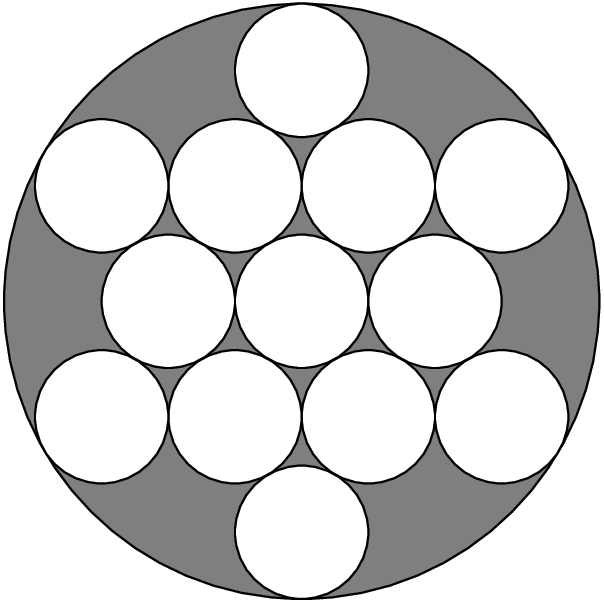
The figure below shows circles of radius within a larger circle. All the intersections occur at points of tangency. What is the area of the region, shaded in the figure, inside the larger circle but outside all the circles of radius
- A)
- B)
- C)
- D)
- E)
- 2.2018 AMC 10A #15
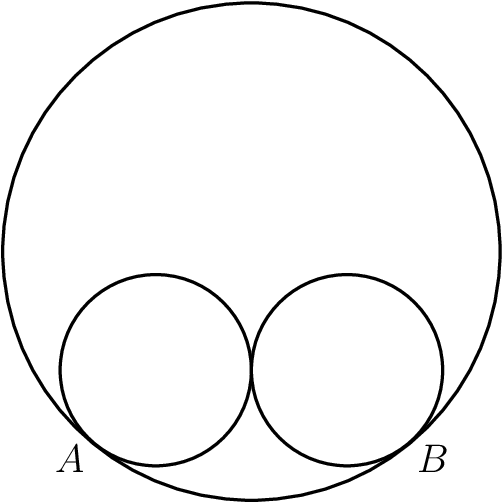
Two circles of radius are externally tangent to each other and are internally tangent to a circle of radius at points and , as shown in the diagram. The distance can be written in the form , where and are relatively prime positive integers. What is ?
- A)
- B)
- C)
- D)
- E)
- 3.2015 AMC 10A #14
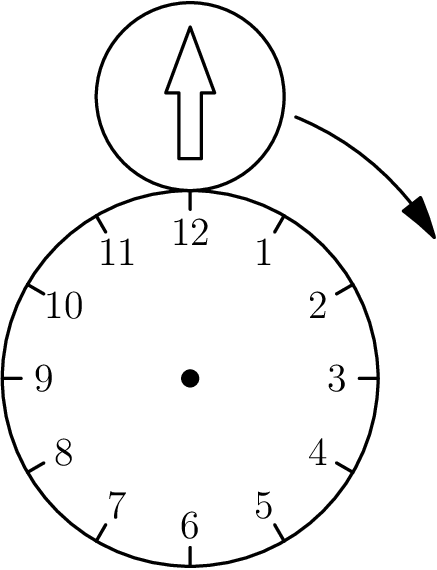
The diagram below shows the circular face of a clock with radius cm and a circular disk with radius cm externally tangent to the clock face at o'clock. The disk has an arrow painted on it, initially pointing in the upward vertical direction. Let the disk roll clockwise around the clock face. At what point on the clock face will the disk be tangent when the arrow is next pointing in the upward vertical direction?
- A)
- B)
- C)
- D)
- E)
- 4.2012 AMC 10A #18
The closed curve in the figure is made up of congruent circular arcs each of length , where each of the centers of the corresponding circles is among the vertices of a regular hexagon of side . What is the area enclosed by the curve?
- A)
- B)
- C)
- D)
- E)
- 5.2011 AMC 10B #17
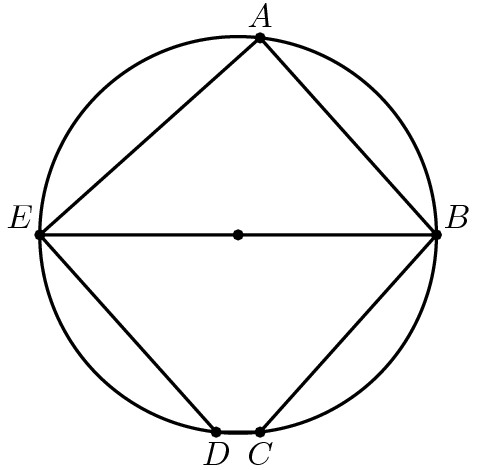
In the given circle, the diameter is parallel to , and is parallel to . The angles and are in the ratio . What is the degree measure of angle ?
- A)
- B)
- C)
- D)
- E)
- 6.2011 AMC 10A #18
Circles and each have radius 1. Circles and share one point of tangency. Circle has a point of tangency with the midpoint of . What is the area inside Circle but outside circle and circle ?
- A)
- B)
- C)
- D)
- E)
- 7.2010 AMC 10B #16
A square of side length and a circle of radius share the same center. What is the area inside the circle, but outside the square?
- A)
- B)
- C)
- D)
- E)
- 8.2009 AMC 10A #21
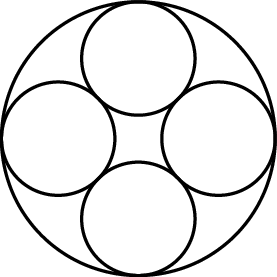
Many Gothic cathedrals have windows with portions containing a ring of congruent circles that are circumscribed by a larger circle. In the figure shown, the number of smaller circles is four. What is the ratio of the sum of the areas of the four smaller circles to the area of the larger circle?
- A)
- B)
- C)
- D)
- E)
- 9.2008 AMC 10A #16
Points and lie on a circle centered at , and . A second circle is internally tangent to the first and tangent to both and . What is the ratio of the area of the smaller circle to that of the larger circle?
- A)
- B)
- C)
- D)
- E)
- 10.2008 AMC 10A #17
An equilateral triangle has side length 6. What is the area of the region containing all points that are outside the triangle but not more than 3 units from a point on the triangle?
- A)
- B)
- C)
- D)
- E)
- 11.2007 AMC 10B #11
A circle passes through the three vertices of an isosceles triangle that has two sides of length and a base of length . What is the area of this circle?
- A)
- B)
- C)
- D)
- E)
- 12.2007 AMC 10A #15
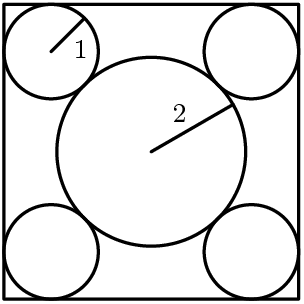
Four circles of radius are each tangent to two sides of a square and externally tangent to a circle of radius , as shown. What is the area of the square?
- A)
- B)
- C)
- D)
- E)
- 13.2007 AMC 10B #18
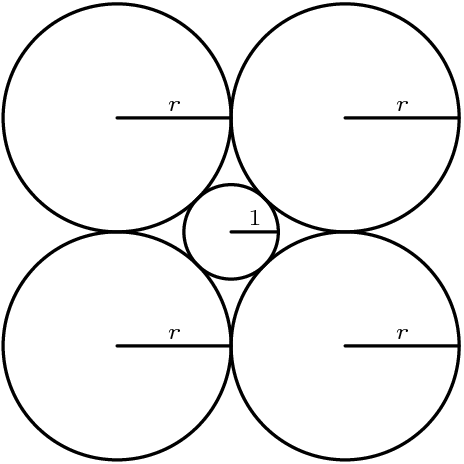
A circle of radius is surrounded by circles of radius as shown. What is ?
- A)
- B)
- C)
- D)
- E)
- 14.2007 AMC 10B #13
Two circles of radius are centered at and at What is the area of the intersection of the interiors of the two circles?
- A)
- B)
- C)
- D)
- E)
- 15.2006 AMC 10B #19
A circle of radius is centered at . Square has side length . Sides and are extended past to meet the circle at and , respectively. What is the area of the shaded region in the figure, which is bounded by , , and the minor arc connecting and ?
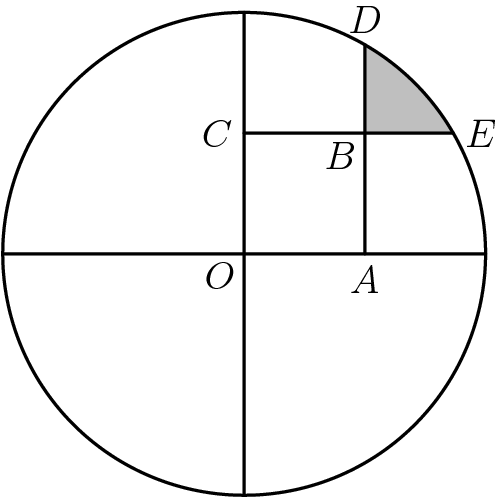
- A)
- B)
- C)
- D)
- E)
- 16.2005 AMC 10A #12
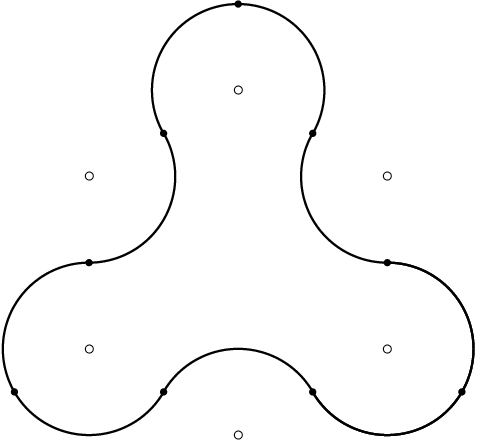
The figure shown is called a trefoil and is constructed by drawing circular sectors about sides of the congruent equilateral triangles. What is the area of a trefoil whose horizontal base has length ?
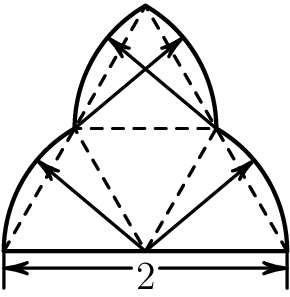
- A)
- B)
- C)
- D)
- E)
- 17.2004 AMC 10B #16
Three circles of radius are externally tangent to each other and internally tangent to a larger circle. What is the radius of the large circle?
- A)
- B)
- C)
- D)
- E)
- 18.2003 AMC 10A #19
A semicircle of diameter sits at the top of a semicircle of diameter , as shown. The shaded area inside the smaller semicircle and outside the larger semicircle is called a lune. Determine the area of this lune.
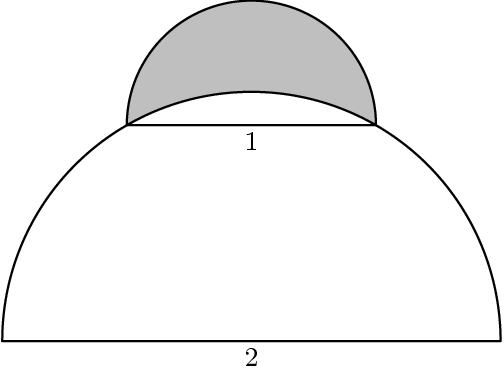
- A)
- B)
- C)
- D)
- E)
- 19.2003 AMC 10A #17
The number of inches in the perimeter of an equilateral triangle equals the number of square inches in the area of its circumscribed circle. What is the radius, in inches, of the circle?
- A)
- B)
- C)
- D)
- E)
- 20.2003 AMC 10B #19
Three semicircles of radius are constructed on diameter of a semicircle of radius . The centers of the small semicircles divide into four line segments of equal length, as shown. What is the area of the shaded region that lies within the large semicircle but outside the smaller semicircles?
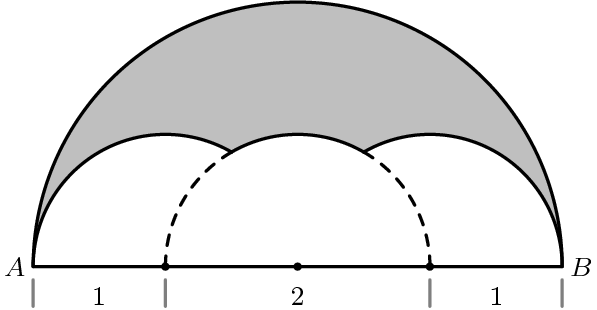
- A)
- B)
- C)
- D)
- E)
Answers
| # | Answer | The idea it turns on |
|---|---|---|
| 1 | A | Join the centers of touching circles; each join is 2 long. The top center is 2 times root 3 above the middle, so the big radius is that plus 1. |
| 2 | D | A touching point lies on the line through both centers. Stretching the center segments from 8 to 13 turns triangle OPQ into triangle OAB. |
| 3 | C | The disk turns from rolling and also from traveling around the clock: 3 turns per lap. So the arrow is up again after one third of a lap. |
| 4 | E | Each arc has radius 1 and turns 120 degrees. Take the hexagon, add three outside bumps of 240 degrees, and remove three inside dents of 120 degrees. |
| 5 | C | Angle A is 90 degrees because EB is a diameter, so angle ABE is 50. Parallel lines copy that 50 to angle BED, and angle BCD is 180 minus 50. |
| 6 | C | Circle C passes through the point where A and B touch, so it overlaps each of them in a lens of area π/2 − 1. What is left is 2. |
| 7 | B | The circle bulges out past each side of the square in four equal caps. Each cap is a 60-degree slice of the circle minus an equilateral triangle. |
| 8 | C | The four small centers form a square of side 2r. The big center is half a diagonal, r times root 2, from each, so R = r(1 + root 2). |
| 9 | B | The small center lies on the line halving the 60 degree angle. A 30-60-90 triangle puts it 2r from O, and 2r + r = R, so r = R/3. |
| 10 | B | The band around the triangle is three 6 by 3 rectangles, one along each side, plus three rounded corner pieces that fit together into one full circle of radius 3. |
| 11 | C | The center lies on the triangle's line of symmetry. Setting its distance to the top corner equal to its distance to a bottom corner gives one equation. |
| 12 | B | Walk along a diagonal from the center to a corner: 2 + 1 = 3 to a small circle's center, then the diagonal of a 1-by-1 square to the corner. |
| 13 | B | Join the middle center to two neighboring outer centers: a right triangle with legs 1 + r and long side 2r. |
| 14 | D | Both circles pass through (0,0) and (2,2). The overlap is split by the line between those points into two equal pieces, each a quarter circle with a right triangle removed. |
| 15 | A | Draw OD and OE to make a 30 degree slice of the circle. The slice is the shaded piece plus two thin triangles, OBD and OBE. |
| 16 | B | Each bulge is a sector minus a small triangle, and the four small triangles fill the big one. So the trefoil is just four 60 degree sectors. |
| 17 | D | Join the three small centers: they form an equilateral triangle with side 2. The big circle's radius is the distance from the triangle's center to a corner, plus 1. |
| 18 | C | The lune is the small half-circle minus the piece of the big circle above its diameter. That piece is a 60 degree slice minus an equilateral triangle of side 1. |
| 19 | B | In an equilateral triangle drawn inside a circle, each side equals the radius times the square root of 3. Set 3 times that side equal to pi times radius squared. |
| 20 | E | Neighboring small semicircles cross at a point 1 away from both centers, forming equilateral triangles. The white part is two triangles plus slices totaling 5/6 of a circle. |
Problems © Mathematical Association of America (MAA), American Mathematics Competitions. Reproduced for non-commercial educational use. The topic note, tags and key insights are original to this site.