Circles
Chords, tangents, inscribed angles, power of a point, arc length, sectors, inscribed/circumscribed circles
What you need to know
- Inscribed Angle Theorem. An inscribed angle (corner on the circle) is half the arc it cuts off. So an inscribed angle whose sides pass through the two ends of a diameter is a right angle. Example: an inscribed angle on a arc is .
- Tangents. A tangent line is perpendicular to the radius at the point where it touches. Two Tangent Theorem: the two tangent segments from a point outside the circle are equal. Example: from a point away from the center of a circle with radius , both tangents are long.
- Power of a Point. If chords and cross at , then . From a point outside the circle, with a tangent and a line (a secant) meeting the circle at and then : . Example: chords with , , give . A secant with , gives .
- Arcs and sectors. A central angle of degrees cuts off of the circle: the arc length is , and the sector (pizza slice) has area . Example: with and , the arc is long and the sector's area is .
How AMC 10 tests it
- Shaded regions (problems 3–12): circles in squares, or semicircles on the sides of a triangle. Subtract sectors and triangles.
- Tangent lines from a point, or one line tangent to two circles. Radii to the points of tangency give a right triangle or a trapezoid with two right angles.
- Problems 17–23: Power of a Point for a length, or a rope wrapping around a polygon, giving a sum of sectors.
Standard approaches
- Draw the radius to every point of tangency and every chord end. Look for right angles, and for isosceles triangles (radii are equal).
- Turn inscribed angles into arcs, add the arcs, and turn back.
- When two chords, or a tangent and a secant, pass through one point, write Power of a Point.
Worked example
Point lies outside a circle with center and radius . The two tangent segments from touch the circle at and , and . What is the area of the region bounded by , , and the minor arc ?
(A) (B) (C) (D) (E)
Solution. Step 1. Each tangent is perpendicular to its radius, so .
Step 2. Right triangles and share the hypotenuse and have , so they are congruent, and . Triangle is a -- triangle with short leg , so and .
Step 3. The kite is two copies of triangle , so its area is .
Step 4. The central angle is , so sector has area .
Step 5. The region is the kite minus the sector: .
The answer is .
Pitfalls
- Putting the diameter into instead of the radius. The area comes out times too big, and the answer choices often differ by that factor of .
- Finding a sector's area with the inscribed angle instead of the central angle (which is twice as big).
- In Power of a Point, using instead of . Both lengths start at . Example: with and , the product is , not .
Traps that recur
- Assuming the inner corners lie on a circle of radius 3 (the table radius minus the mat width), rather than at distance x from the center. (2008 AMC 10A #25)
- Assuming the inner circle is the incircle of the triangle of centres, whose inradius is 1, or reading the picture's apparent symmetry as meaning the inner centre is equidistant from the three outer centres. (2025 AMC 10A #22)
- Losing a minus sign when writing the diameter, giving (sqrt 2 - 1)(sqrt 3 + 1) and the sum 5 in (B). (2025 AMC 10B #20)
- Finding only the small pipe wedged between the two and answering 1/9, forgetting that a pipe on the far side of the small one is also in contact with both. (2024 AMC 10B #21)
- 1.2023 AMC 10B #3
A right triangle is inscribed in circle , and a right triangle is inscribed in circle . What is the ratio of the area of circle to the area of circle ?
- A)
- B)
- C)
- D)
- E)
- 2.2010 AMC 10A #5
The area of a circle whose circumference is is . What is the value of ?
- A)
- B)
- C)
- D)
- E)
- 3.2010 AMC 10B #6
A circle is centered at , is a diameter and is a point on the circle with . What is the degree measure of ?
- A)
- B)
- C)
- D)
- E)
- 4.2006 AMC 10B #6
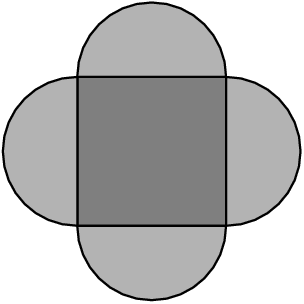
A region is bounded by semicircular arcs constructed on the side of a square whose sides measure , as shown. What is the perimeter of this region?
- A)
- B)
- C)
- D)
- E)
- 5.2006 AMC 10B #4
Circles of diameter inch and inches have the same center. The smaller circle is painted red, and the portion outside the smaller circle and inside the larger circle is painted blue. What is the ratio of the blue-painted area to the red-painted area?

- A)
- B)
- C)
- D)
- E)
- 6.2002 AMC 10B #5
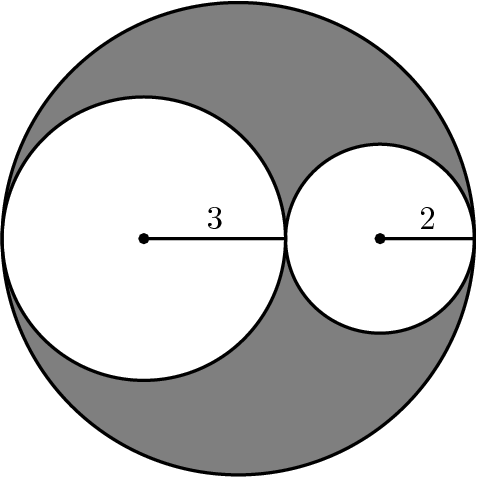
Circles of radius and are externally tangent and are circumscribed by a third circle, as shown in the figure. Find the area of the shaded region.
- A)
- B)
- C)
- D)
- E)
- 7.2002 AMC 10A #5
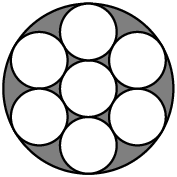
Each of the small circles in the figure has radius one. The innermost circle is tangent to the six circles that surround it, and each of those circles is tangent to the large circle and to its small-circle neighbors. Find the area of the shaded region.
- A)
- B)
- C)
- D)
- E)
- 8.2001 AMC 10 #4
What is the maximum number of possible points of intersection of a circle and a triangle?
- A)
- B)
- C)
- D)
- E)
- 9.2025 AMC 10B #5
In , , , and Let be the center of the circle containing , , and What is the degree measure of ?
- A)
- B)
- C)
- D)
- E)
- 10.2021 AMC 10B #7
In a plane, four circles with radii and are tangent to line at the same point but they may be on either side of . Region consists of all the points that lie inside exactly one of the four circles. What is the maximum possible area of region ?
- A)
- B)
- C)
- D)
- E)
- 11.2019 AMC 10A #6
For how many of the following types of quadrilaterals does there exist a point in the plane of the quadrilateral that is equidistant from all four vertices of the quadrilateral?
- a square
- a rectangle that is not a square
- a rhombus that is not a square
- a parallelogram that is not a rectangle or a rhombus
- an isosceles trapezoid that is not a parallelogram
- A)
- B)
- C)
- D)
- E)
- 12.2018 AMC 10B #7
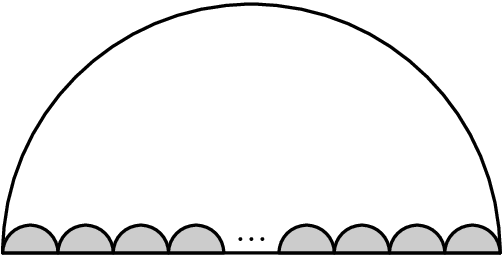
In the figure below, congruent semicircles are drawn along a diameter of a large semicircle, with their diameters covering the diameter of the large semicircle with no overlap. Let be the combined area of the small semicircles and be the area of the region inside the large semicircle but outside the small semicircles. The ratio is . What is ?
- A)
- B)
- C)
- D)
- E)
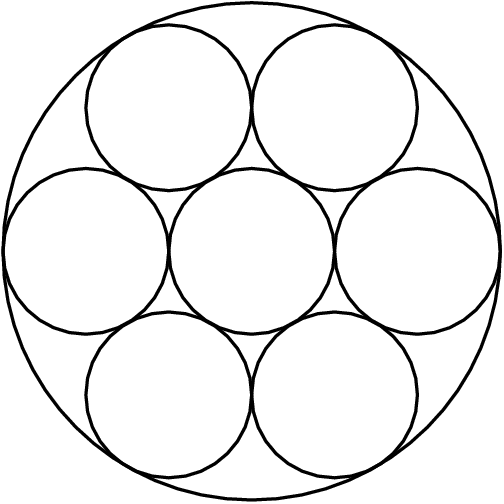
- 13.2016 AMC 10A #15
Seven cookies of radius inch are cut from a circle of cookie dough, as shown. Neighboring cookies are tangent, and all except the center cookie are tangent to the edge of the dough. The leftover scrap is reshaped to form another cookie of the same thickness. What is the radius in inches of the scrap cookie?
- A)
- B)
- C)
- D)
- E)
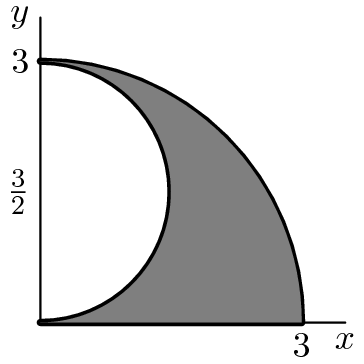
- 14.2015 AMC 10B #9
The shaded region below is called a shark's fin falcata, a figure studied by Leonardo da Vinci. It is bounded by the portion of the circle of radius and center that lies in the first quadrant, the portion of the circle with radius and center that lies in the first quadrant, and the line segment from to . What is the area of the shark's fin falcata?
- A)
- B)
- C)
- D)
- E)
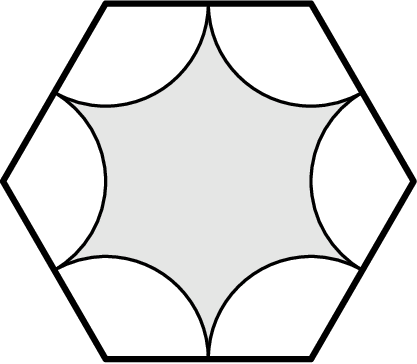
- 15.2014 AMC 10A #12
A regular hexagon has side length 6. Congruent arcs with radius 3 are drawn with the center at each of the vertices, creating circular sectors as shown. The region inside the hexagon but outside the sectors is shaded as shown. What is the area of the shaded region?
- A)
- B)
- C)
- D)
- E)
- 16.2012 AMC 10A #11
Externally tangent circles with centers at points and have radii of lengths and , respectively. A line externally tangent to both circles intersects ray at point . What is ?
- A)
- B)
- C)
- D)
- E)
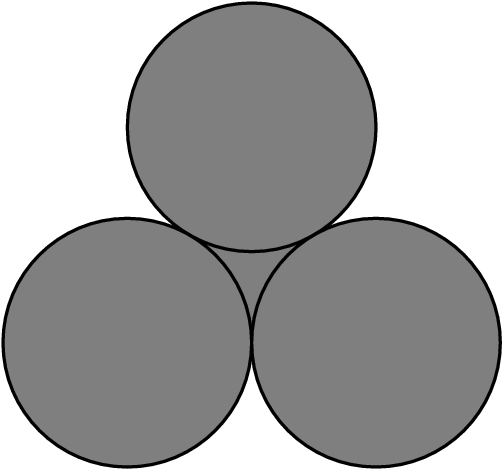
- 17.2012 AMC 10B #16
Three circles with radius 2 are mutually tangent. What is the total area of the circles and the region bounded by them, as shown in the figure?
- A)
- B)
- C)
- D)
- E)
- 18.2011 AMC 10B #12
Keiko walks once around a track at exactly the same constant speed every day. The sides of the track are straight, and the ends are semicircles. The track has a width of meters, and it takes her seconds longer to walk around the outside edge of the track than around the inside edge. What is Keiko's speed in meters per second?
- A)
- B)
- C)
- D)
- E)
- 19.2009 AMC 10A #6
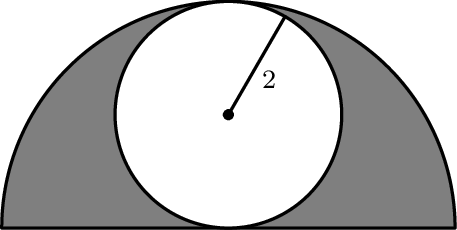
A circle of radius is inscribed in a semicircle, as shown. The area inside the semicircle but outside the circle is shaded. What fraction of the semicircle's area is shaded?
- A)
- B)
- C)
- D)
- E)
- 20.2009 AMC 10B #16
Points and lie on a circle centered at , each of and are tangent to the circle, and is equilateral. The circle intersects at . What is ?
- A)
- B)
- C)
- D)
- E)
Answers
| # | Answer | The idea it turns on |
|---|---|---|
| 1 | D | When a right triangle sits inside a circle with all three corners on it, its longest side is a diameter. So the diameters are 5 and 13. |
| 2 | E | Go through the radius: the circumference 2 times pi times r equals 24 pi, so r = 12, and the area is pi times 12 squared = 144 pi. |
| 3 | B | Angles CAB and COB open onto the same arc CB. The one with its corner on the circle is half the one at the center: 25 degrees. |
| 4 | D | Each square side is the diameter of one half-circle. Half of pi times 2/pi is exactly 1, so the four arcs total 4. |
| 5 | D | The big circle is 3 times as wide, so its area is 9 times the red circle. The blue ring is that minus the red: 8 times. |
| 6 | E | The two small circles sit side by side across the big circle, so the big circle's diameter is 6 + 4 = 10 and its radius is 5. |
| 7 | C | Along a line through the centers, the big radius is 1 + 2 = 3. Its area, 9 pi, minus seven small circles of area pi leaves 2 pi. |
| 8 | E | Each side of the triangle can cross the circle at most twice, so three sides give at most 6 points, and a slightly enlarged incircle reaches 6. |
| 9 | C | Angle B is 130 degrees, so the far arc AC is 260 and the near arc is 100. Triangle AOC is isosceles with a 100-degree angle at O. |
| 10 | D | Circles on one side sit inside each other, so a side counts only its biggest circle minus its second biggest. Put 7 alone: 49 + 16 = 65. |
| 11 | C | A point equally far from all four corners is the center of a circle through them. That needs opposite angles adding to 180 degrees. |
| 12 | D | If the big radius is N times the small one, the big semicircle holds N squared small areas, so the leftover is N squared minus N. |
| 13 | A | The dough's radius is 3: the center cookie's radius plus an outer cookie's width. The scrap is 9 pi - 7 pi = 2 pi. |
| 14 | B | The shaded fin is a quarter of the big circle with half of the small circle cut out: 9pi/4 - 9pi/8 = 9pi/8. |
| 15 | C | Each sector opens as wide as the hexagon's corner, 120 degrees, which is one third of a circle. Six thirds make two whole circles of radius 3. |
| 16 | D | The radii to the tangent line both meet it at right angles, so the two right triangles with a corner at C are similar, in the ratio 5 to 3. |
| 17 | A | Connect the three centers to make an equilateral triangle of side 4. The triangle is the middle gap plus three 60-degree slices of circle that together make half a circle. |
| 18 | A | The straight parts are equal on both edges. The two round ends form a circle whose radius grows by 6, adding exactly 12 pi meters. |
| 19 | A | The small circle reaches from the middle of the flat edge up to the top of the arc, so the semicircle's radius is the small circle's diameter, 4. |
| 20 | B | BO cuts the 60 degree angle at B in half, and radius OA meets the tangent at a right angle, so triangle OAB is 30-60-90 with BO twice the radius. |
Problems © Mathematical Association of America (MAA), American Mathematics Competitions. Reproduced for non-commercial educational use. The topic note, tags and key insights are original to this site.