Basic Counting
Multiplication principle, permutations, combinations, counting by listing
What you need to know
- Multiplication principle. If a job has stages, and each stage has the same number of choices no matter what you chose before, multiply. Cases that do not overlap add. Example: letters then digits make license plates.
- Permutations (order matters). different objects can be put in order in ways. Picking of them in order: ways. Example: a president, vice president, and secretary from people: .
- Combinations (order does not matter). Choosing of different objects: . Also (choosing who is in is choosing who is out), and (each object is in or out). Example: a -person committee from people: , since each committee has orders.
- Repeated objects: , where , , … count each group of identical objects. Example: ALABAMA has four A's, so arrangements.
- Complementary counting. Count what you do not want and subtract from the total. Example: four-digit numbers use only odd digits, so have an even digit.
How AMC 10 tests it
- Problems 3–10: "How many three-digit numbers / license plates / subsets have property X?", by multiplying or by one .
- Problems 10–18: choose-then-arrange questions (committees, handshakes, seating) where the trap is whether order matters.
- Digit problems that come down to short casework on the first digit.
- Counting the right thing: pairs of people, diagonals (: pairs of corners minus the sides), crossing points of chords ( for points on a circle, if no three chords meet at one point).
- The count is often the hidden step inside a probability problem.
Standard approaches
- Decide whether order matters. Then build the object stage by stage and multiply.
- If the total is quick to find, count the opposite and subtract.
- Split into cases that do not overlap, based on the most limited spot (first digit, largest number, a special object), and add.
- Look for a one-to-one correspondence with something you can count directly: strings of s and s, subsets, grid paths. Example: subsets of match the - strings of length ( means "in"), so there are .
- Check with a tiny case you can list by hand.
Worked example
How many four-digit positive integers have digits that are strictly increasing from left to right or strictly decreasing from left to right?
(A) (B) (C) (D) (E)
Solution. Any four different digits can be written in increasing order in exactly one way, and in decreasing order in one way. So we count sets of four digits.
Step 1: increasing. A would be the smallest digit, so it would come first, which is not allowed. Choose digits from to : .
Step 2: decreasing. Now a would come last, which is fine. Choose digits from to : . (For example, gives .)
Step 3: add. No number is both: .
The answer is .
Pitfalls
- Multiplying when one stage's choices depend on an earlier choice. Use casework. Example: in a two-digit number whose second digit is bigger than the first, the second digit has choices after a but choice after an .
- Mixing up and . A committee has no order; a line-up does.
- Forgetting that the first digit cannot be , while is fine elsewhere. There are three-digit numbers, not .
- Counting things twice in "at least one" problems. Example: -person committees from boys and girls with at least one girl: "pick a girl, then any others" gives , but the answer is . Complementary counting avoids this.
Traps that recur
- Summing binom(9,k) 2^k instead of binom(9,k) 2^(k-1), which gives 3^9 - 1 = 19682, choice (E); the factor 2^(k-1) is right because the largest digit's position is forced. (2025 AMC 10A #24)
- Multiplying the 81 multiples of 11 by the number of permutations, which double counts triples like {2, 0, 9} that give two different multiples (209 and 902). (2017 AMC 10A #25)
- Answering 70 by assuming no three diagonals are concurrent; the regular octagon has concurrency at the center and at eight other points. (2013 AMC 10A #25)
- Forgetting that the two-friends case includes two separate triangles as well as one six-person loop, or overcounting loops by ignoring rotations and reflections. (2012 AMC 10A #23)
- 1.2005 AMC 10B #20
What is the average (mean) of all 5-digit numbers that can be formed by using each of the digits 1, 3, 5, 7, and 8 exactly once?
- A)
- B)
- C)
- D)
- E)
- 2.2004 AMC 10A #16
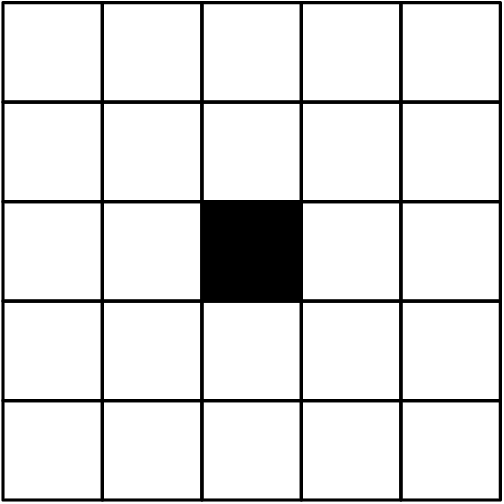
The grid shown contains a collection of squares with sizes from to . How many of these squares contain the black center square?
- A)
- B)
- C)
- D)
- E)
- 3.2024 AMC 10B #22
A group of people will be partitioned into indistinguishable -person committees. Each committee will have one chairperson and one secretary. The number of different ways to make these assignments can be written as , where and are positive integers and is not divisible by . What is ?
- A)
- B)
- C)
- D)
- E)
- 4.2022 AMC 10A #22
Suppose that cards numbered are arranged in a row. The task is to pick them up in numerically increasing order, working repeatedly from left to right. In the example below, cards are picked up on the first pass, and on the second pass, on the third pass, on the fourth pass, and on the fifth pass. For how many of the possible orderings of the cards will the cards be picked up in exactly two passes?

- A)
- B)
- C)
- D)
- E)
- 5.2021 AMC Fall 10B #21
Regular polygons with and sides are inscribed in the same circle. No two of the polygons share a vertex, and no three of their sides intersect at a common point. At how many points inside the circle do two of their sides intersect?
- A)
- B)
- C)
- D)
- E)
- 6.2020 AMC 10A #19
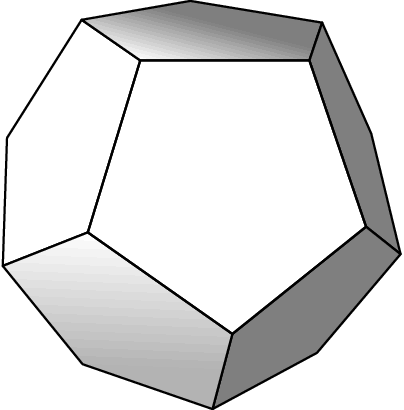
As shown in the figure below, a regular dodecahedron (the polyhedron consisting of congruent regular pentagonal faces) floats in empty space with two horizontal faces. Note that there is a ring of five slanted faces adjacent to the top face, and a ring of five slanted faces adjacent to the bottom face. How many ways are there to move from the top face to the bottom face via a sequence of adjacent faces so that each face is visited at most once and moves are not permitted from the bottom ring to the top ring?
- A)
- B)
- C)
- D)
- E)
- 7.2020 AMC 10B #17
There are people standing equally spaced around a circle. Each person knows exactly of the other people: the people standing next to him or her, as well as the person directly across the circle. How many ways are there for the people to split up into pairs so that the members of each pair know each other?
- A)
- B)
- C)
- D)
- E)
- 8.2020 AMC 10B #23
Square in the coordinate plane has vertices at the points and Consider the following four transformations:
a rotation of counterclockwise around the origin;
a rotation of clockwise around the origin;
a reflection across the -axis; and
a reflection across the -axis.
Each of these transformations maps the squares onto itself, but the positions of the labeled vertices will change. For example, applying and then would send the vertex at to and would send the vertex at to itself. How many sequences of transformations chosen from will send all of the labeled vertices back to their original positions? (For example, is one sequence of transformations that will send the vertices back to their original positions.)
- A)
- B)
- C)
- D)
- E)
- 9.2017 AMC 10A #23
How many triangles with positive area have all their vertices at points in the coordinate plane, where and are integers between and , inclusive?
- A)
- B)
- C)
- D)
- E)
- 10.2012 AMC 10B #24
Amy, Beth, and Jo listen to four different songs and discuss which ones they like. No song is liked by all three. Furthermore, for each of the three pairs of the girls, there is at least one song liked by those girls but disliked by the third. In how many different ways is this possible?
- A)
- B)
- C)
- D)
- E)
- 11.2010 AMC 10A #22
Eight points are chosen on a circle, and chords are drawn connecting every pair of points. No three chords intersect in a single point inside the circle. How many triangles with all three vertices in the interior of the circle are created?
- A)
- B)
- C)
- D)
- E)
- 12.2008 AMC 10A #23
Two subsets of the set are to be chosen so that their union is and their intersection contains exactly two elements. In how many ways can this be done, assuming that the order in which the subsets are chosen does not matter?
- A)
- B)
- C)
- D)
- E)
- 13.2003 AMC 10A #23
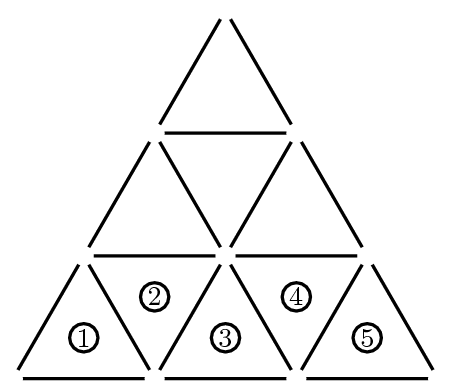
A large equilateral triangle is constructed by using toothpicks to create rows of small equilateral triangles. For example, in the figure, we have rows of small congruent equilateral triangles, with small triangles in the base row. How many toothpicks would be needed to construct a large equilateral triangle if the base row of the triangle consists of small equilateral triangles?
- A)
- B)
- C)
- D)
- E)
- 14.2025 AMC 10A #24
Call a positive integer fair if no digit is used more than once, it has no 0s, and no digit is adjacent to two greater digits. For example, , , and are fair, but , , and are not fair. How many fair positive integers are there?
- A)
- B)
- C)
- D)
- E)
- 15.2017 AMC 10A #25
How many integers between and , inclusive, have the property that some permutation of its digits is a multiple of between and For example, both and have this property.
- A)
- B)
- C)
- D)
- E)
- 16.2013 AMC 10A #25
All 20 diagonals are drawn in a regular octagon. At how many distinct points in the interior of the octagon (not on the boundary) do two or more diagonals intersect?
- A)
- B)
- C)
- D)
- E)
- 17.2012 AMC 10A #23
Adam, Benin, Chiang, Deshawn, Esther, and Fiona have internet accounts. Some, but not all, of them are internet friends with each other, and none of them has an internet friend outside this group. Each of them has the same number of internet friends. In how many different ways can this happen?
- A)
- B)
- C)
- D)
- E)
Problems © Mathematical Association of America (MAA), American Mathematics Competitions. Reproduced for non-commercial educational use. The topic note, tags and key insights are original to this site.