Arrangements with Restrictions
Permutations with constraints, adjacency, circular arrangements, forbidden positions
What you need to know
- Block method (glue). To keep chosen objects together in a row of different objects, tape them into one block. Arrange the things in ways, then multiply by for the order inside the block. Example: people in a row with Ann, Ben, and Cal together: .
- Gap method. To keep different objects apart (no two side by side), first line up the other objects. That leaves gaps, counting both ends. Put the objects into different gaps: ways. Then multiply by the ways to line up the other . Example: boys and girls in a row, no two girls together: .
- Round table. different people sit around a table in ways when turning the table gives the same seating. If flipping it over also gives the same one (beads on a bracelet), it is , for . If the seats are numbered, it is . Example: people at a round table: ways; beads on a bracelet: .
- Identical objects: , where , , … count each group of identical objects. Example: LEVEL has two L's and two E's, so arrangements.
- Derangements are arrangements with nothing in its own spot. Call the number for objects : , , , . Example: letters put into addressed envelopes at random are all wrong with probability .
How AMC 10 tests it
- Problems 8–15: seating in a row or around a table where "A and B must sit together" or "must not sit together."
- Letters of a word with a condition: vowels together, no two vowels side by side, a certain letter not first.
- Problems 15–22: restrictions mixed with symmetry (a round table, necklaces, painted cubes), or "no two side by side" around a circle.
- Often dressed up as a probability: (arrangements that follow the rule) (all arrangements).
Standard approaches
- For "together," glue into a block. For "not together," subtract the "together" count from . Example: people, Ann and Ben not side by side: .
- For "no two of type X side by side," place the others first, count the gaps, then choose gaps.
- Seat the hardest-to-place object first, then multiply the choices left. On a circle, seat one person first as a fixed reference point; that removes the turned copies of each seating.
- Do casework on where one special object sits. An end seat has only one neighbor.
- For , draw the seats and a small tree of cases.
Worked example
Six students, including Ana and Ben, sit in a row of six chairs. Ana refuses to sit at either end, and Ben must sit next to Ana. How many seatings are possible?
(A) (B) (C) (D) (E)
Solution. Seat the most limited person first.
Step 1: Ana. She cannot sit at either end, so she takes one of the middle chairs , , , : choices.
Step 2: Ben. Every middle chair has a chair on each side, so Ben has choices.
Step 3: everyone else. The other students fill the empty chairs in ways.
Step 4: multiply. .
The answer is .
Pitfalls
- Forgetting the for the order inside a block. "Ann, Ben" and "Ben, Ann" are different seatings, so people with those two together give , not .
- Using for a circle when the seats are numbered (then it is ), or when they are not.
- In a "no two side by side" problem, placing the restricted objects first instead of putting them into the gaps.
- Doing position casework for "A not next to B" and forgetting that an end seat has one neighbor, not two.
Traps that recur
- Counting the labelled colourings and dividing by 8, which fails because three of the twelve classes are left fixed by a reflection; 84 is not even divisible by 8. (2025 AMC 10B #21)
- Merging the two mirror-image spiral shapes into one because they look alike; a rotation can never turn a left-handed spiral into a right-handed one. (2021 AMC Fall 10B #24)
- Trying to place numbers by trial without deriving a structural constraint, or dividing by the wrong symmetry count (24 rotations, not 48 symmetries). (2016 AMC 10A #18)
- Counting the L/R patterns but then assigning the six shoes freely (3! * 3!) instead of noticing that each boundary forces a specific pair to occupy both boundary slots. (2024 AMC 10B #20)
- 1.2018 AMC 10A #4
How many ways can a student schedule mathematics courses -- algebra, geometry, and number theory -- in a -period day if no two mathematics courses can be taken in consecutive periods? (What courses the student takes during the other periods is of no concern here.)
- A)
- B)
- C)
- D)
- E)
- 2.2014 AMC 10A #4
Walking down Jane Street, Ralph passed four houses in a row, each painted a different color. He passed the orange house before the red house, and he passed the blue house before the yellow house. The blue house was not next to the yellow house. How many orderings of the colored houses are possible?
- A)
- B)
- C)
- D)
- E)
- 3.2022 AMC 10A #9
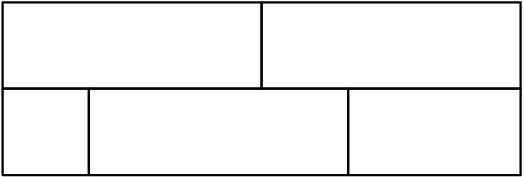
A rectangle is partitioned into regions as shown. Each region is to be painted a solid color - red, orange, yellow, blue, or green - so that regions that touch are painted different colors, and colors can be used more than once. How many different colorings are possible?
- A)
- B)
- C)
- D)
- E)
- 4.2015 AMC 10A #10
How many rearrangements of are there in which no two adjacent letters are also adjacent letters in the alphabet? For example, no such rearrangements could include either or .
- A)
- B)
- C)
- D)
- E)
- 5.2012 AMC 10B #11
A dessert chef prepares the dessert for every day of a week starting with Sunday. The dessert each day is either cake, pie, ice cream, or pudding. The same dessert may not be served two days in a row. There must be cake on Friday because of a birthday. How many different dessert menus for the week are possible?
- A)
- B)
- C)
- D)
- E)
- 6.2025 AMC 10B #16
A circle has been divided into sectors of different sizes. Then of the sectors are painted red, painted green, and painted blue so that no two neighboring sectors are painted the same color. One such coloring is shown below.
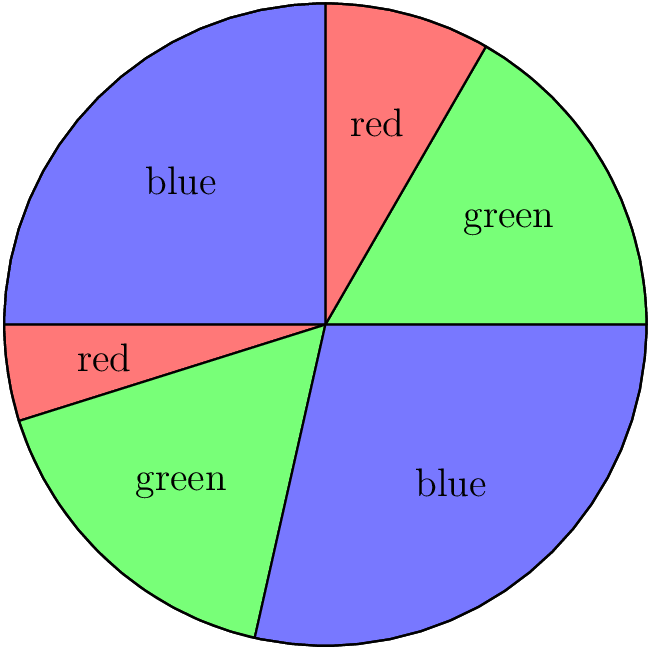
How many different colorings are possible?
- A)
- B)
- C)
- D)
- E)
- 7.2024 AMC 10B #17
In a race among snails, there is at most one tie, but that tie can involve any number of snails. For example, the result might be that Dazzler is first; Abby, Cyrus, and Elroy are tied for second; and Bruna is fifth. How many different results of the race are possible?
- A)
- B)
- C)
- D)
- E)
- 8.2022 AMC 10A #14
How many ways are there to split the integers through into pairs such that in each pair, the greater number is at least times the lesser number?
- A)
- B)
- C)
- D)
- E)
- 9.2021 AMC Fall 10A #18
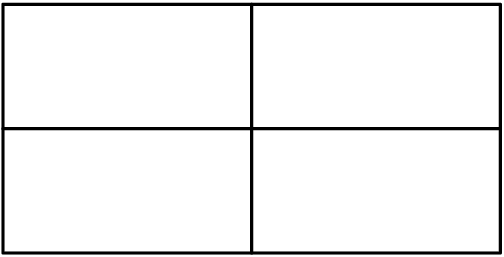
A farmer's rectangular field is partitioned into by grid of rectangular sections as shown in the figure. In each section the farmer will plant one crop: corn, wheat, soybeans, or potatoes. The farmer does not want to grow corn and wheat in any two sections that share a border, and the farmer does not want to grow soybeans and potatoes in any two sections that share a border. Given these restrictions, in how many ways can the farmer choose crops to plant in each of the four sections of the field?
- A)
- B)
- C)
- D)
- E)
- 10.2017 AMC 10A #19
Alice refuses to sit next to either Bob or Carla. Derek refuses to sit next to Eric. How many ways are there for the five of them to sit in a row of 5 chairs under these conditions?
- A)
- B)
- C)
- D)
- E)
- 11.2000 AMC 10 #13
There are 5 yellow pegs, 4 red pegs, 3 green pegs, 2 blue pegs, and 1 orange peg to be placed on a triangular peg board. In how many ways can the pegs be placed so that no (horizontal) row or (vertical) column contains two pegs of the same color?

- A)
- B)
- C)
- D)
- E)
- 12.2024 AMC 10B #20
Three different pairs of shoes are placed in a row so that no left shoe is next to a right shoe from a different pair. In how many ways can these six shoes be lined up?
- A)
- B)
- C)
- D)
- E)
- 13.2021 AMC Fall 10A #24
Each of the edges of a cube is labeled or . Two labelings are considered different even if one can be obtained from the other by a sequence of one or more rotations and/or reflections. For how many such labelings is the sum of the labels on the edges of each of the faces of the cube equal to ?
- A)
- B)
- C)
- D)
- E)
- 14.2021 AMC 10A #20
In how many ways can the sequence be rearranged so that no three consecutive terms are increasing and no three consecutive terms are decreasing?
- A)
- B)
- C)
- D)
- E)
- 15.2018 AMC 10B #18
Three young brother-sister pairs from different families need to take a trip in a van. These six children will occupy the second and third rows in the van, each of which has three seats. To avoid disruptions, siblings may not sit right next to each other in the same row, and no child may sit directly in front of his or her sibling. How many seating arrangements are possible for this trip?
- A)
- B)
- C)
- D)
- E)
- 16.2017 AMC 10B #18
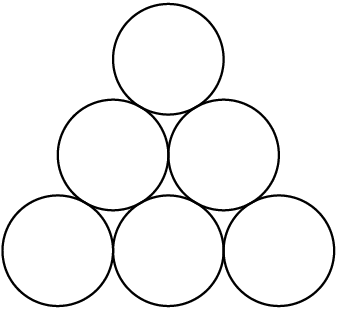
In the figure below, of the disks are to be painted blue, are to be painted red, and is to be painted green. Two paintings that can be obtained from one another by a rotation or a reflection of the entire figure are considered the same. How many different paintings are possible?
- A)
- B)
- C)
- D)
- E)
- 17.2014 AMC 10B #24
The numbers 1, 2, 3, 4, 5 are to be arranged in a circle. An arrangement is bad if it is not true that for every from to one can find a subset of the numbers that appear consecutively on the circle that sum to . Arrangements that differ only by a rotation or a reflection are considered the same. How many different bad arrangements are there?
- A)
- B)
- C)
- D)
- E)
- 18.2013 AMC 10B #22
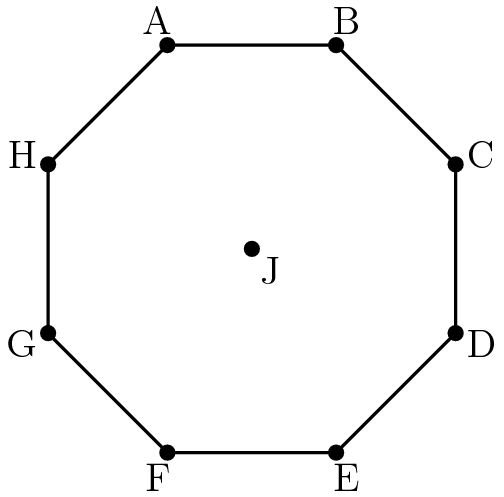
The regular octagon has its center at . Each of the vertices and the center are to be associated with one of the digits through , with each digit used once, in such a way that the sums of the numbers on the lines , , , and are all equal. In how many ways can this be done?
- A)
- B)
- C)
- D)
- E)
- 19.2012 AMC 10B #22
Let be a list of the first 10 positive integers such that for each either or or both appear somewhere before in the list. How many such lists are there?
- A)
- B)
- C)
- D)
- E)
- 20.2011 AMC 10A #22
Each vertex of convex pentagon is to be assigned a color. There are colors to choose from, and the ends of each diagonal must have different colors. How many different colorings are possible?
- A)
- B)
- C)
- D)
- E)
- 21.2010 AMC 10B #23
The entries in a array include all the digits from through , arranged so that the entries in every row and column are in increasing order. How many such arrays are there?
- A)
- B)
- C)
- D)
- E)
- 22.2008 AMC 10B #21
Ten chairs are evenly spaced around a round table and numbered clockwise from through . Five married couples are to sit in the chairs with men and women alternating, and no one is to sit either next to or across from his/her spouse. How many seating arrangements are possible?
- A)
- B)
- C)
- D)
- E)
- 23.2025 AMC 10B #21
Each of the squares in a grid is to be colored red, blue, or yellow in such a way that each red square shares an edge with at least one blue square, each blue square shares an edge with at least one yellow square, and each yellow square shares an edge with at least one red square. Colorings that can be obtained from one another by rotations and/or reflections are to be considered the same. How many different colorings are possible?
- A)
- B)
- C)
- D)
- E)
- 24.2021 AMC Fall 10B #24
A cube is constructed from white unit cubes and blue unit cubes. How many different ways are there to construct the cube using these smaller cubes? (Two constructions are considered the same if one can be rotated to match the other.)
- A)
- B)
- C)
- D)
- E)
- 25.2016 AMC 10A #18
Each vertex of a cube is to be labeled with an integer through , with each integer being used once, in such a way that the sum of the four numbers on the vertices of a face is the same for each face. Arrangements that can be obtained from each other through rotations of the cube are considered to be the same. How many different arrangements are possible?
- A)
- B)
- C)
- D)
- E)
Answers
| # | Answer | The idea it turns on |
|---|---|---|
| 1 | E | First choose which three periods hold math, with gaps between them; only four choices work. Then put the three different courses into those periods in 6 orders. |
| 2 | B | Place blue and yellow first, since they have the most rules. Only three spot pairs keep blue first with a gap; orange and red then fit in exactly one way. |
| 3 | D | The wide bottom-middle region touches all four others. Paint it first, then go around the other four in order: 4 choices for the first, then 3 for each. |
| 4 | C | The letter b may only sit next to d, and c only next to a. With one allowed neighbor each, both must sit at the ends. |
| 5 | A | Fill in Friday (cake) first, then work outward from it. Every other day then has 3 choices, since only the neighbor already filled in is ruled out. |
| 6 | D | Each color covers two non-neighboring sectors. Split the sectors into three such pairs (4 ways), then give the pairs the three colors (6 ways). |
| 7 | D | Split into cases by how many snails tie. Choose the tied snails, treat them as one block, then line up the block and the other snails. |
| 8 | E | Numbers 8 to 14 can never be the smaller one in a pair, so they are the seven larger numbers. Pair 7 first, then 6, 5, 4. |
| 9 | C | Diagonal sections do not touch, so fill them first. Each other section then has 3 choices if the diagonal crops match, 2 if not. |
| 10 | C | Alice can sit only next to Derek or Eric, so place Alice first. Derek and Eric can end up side by side only when Alice sits at an end. |
| 11 | B | Five yellow pegs need five different rows and five different columns, and the board has exactly five of each. That forces their places, and every other color's too. |
| 12 | A | A left shoe next to a right shoe must be its own mate. First find the allowed left-right patterns, then see which pairs are forced into place. |
| 13 | E | Exactly six edges are 1s, and top and bottom use four, so exactly 2 upright edges are 1s. Opposite uprights give 12; neighboring uprights give 8. |
| 14 | D | The terms must go up, down, up, down, or the reverse. In the up-down pattern 5 must sit in position 2 or 4, and each spot gives 8 ways. |
| 15 | D | Siblings can never share a row, so each row has one child per family. Choose and order the front row; then only 2 back rows work. |
| 16 | D | Put the single green disk at the top corner or the bottom middle. Only a left-right flip is left, and the 10 red placements give 6 paintings each. |
| 17 | B | What is left after removing a run of neighbors is also a run, and the two sums add to 15. So only sums 6 and 7 can fail. |
| 18 | C | J is on every line, so the lines have equal sums exactly when the four opposite pairs have equal sums. The eight outer numbers add to 45 - J. |
| 19 | B | The numbers written so far always form a run of consecutive numbers. Reading the list backward, each number removed must be an end of the run: 2 choices, nine times. |
| 20 | C | The five diagonals join up into one closed loop A, C, E, B, D, back to A. So count colorings where neighbours on this loop differ. |
| 21 | D | 1 and 9 are stuck in opposite corners. The center must be 4, 5 or 6; in each case the leftover cells split into small pieces you can count. |
| 22 | C | Seat the men first. Each wife then has exactly two allowed chairs, and one wife's choice forces all the others, so the wives can sit in just 2 ways. |
| 23 | C | Renaming colors red to blue, blue to yellow, yellow to red keeps every rule, so count only colorings with a red center and multiply by 3. |
| 24 | A | Sort by the most white cubes on any one face. Four gives 1 cube, three gives 4 (including two mirror-image twists), and two on every face gives 2. Total 7. |
| 25 | C | Equal face sums force opposite corners to differ by one fixed amount. The numbers 1 to 8 pair up that way only for differences 1, 2 and 4. |
Problems © Mathematical Association of America (MAA), American Mathematics Competitions. Reproduced for non-commercial educational use. The topic note, tags and key insights are original to this site.