Angles & Polygons
Angle chasing, polygon angle sums, regular polygons, parallel lines
What you need to know
- Interior angles. The angles of a polygon with sides add up to , because the diagonals from one corner cut it into triangles. Example: a hexagon's angles add up to .
- Exterior angles. The exterior angles of any convex polygon (one at each corner) add up to . So a regular -gon has exterior angles of and interior angles of . Example: a regular octagon has exterior and interior angles.
- Parallel lines. When a line crosses two parallel lines, alternate interior angles (a "Z" shape) are equal, and co-interior angles (a "C" shape) add up to . Example: a angle has a Z-partner and a C-partner.
- Exterior angle of a triangle. It equals the sum of the two inside angles at the other two corners. Example: angles of and give a exterior angle at the third corner.
- Isosceles triangles. Their base angles are equal, and a regular polygon's equal sides hide many of them. Example: in regular pentagon , and , so .
- Angles in a circle. A central angle (corner at the center) equals its arc. An inscribed angle (corner on the circle) is half its arc. Example: a arc has a central angle and a inscribed angle.
- Diagonals. A convex polygon with sides has diagonals: each corner joins others (not itself or its neighbors), counting each diagonal twice. Example: an octagon has .
How AMC 10 tests it
- Problems 1–8: one missing angle in a figure of parallel lines, a triangle, or a kite.
- "A regular polygon's interior angle is (or times its exterior angle); how many sides?" Solve (exterior angle) for . Example: inside means outside, so .
- Problems 10–16: a regular pentagon, hexagon, or octagon with diagonals, or with an equilateral triangle or square attached. The trick is spotting the isosceles triangles.
Standard approaches
- Name unknown angles with letters, and write equations from triangle and polygon angle sums.
- For regular polygons, use exterior angles (). The arithmetic is cleaner.
- Find isosceles triangles made by equal sides or radii, and copy their base angles.
- With a circle, turn angles into arcs, add the arcs, and turn back.
Worked example
Regular pentagon has an equilateral triangle drawn inside it, with interior to the pentagon. What is the measure, in degrees, of ?
(A) (B) (C) (D) (E)
Solution. Step 1. Each angle of a regular pentagon is .
Step 2. Triangle is equilateral, so , leaving .
Step 3. , so triangle is isosceles with at . Its base angles share , so .
Step 4. The figure is symmetric across line , which swaps with and with . So too.
Step 5. The angles , , , go once around , so they add up to :
The answer is .
Pitfalls
- Using for the exterior angles. Exterior angles always add up to .
- Deciding a triangle is isosceles, or a quadrilateral is a rectangle, because the drawing looks that way.
- Giving the arc when the question asks for the inscribed angle. You are off by a factor of two.
Traps that recur
- Halving the original apothem instead of the circumradius; the crease sits at half the distance from the center to a vertex, not to a side. (2023 AMC 10B #25)
- Trying to compute the angle by brute-force trigonometry or coordinates, which is slow and error-prone without a calculator. (2022 AMC 10B #20)
- Trying to solve for the six individual side lengths, which the data does not determine, instead of grouping them into the two triangle sides. (2021 AMC 10A #21)
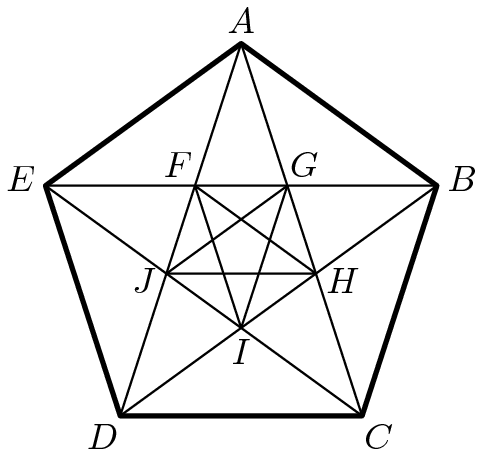
- Assuming G is the midpoint of AC, or misreading which points F, G, H, J are, e.g. treating JH as a side of the inner pentagon rather than a diagonal. (2015 AMC 10B #22)
- 1.2012 AMC 10A #4
Let and . What is the smallest possible degree measure for angle ?
- A)
- B)
- C)
- D)
- E)
- 2.2021 AMC Fall 10A #7
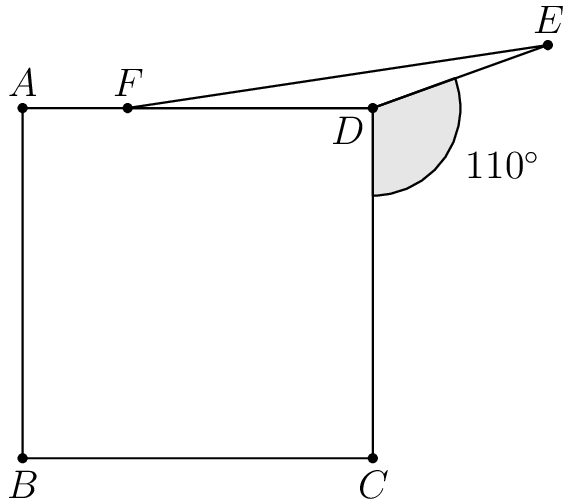
As shown in the figure below, point lies on the opposite half-plane determined by line from point so that . Point lies on so that , and is a square. What is the degree measure of ?
- A)
- B)
- C)
- D)
- E)
- 3.2011 AMC 10B #7
The sum of two angles of a triangle is of a right angle, and one of these two angles is larger than the other. What is the degree measure of the largest angle in the triangle?
- A)
- B)
- C)
- D)
- E)
- 4.2009 AMC 10B #9
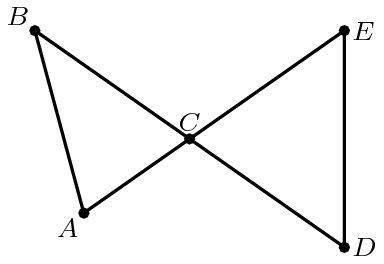
Segment and intersect at , as shown, , and . What is the degree measure of ?
- A)
- B)
- C)
- D)
- E)
- 5.2007 AMC 10B #7
All sides of the convex pentagon are of equal length, and What is the degree measure of
- A)
- B)
- C)
- D)
- E)
- 6.2007 AMC 10A #8
Triangles and are isosceles with and . Point is inside triangle , angle measures degrees, and angle measures degrees. What is the degree measure of angle ?
- A)
- B)
- C)
- D)
- E)
- 7.2007 AMC 10B #15
The angles of quadrilateral satisfy What is the degree measure of rounded to the nearest whole number?
- A)
- B)
- C)
- D)
- E)
- 8.2025 AMC 10A #6
In an equilateral triangle each interior angle is trisected by a pair of rays. The intersection of the interiors of the middle -angle at each vertex is the interior of a convex hexagon. What is the degree measure of the smallest angle of this hexagon?
- A)
- B)
- C)
- D)
- E)
- 9.2019 AMC 10A #14
For a set of four distinct lines in a plane, there are exactly distinct points that lie on two or more of the lines. What is the sum of all possible values of ?
- A)
- B)
- C)
- D)
- E)
- 10.2010 AMC 10A #14
Triangle has . Let and be on and , respectively, such that . Let be the intersection of segments and , and suppose that is equilateral. What is ?
- A)
- B)
- C)
- D)
- E)
- 11.2006 AMC 10A #19
How many non-similar triangles have angles whose degree measures are distinct positive integers in arithmetic progression?
- A)
- B)
- C)
- D)
- E)
- 12.2001 AMC 10 #20
A regular octagon is formed by cutting an isosceles right triangle from each of the corners of a square with sides of length . What is the length of each side of the octagon?
- A)
- B)
- C)
- D)
- E)
- 13.2022 AMC 10B #20
Let be a rhombus with . Let be the midpoint of , and let be the point on such that is perpendicular to . What is the degree measure of ?
- A)
- B)
- C)
- D)
- E)
- 14.2021 AMC 10A #21
Let be an equiangular hexagon. The lines and determine a triangle with area , and the lines and determine a triangle with area . The perimeter of hexagon can be expressed as , where and are positive integers and is not divisible by the square of any prime. What is ?
- A)
- B)
- C)
- D)
- E)
- 15.2015 AMC 10B #22
In the figure shown below, is a regular pentagon and . What is ?
- A)
- B)
- C)
- D)
- E)
- 16.2009 AMC 10B #24
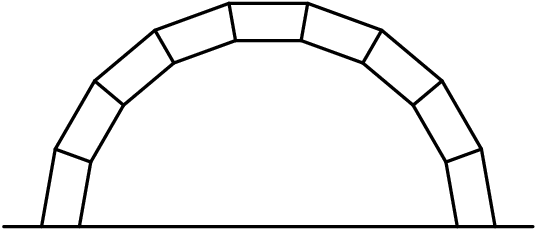
The keystone arch is an ancient architectural feature. It is composed of congruent isosceles trapezoids fitted together along the non-parallel sides, as shown. The bottom sides of the two end trapezoids are horizontal. In an arch made with trapezoids, let be the angle measure in degrees of the larger interior angle of the trapezoid. What is ?
- A)
- B)
- C)
- D)
- E)
- 17.2008 AMC 10B #24
Quadrilateral has , angle and angle . What is the measure of angle ?
- A)
- B)
- C)
- D)
- E)
- 18.2023 AMC 10B #25
A regular pentagon with area is printed on paper and cut out. All five vertices are folded to the center of the pentagon, creating a smaller pentagon. What is the area of the new pentagon?
- A)
- B)
- C)
- D)
- E)
Answers
| # | Answer | The idea it turns on |
|---|---|---|
| 1 | C | Rays BC and BD can be on the same side of BA or on opposite sides. The same side gives 24 - 20 = 4, the smaller choice. |
| 2 | D | Around D, 360 - 90 - 110 leaves 160 degrees inside triangle DEF. Its two equal sides make the other angles 10 each, so angle AFE is 170. |
| 3 | B | The two angles add to 108 degrees, so they are 39 and 69. The third angle is 180 minus 108, which is 72, and it is the biggest. |
| 4 | A | The equal sides meet at B, so triangle ABC has angles B, and twice five-halves of B, giving B = 30. Vertical angles carry C's angle across. |
| 5 | E | Draw the line from C to E. It cuts the pentagon into a square and an equilateral triangle, so the angle at E is 90 plus 60. |
| 6 | D | Both isosceles triangles have AC as the base. Find the base angle at A in each one (70 and 20 degrees); angle BAD is the gap between them. |
| 7 | D | Write each angle as a piece of A: B is half of A, C a third, D a quarter. The four angles add to 360. |
| 8 | C | Each hexagon corner is where rays from two triangle corners meet. The small triangle they form with a side has base angles 20 and 20, or 40 and 40. |
| 9 | D | Four lines give at most 6 crossing points. Parallel lines and three lines through one point reduce that. Every count from 0 to 6 can happen except 2. |
| 10 | C | Chasing angles around the equilateral triangle shows angle A = 60 degrees. A 60-degree angle between sides 1 and 2 makes a 30-60-90 triangle, so angle C = 90. |
| 11 | C | Three evenly spaced angles adding to 180 have middle angle 60. Write them as 60 − d, 60, 60 + d, with d from 1 to 59. |
| 12 | B | Each side of the square is made of two triangle legs and one octagon side. Each leg is the octagon side divided by the square root of 2. |
| 13 | D | Extend BE until it meets line AD at G. Then D is the midpoint of AG, and A, F, G, C all lie on one circle centred at D. |
| 14 | C | Every angle is 120 degrees, so extending every other side makes an equilateral triangle. Each big triangle's side is three hexagon sides, and the two triangles together use all six. |
| 15 | D | Every triangle in the figure has angles 36, 72, 108 degrees, so lengths grow by the golden ratio: FG = 1/phi, JH = 1, CD = phi. |
| 16 | A | Extend the slanted sides of all the trapezoids down to the center of the arch. The nine trapezoids split the 180 degree straight angle into nine 20 degree slices. |
| 17 | C | Cut angles B and C in half with lines meeting at E. This makes three matching triangles with 60-degree angles at E, so E lands on side AD. |
| 18 | B | Folding a corner to the center creases halfway between them. So the new center-to-side distance is half the old center-to-corner distance: a golden-ratio shrink. |
Problems © Mathematical Association of America (MAA), American Mathematics Competitions. Reproduced for non-commercial educational use. The topic note, tags and key insights are original to this site.