2026 AMC 10A Problem 15
The tree diagram below has nodes labeled with rational numbers. The top node, at level 0, is . Each node sprouts two nodes in the level below it, and . For example, level has nodes and .
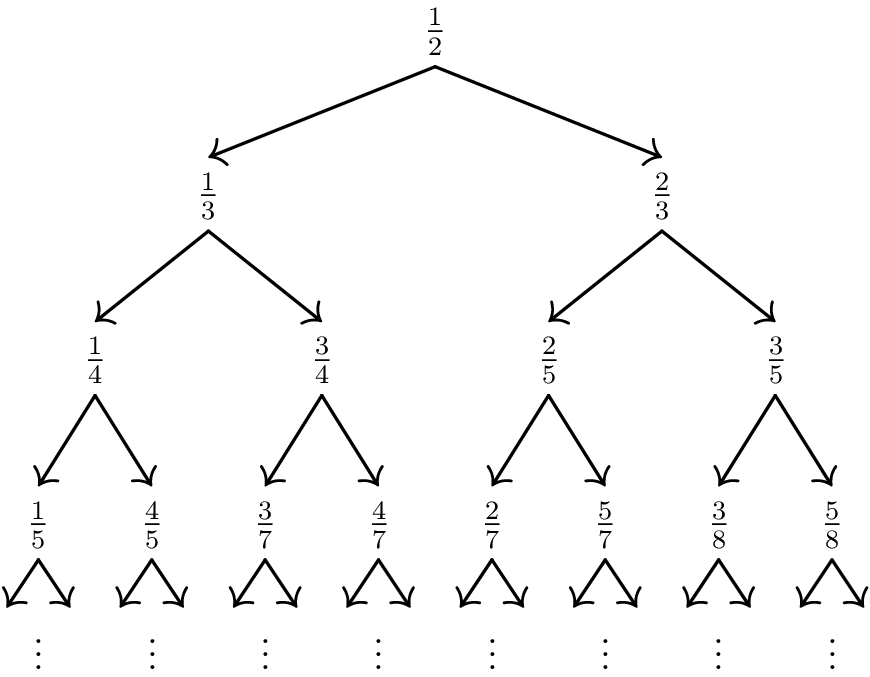
At what level does the node appear in the diagram?
Show solution without answering
Key insight
Work upward. The node 20/27 has a partner 7/27 (they add to 1), and their parent is 7/20. Repeat until you reach 1/2, counting the steps.
Solution
Going down, the tree doubles in size at every level, so searching downward for could take a very long time. Going up is easy, because every node has exactly one parent. So work backwards from to the top.
1. Look at one parent and its children. In the figure, has children and . Notice two things:
- both children have the same bottom number, , which is the parent's top plus bottom;
- the two children's top numbers, and , are exactly the parent's top and bottom.
This is true for every node, because has children and .
- Every node is less than . The top node is less than , and each child has a top number smaller than its bottom number . So every parent is written as smaller number over larger number.
- How to go up one level. Start from a node . Its partner (the other child of the same parent) is . The parent is built from the two top numbers and , with the smaller one on top. Test it on : the two numbers are and , so the parent is , matching the figure.
- Climb from .
| Step | Node | Two numbers ( and ) | Parent |
|---|---|---|---|
| and | |||
| and | |||
| and | |||
| and | |||
| and | |||
| and | |||
| and | |||
| and |
- Count the levels. Each step moves up exactly one level, and after steps we reach at level . So is at level . Check with the figure: is drawn at level , and is steps below it, so its level is .
6. Choice (E) is out. Reading the table from the bottom up gives an actual path down the tree:
For instance, sprouts and . So the node does appear.
The answer is .
Why this works
When a process branches out going forward but has only one way back, work backwards: the path from the start to any node is forced, so climbing up finds it with no guessing. Each step up replaces the pair of numbers by , which is the subtraction form of the Euclidean algorithm, so the numbers keep shrinking and the climb always ends at . In fact, every fraction between and in lowest terms appears in this tree exactly once.
Concise solution
A shorter write-up, the way contest solutions are usually written. It may take a different route from the solution above.
The children of are and , and every node is less than . So the parent of is the fraction formed by and , smaller over larger. Climbing from :
That is steps up to level , so is at level .
The answer is .
Review in the AoPS books
- Intermediate Counting & Probability, Chapter 13: Events With States (§13.4)
- Introduction to Number Theory, Chapter 11: Decimals and Fractions
- Prealgebra, Chapter 15: Problem-Solving Strategies (§15.4)
- Prealgebra, Chapter 6: Decimals (§6.3, §6.4)
Similar problems
Problem © Mathematical Association of America (MAA), American Mathematics Competitions. Reproduced for non-commercial educational use. Solution and commentary are original to this site. Also appeared as 2026 12A #10.