Square has sides of length . Points and lie on and , respectively, with and . A path begins along the segment from to and continues by reflecting against the sides of (with congruent incoming and outgoing angles). If the path hits a vertex of the square, it terminates there; otherwise it continues forever. At which vertex does the path terminate? 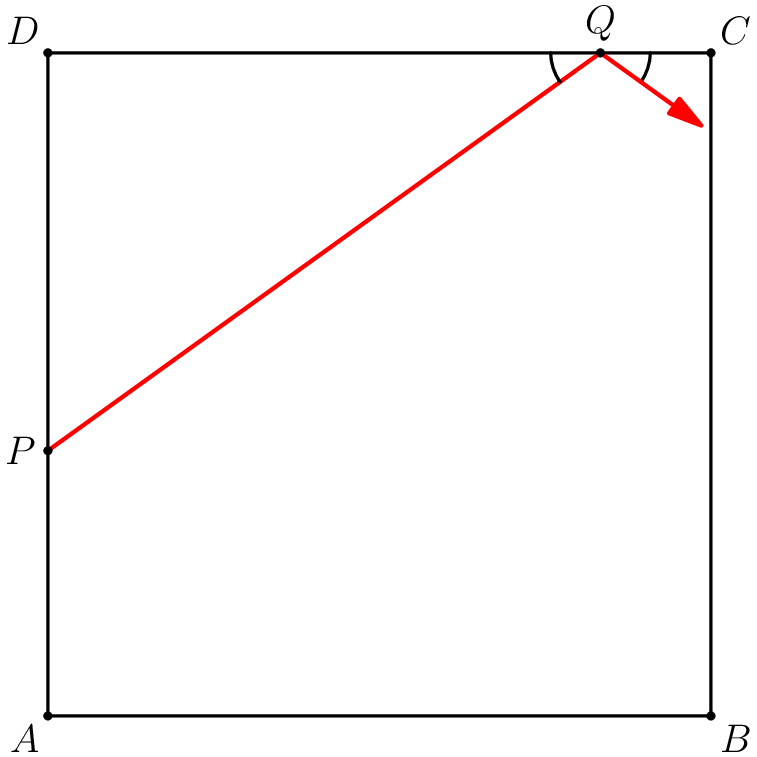
- A)
- B)
- C)
- D)
- E)
Answer
B
Key insight
Reflect the square rather than the ray: the path unfolds to a straight line of slope 18/25, dying at the first image point, whose parities name the corner.
Solution
Set coordinates as in the figure: , , , . Then is the left side and the top side, so
Unfold. Instead of reflecting the ray at a side, reflect the square. Repeatedly reflecting the square in its sides tiles the plane with copies, one in each cell
and under this unfolding the bouncing path becomes a single straight ray from . A bounce is just the moment the ray crosses from one cell to the next, and the images of the four vertices of the square are exactly the lattice points . So:
> the path terminates at a vertex precisely when the straight ray from first meets a point .
The ray. Its direction is
so the ray is with increasing.
When does it hit a lattice point? Put and with positive integers:
Reducing modulo : . Since , multiply by :
The smallest positive solution is , which gives . So the ray first reaches a lattice point at , and the path does terminate.
Which vertex? Folding back, the copies alternate orientation, so the image point corresponds to the corner of the original square whose -coordinate is when is even and when is odd, and whose -coordinate is when is even and when is odd. Here is odd and is even, so the corner is , which is .
The answer is .
Why this works
Reflecting the billiard table rather than the ball is the standard device for any "bounce off the walls" problem: it replaces an unbounded amount of casework by one straight line, and every question about the path becomes a question about that line's intersections with a lattice. Hitting a corner then reads as a single linear congruence, which also settles choice (E) at once — either the congruence has a solution or it does not. The last step, recovering which corner, is pure parity: an even number of reflections in the vertical sides returns the left edge to the left, an odd number swaps it to the right. As a check, and say the ray crosses five columns and four rows of cells, so the real path consists of segments before it dies, which is what a careful hand trace confirms.
The trap
Tracing the bounces one at a time, losing the thread after four or five reflections and concluding from the absence of an early corner that the path runs forever, which is (E).
Common mistakes
- Tracing the bounces one at a time, losing the thread after four or five reflections and concluding from the absence of an early corner that the path runs forever, which is (E).
- Placing and from the wrong ends of their sides: is measured from and from , so and , not and .
- Finding and but then reading the corner off as or ; it is the parity of each index separately that decides each coordinate.
Techniques
Place the figure on coordinates and compute · Use an invariant, parity, or coloring argument