A circle has been divided into sectors of different sizes. Then of the sectors are painted red, painted green, and painted blue so that no two neighboring sectors are painted the same color. One such coloring is shown below.
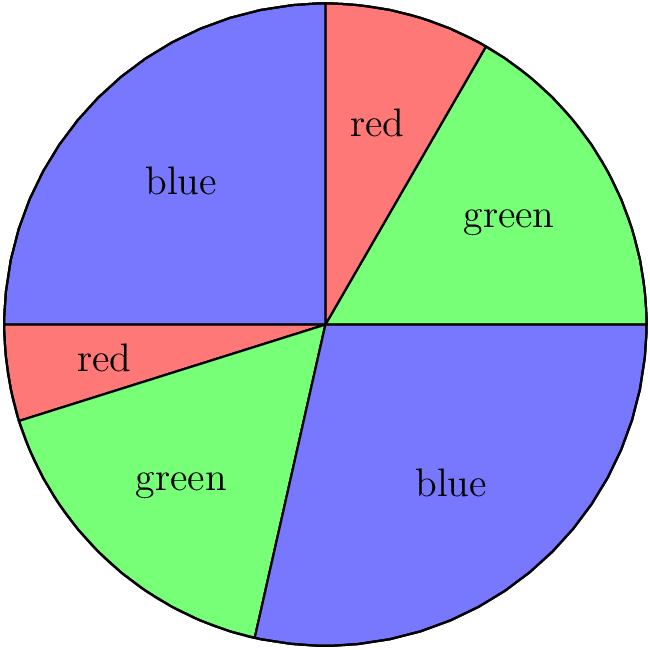
How many different colorings are possible?
- A)
- B)
- C)
- D)
- E)
Answer
D
Key insight
A colouring is a pairing of the six sectors into three non-neighbouring pairs together with a naming of the colours, and there are exactly 4 such pairings.
Solution
The sectors have different sizes, so all six are distinguishable and no colouring is identified with a rotation of itself. Only the cyclic adjacency matters, so label the sectors in order around the circle, with next to .
Each colour is used on exactly two sectors, so a colouring amounts to two independent choices:
- split the six sectors into three pairs, no pair being two neighbours;
- give the three pairs the three colours, in ways.
Count the pairings. Sector must be paired with , or .
Partner . Sectors remain. Sector can take , or : taking leaves the neighbours ; taking leaves the neighbours ; taking leaves , which are not neighbours. One pairing, .
Partner . The mirror image of the previous case. Sector must take (taking would leave the neighbours ). One pairing, .
Partner . Sectors remain, and sector can take or . Taking leaves ; taking leaves . Both work, so two pairings, and .
That is pairings, and each gives colourings:
The answer is .
Why this works
When every colour is used the same number of times, it pays to strip the colours off first and count the underlying partition, then put the colours back with a clean factorial. What remains is a small structural question, "how many ways can six points on a cycle be matched in non-adjacent pairs", which yields to one round of casework on a single sector's partner. The factor at the end is exact because the three pairs are distinguishable as sets, so no two colourings are ever counted twice.
Alternative approach
Complementary counting. There are ways to place the multiset of colours on the six sectors. Let be the event that the two red sectors are neighbours, and similarly for green and blue. There are neighbouring pairs on the circle, so . For two colours at once, choosing a neighbouring pair for red leaves four sectors in a row, which contain neighbouring pairs, so . For all three, the remaining row of four must split into its two end pairs, in way, with ways to name them, so the triple intersection is . Inclusion-exclusion gives bad colourings, and .
The trap
Finding only three of the four valid pairings, typically missing one of the two that go with a pair of opposite sectors, which gives 3 * 3! = 18 at choice (C).
Common mistakes
- Finding only three of the four valid pairings, typically missing one of the two that go with a pair of opposite sectors, which gives 3 * 3! = 18 at choice (C).
- Assuming the two sectors of a colour must be diametrically opposite, which counts only the single pairing and gives .
- Dividing by for rotations; the sectors have different sizes precisely so that rotated colourings are different colourings.
Techniques
Map the objects to something easier to count · Split into exhaustive cases and handle each · Count the complement and subtract from the total